
The Binary Material Synthlet

Binary compounds are here defined (other authors may choose to use other definitions) as substances that exhibiting only one type of strong chemical bond: metallic, ionic or covalent.

  • Binary substances present as metallic, ionic, network covalent or molecular van der Waals materials or as intermediates between these four extremes.
  • Water, H2O, methane, CH4, silicon dioxide, SiO2, sodium chloride, NaCl, and sodium-potassium alloy are typical main group binary materials.
  • Hydrogen peroxide, H2O2 or HOOH, and ethane, C2H6 or CH3CH3, have more than one type of strong bond and so are not considered to be binary materials here.
  • Hydrogen, H2, oxygen, O2, and nitrogen, N2, are here classified as binary materials, with the two elements being the same. Argon, Ar, is considered to be a molecular material, where the molecule consists of a single atom.

Many structural, bonding, material and chemical properties can be predicted using just three parameters: electronegativity difference, absolute electronegativity and valency.(The lower common valency is used, this is the valency shown by the hydride, for example: phosphine PH3.)

There are three rules:

  • Electronegativity difference correlates with the degree of ionic vs covalent bonding: electrostatic attraction vs shared electron pair, % ionic/covalent character.

    A large electronegativity difference equates with ionic bonding, for example cesium (0.79) fluoride (3.98), Deneg = 3.19.

    A zero or small electronegativity difference equates with covalent bonding, for example methane, CH4, 2.55 – 2.20 Deneg = 0.35 or fluorine, F2, 3.98 – 3.98 Deneg = 0.00.

  • Absolute electronegativity, the average electronegativity of the binary, correlates with the degree of metallic vs covalent bonding.

    Metals and metallic aloys have a low average electronegativity: sodium, Na, (0.93) and sodium-potassium alloy (0.93 + 0.82) / 2 = 0.875

    Non-metallic binary materials have a large average electronegativity: CH4, 2.55 – 2.20 average eneg = 0.35 or fluorine, F2, 3.98 – 3.98 average eneg= 0.00.


  • If one of the chosen elements has a valency of 1 (hydrogen, the halogens & the Group I metals) the resulting chemical compound is predicted to be a molecular material and the appropriate side of the Laing tetrahedron is shown: MolecularIonicMetallic.

    Otherwise, the IonicMetallicNetwork side of the Laing Tetrahedron is shown.


Choose a pair of elements from the drop boxes and the software gadget will attempt to predict the structure and bonding associated with the binary compound/material/substance using electronegativity and valency data only.

Data is mapped to the van Arkel-Ketelaar Triangle and Laing Tetrahedron of Bonding & Material Type, as discussed in some detail on the previous two pages of this web book, here & here.

The synthlet only uses the lower or common oxidation state and it makes some interesting "mistakes". For example, carbon dioxide, the well known gas, is predicted to be a network covalent material like silicon dioxide, SiO2 (sand).

A couple of points:

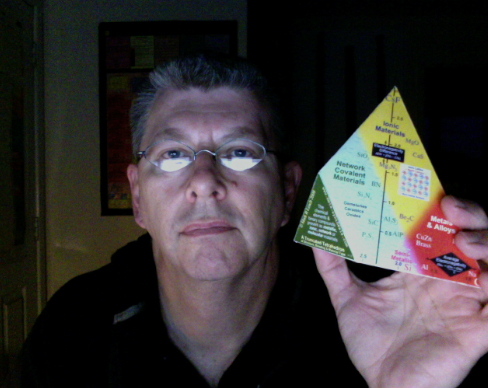
The Laing Tetrahedron of bonding & material type is in a slightly different orientation compared with the representations on the previous page. On this page, metals & alloys occur at the lower left corner and ionic salts at the top. On the previous page this is reversed: ionic salts are lower left and metals at the top.

The gadget maps the van Arkel-Ketelaar Triangle to the two faces of the Laing Tetrahedron of Bonding & Material Type depending upon the valency of the two elements.


The Laing Tetrahedron
of Bonding & Material Type
  • Ionic Materials
  • Ionic salt: sodium chloride
  • Lattice of electrostatically attracted anions & cations
  • Usually soluble in water to some extent
  • Insulators when solids
  • Conduct electricity when molten
  • Conduct electricity when in aqueous solution
  • Intermediate melting points ~300 – 1000°C
    • Metallic Materials
    • Metal like aluminium or alloy like brass
    • Lattice of metal cations in sea of delocalised electrons
    • Conduct electricity & heat as solid and liquid
    • Metallic lustre & ductility
    • Huge range of melting points: mercury –39°C tungsten 3407°C
    • Metals may, or may not, alloy with each other
  • Network Covalent Materials
  • Network of strong covalent bonds
  • Diamond
  • Very high melting point, >1500°C
  • Insoluble, insulators
  • Refractory materials

  •  
  • Molecular van der Waals Materials
  • Molecular material like methane, CH4
  • Small molecules
  • Strong intramolecular – within molecule – covalent bonds
  • Weak intermolecular – between molecule – bonds: van der Waals forces
  • Low melting and boiling points: liquids & gases at 25°C
  • Insulators
  • Soluble in polar or non-polar solvents

  • Laing Tetrahedron
    Classification of Matter

    © Mark R. Leach 1999-2008


    Queries, Suggestions, Bugs, Errors, Typos...

    If you have any:

    Queries
    Comments
    Suggestions
    Suggestions for links
    Bug, typo or grammatical error reports about this page,

    please contact Mark R. Leach, the author, using mrl@meta-synthesis.com

    This free, open access web book is an ongoing project and your input is appreciated.