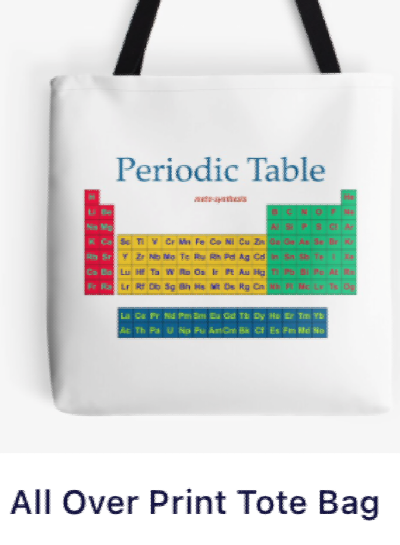
Periodic Table |
 |
 |
 |
 |
 |
 |
 |
| What is the Periodic Table Showing? | Periodicity |
The INTERNET Database of Periodic Tables
There are thousands of periodic tables in web space, but this is the only comprehensive database of periodic tables & periodic system formulations. If you know of an interesting periodic table that is missing, please contact the database curator: Mark R. Leach Ph.D. The database holds information on periodic tables, the discovery of the elements, the elucidation of atomic weights and the discovery of atomic structure (and much, much more).
| Year: 2026 | PT id = 1413, Type = formulation |
Marks: Step-Pyramid Mendeleyev
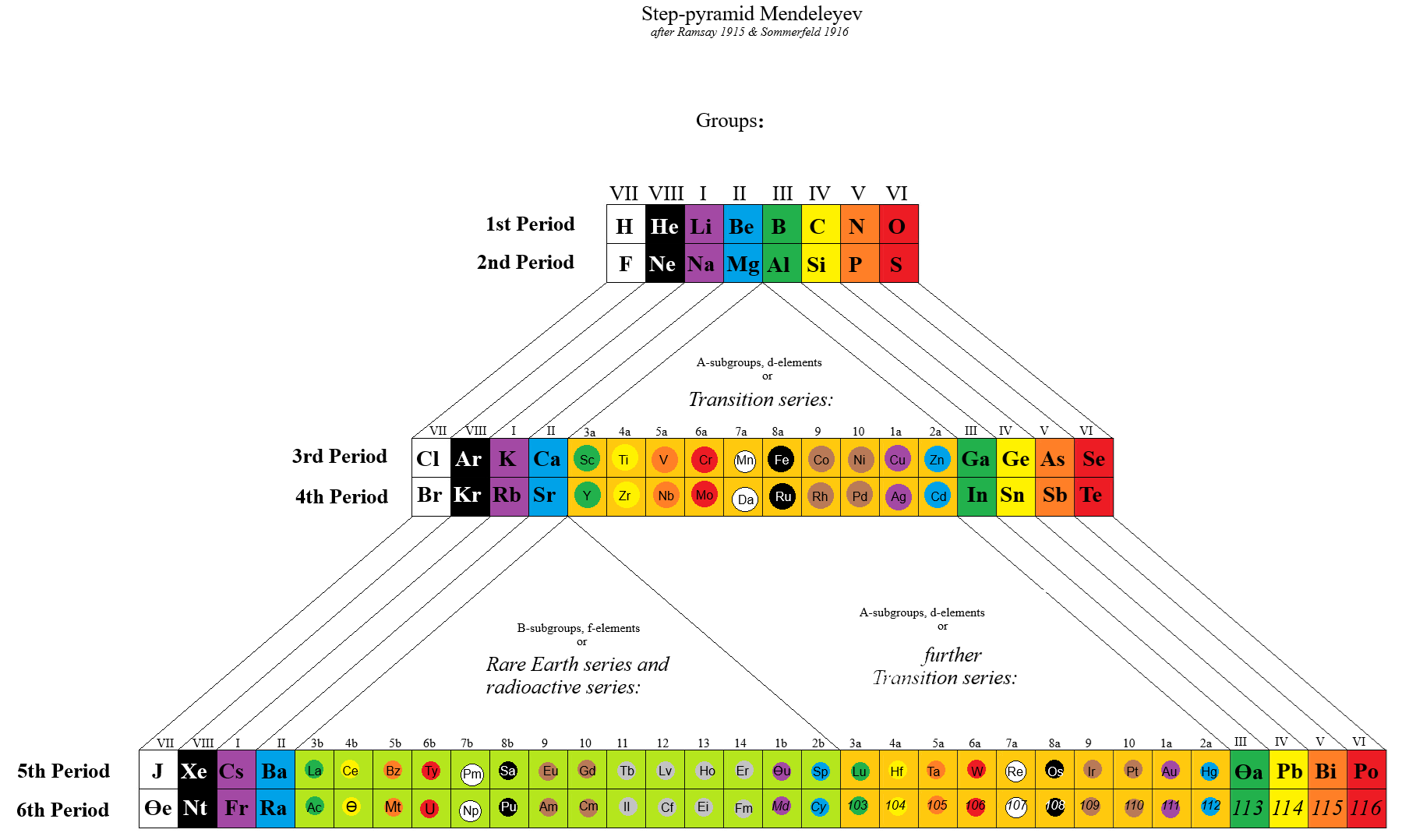
A periodic table highlighting Mendeleyev´s periodic law by John Marks.
It further follows Bohuslav Brauner (1855-1935), a keen disciple of Mendeleyev, in searching for internal periodicity, well demonstrated in the A-subgroups (d-elements), but his attempts to show this in the B-subgroups (f-elements) met with frustration. Ironically, had many of the actinides been available for his examination, he would have had more success than with the lanthanides. The periods comprise two initial sets of octets, followed by two of 18 and then two of 32, the last being incomplete because of spontaneous fission.
Within the periods, Brauner´s internal periodicity is clear to see. After the octets, new elements are added in the middle, between groups VIII (0) and I, yet follow the rhythm of the octets. K and Ca (groups I and II) are followed by Sc, group IIIA. This continues with the additional elements added at groups 9 and 10 (IXA and XA) and then recapitulated with Cu and Zn as groups IA and IIA before continuing the rhythm with Ga (group III). The same phenomenon occurs with the rare-earth and radioactive series. Brauner´s hypothesis would be corroborated by discovery of hexavalent Ty or monovalent θu.
Notes on Nomenclature:
A standard text saw fit to write: "Lanthanum has only one important oxidation state in aqueous solution, the +3 state. With few exceptions, this tells the whole boring story about the other lanthanides." [Pimentel, G., Spratley, R.: "Understanding chemistry", Holden-Day, San Francisco (1971), p. 862]. Others wrote similarly, explaining it as a consequence of the current convention of removing the f-block elements from the body of the periodic table.
However, undoubtedly ugly names like dysprosium and neodymium and confusing ones like terbium, ytterbium and erbium, aggravate this. The problem is not confined to the lanthanoids, with unimaginative examples like technetium, protoactinium and astatine.
The set of chemical canasta cards renames many of the worst offenders. Since the village of Ytterby has four elements named after it (five, if one includes holmium), I have reduced this to yttrium (cf. strontium, after Strontian) plus erbium and terbium to reflect the historical confusion: between 1843 and 1878 erbium and terbium even swapped names! I have replaced neodymium and praseodymium with names both more euphonious and relevant, often pairing a lanthanoid with its corresponding actinoid.
I have left the initiator of the series, lanthanum (Gk. for ‘hidden’) as appropriate and familiar.
Among the actinoids, since the same laboratory in America is represented in three elements, this has been replaced by Am (americum), Il (illinium, after the Argonne national laboratory, Illinois) and Cf (californium). Other alternatives are offered with names that are equivalent contemporary (at the time and place of discovery) metaphors, both more euphonious and more memorable:
Danubium, Da, Z=43 cf Rhenium, Z=75, the other northern boundary of the Roman empire, but the Danube is divided by many cataracts and rapids, reflecting danubium's radioactivity.
Berzelium, Bz, Z=59 and Meitnerum, Mt, Z=91 After Berzelius, the discoverer of a lanthanoid and the difficult properties (especially separation) of the lanthanoids and after Meitner, the discoverer of an actinoid and of many peculiar properties (especially nuclear fission) of the actinoids.
Tyrium, Ty, Z=60 After Tyr (cf uranium, Z=92 after the Greek god, Uranus) and for its tyrian (purple) coloured salts and the Norse god, Tyr.
Spectrium, Sp, Z=70 and Cyclonium, Cy, Z=102 Spectrium after the spectroscope which identified many lanthanoid elements and cyclonium after the cyclotron which identified many actinoid elements. (Cy is not included in the chemical canasta set, which covers only the first hundred elements)
Therine, θe, Z=85 After Thera, the unstable volcanic isle of classical mythology, a metaphor for instability. Niton, Nt, Z=86 From the Latin 'nitens' = shining, the name given it by Ramsay on account of its spontaneous luminescence. 'Radon' is short for 'radium emanation', Nt-222, and is thus merely an isotope of niton. Similarly thoron is Nt-220 and actinon is Nt-219. Lavoisium, Lv, Z=66 is named for Lavoisier, the founder of modern chemistry, replacing the ugly “dysprosium”.
I have also named Mendeleyev´s groups: VII (or -1) Cavendish's; VIII (or 0) Ramsay's; I Davy's; II Döbereiner's; III Mendeleyev's; IV Dalton's; V Boyle's; VI Lavoisier's.
Many recently named elements have had "-ium" added unthinkingly without realizing that "-um" is equally valid and more appropriate for the prosody of many names. Aluminum seems to be the etymologically correct derivative of alumina. Reasons of prosody have chosen "-um" in meitnerum, americum and platinum.
The symbol J for iodine reflects the consonantal nature of the initial. Since science is familiar with the Greek alphabet, θu, θa, θe and θ are suggested for Z = 69, 81, 85 and 90. This would also ease the pressure on finding suitable Berzelian symbols for new superheavy elements.
|
|
|
| What is the Periodic Table Showing? | Periodicity |
© Mark R. Leach Ph.D. 1999 –
Queries, Suggestions, Bugs, Errors, Typos...
If you have any:
Queries
Comments
Suggestions
Suggestions for links
Bug, typo or grammatical error reports about this page,please contact Mark R. Leach, the author, using mark@meta-synthesis.com
This free, open access web book is an ongoing project and your input is appreciated.