Periodic Table |
 |
 |
 |
 |
 |
 |
 |
| What is the Periodic Table Showing? | Periodicity |
The INTERNET Database of Periodic Tables
There are thousands of periodic tables in web space, but this is the only comprehensive database of periodic tables & periodic system formulations. If you know of an interesting periodic table that is missing, please contact the database curator: Mark R. Leach Ph.D. The database holds information on periodic tables, the discovery of the elements, the elucidation of atomic weights and the discovery of atomic structure (and much, much more).
| Year: 1933 | PT id = 60, Type = formulation |
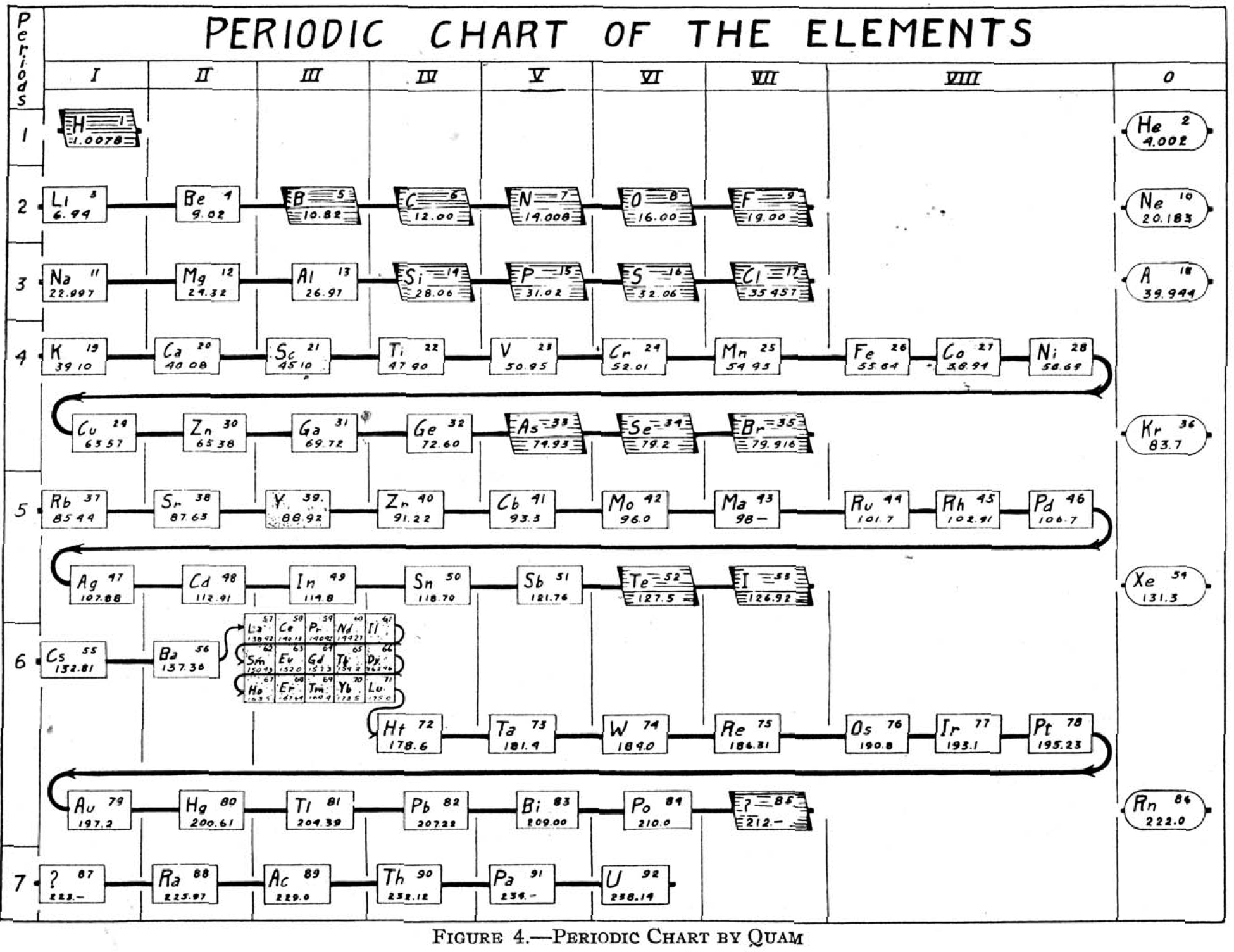
Quam's Periodic Chart
From Quam & Quam's 1934 review paper.pdf who write:
The chart is a modification of the Brauner table.
The heavy black lines maintain the continuity of each period. An effort has been made to indicate families by alignment in each group. Thus the positions of Be and Mg indicate a closer relation to Zn and Cd than to the alkaline-earth elements. The non-metals, other than the zero group elements, are indicated by shading, and the rare-earth elements by the dotted rectangles in group III.
The so-called inert elements are placed in group 0 at the right to show the completion of the stable atomic arrangement, and also to show the transition from the extreme electronegative elements of one period to the extreme electropositive of the next.
|
|
|
| What is the Periodic Table Showing? | Periodicity |
© Mark R. Leach Ph.D. 1999 –
Queries, Suggestions, Bugs, Errors, Typos...
If you have any:
Queries
Comments
Suggestions
Suggestions for links
Bug, typo or grammatical error reports about this page,please contact Mark R. Leach, the author, using mark@meta-synthesis.com
This free, open access web book is an ongoing project and your input is appreciated.