Periodic Table |
 |
 |
 |
 |
 |
 |
 |
| What is the Periodic Table Showing? | Periodicity |
The INTERNET Database of Periodic Tables
There are thousands of periodic tables in web space, but this is the only comprehensive database of periodic tables & periodic system formulations. If you know of an interesting periodic table that is missing, please contact the database curator: Mark R. Leach Ph.D. The database holds information on periodic tables, the discovery of the elements, the elucidation of atomic weights and the discovery of atomic structure (and much, much more).
Periodic Tables referencing the text string "Pyramid", listed by date:
| Year: 1895 | PT id = 368, Type = formulation |
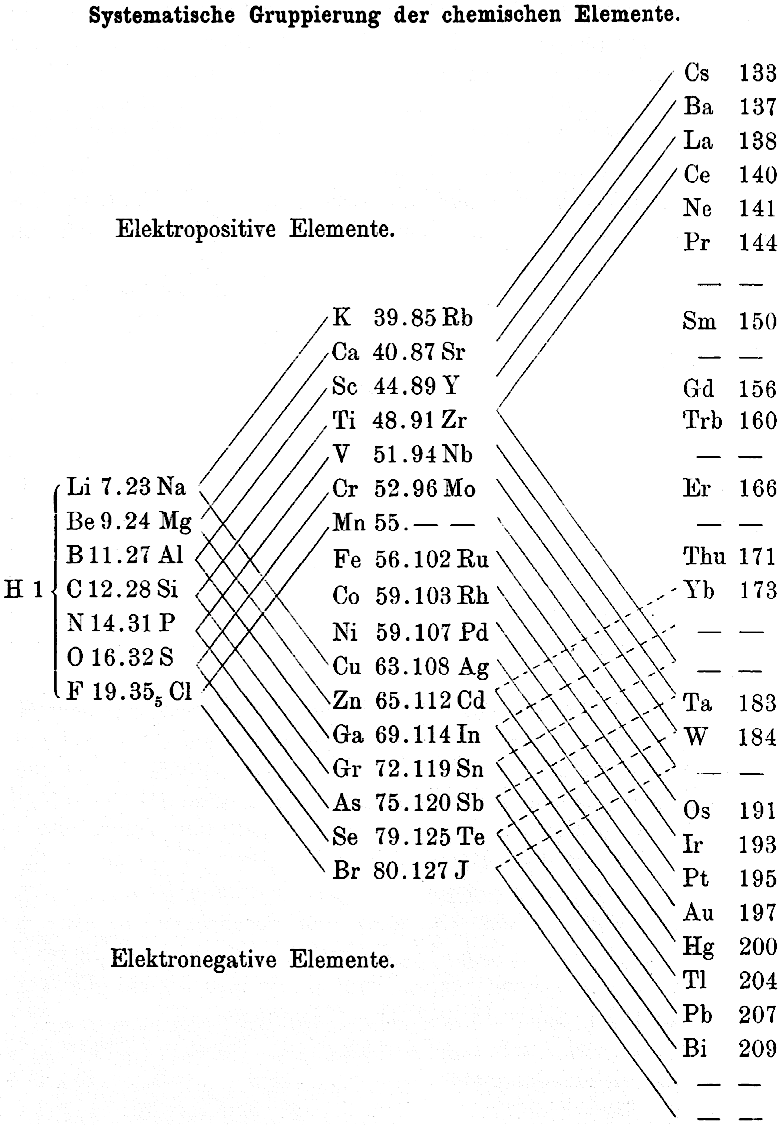
Thomsen's Systematic Arrangement of the Chemical Elements
In 1895 the Danish thermochemist Hans Peter Jørgen Julius Thomsen proposed (Thomsen, J., 1895. Z. Anorg. Chem. 9, 190 & Chemical News, 72, 89–91, p. 90) a pyramidal/ladder representation.
Notice how this formulation identifies the electropositive & electronegative elements with respect to the periodic table, thirty years before Linus Pauling.
| Year: 1945 | PT id = 1118, Type = formulation 3D |
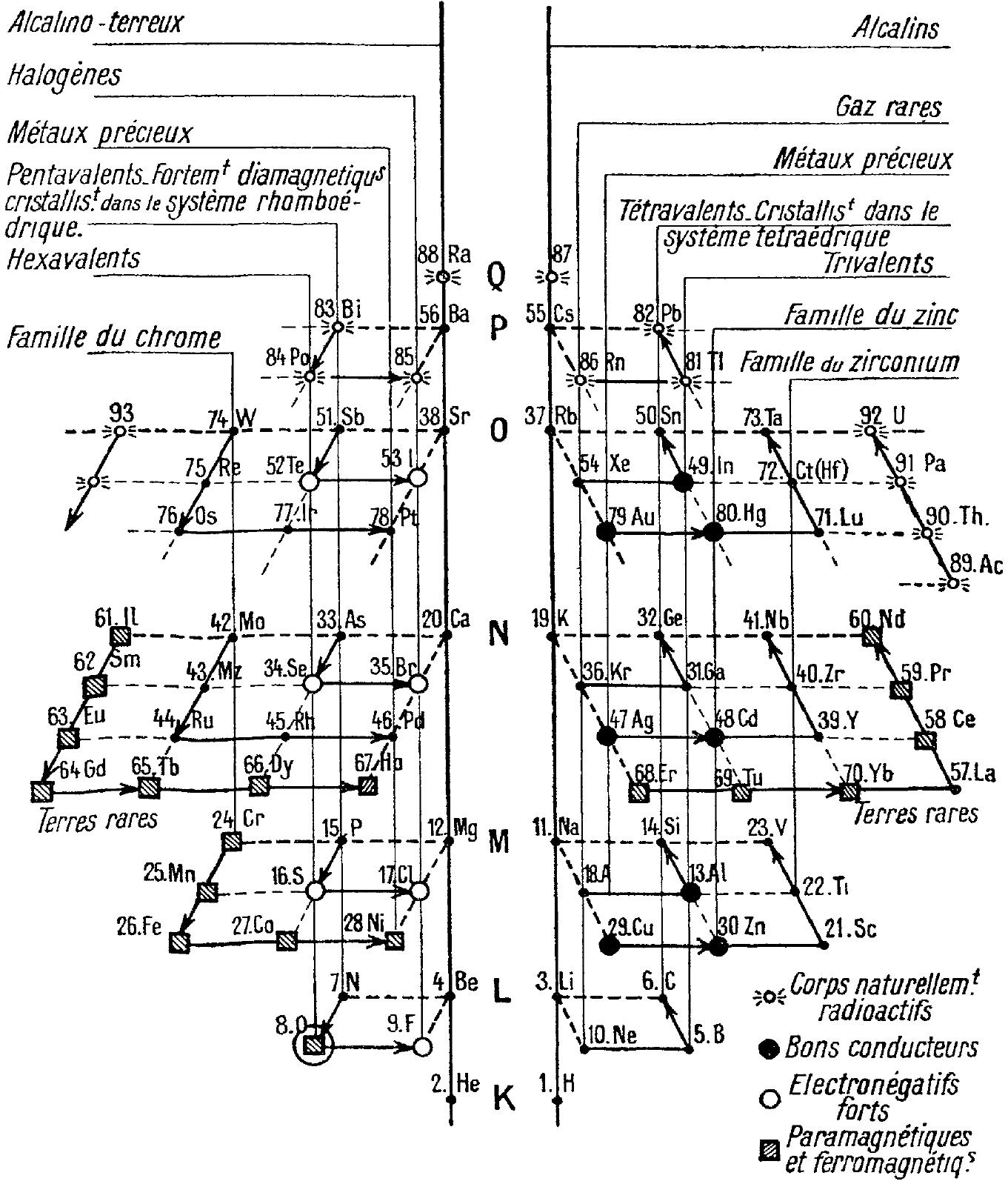
Talpain's Gnomonic Classification of the Elements
Talpain PL 1945, Gnomonic classification of elements, J.Phys. Radium 6, 176-181 (in French), https://doi.org/10.1051/jphysrad:0194500606017600
Talpain writes:
"To overcome the drawbacks presented by the various tables in rows and columns into which the classification of chemical elements is usually inserted, the author proposes a diagram in space, having the form of a double pyramid constructed according to a simple arithmetic law, inspired by Greek surveyors. Under these conditions, all the bodies belonging to the same chemical family are placed on the same column, and all those which have similar physical properties (magnetic, electrical, radioactive, crystallographic, rare earths, etc.) are grouped together. This same diagram also makes it possible to represent the electronic structure of the atoms, the quantified states of the electrons, the energy levels and the spectral lines of hydrogen. Perhaps spectroscopists will be able to use it to also represent the lines of other bodies."
Thanks to René for the tip!
| Year: 1946 | PT id = 776, Type = formulation |
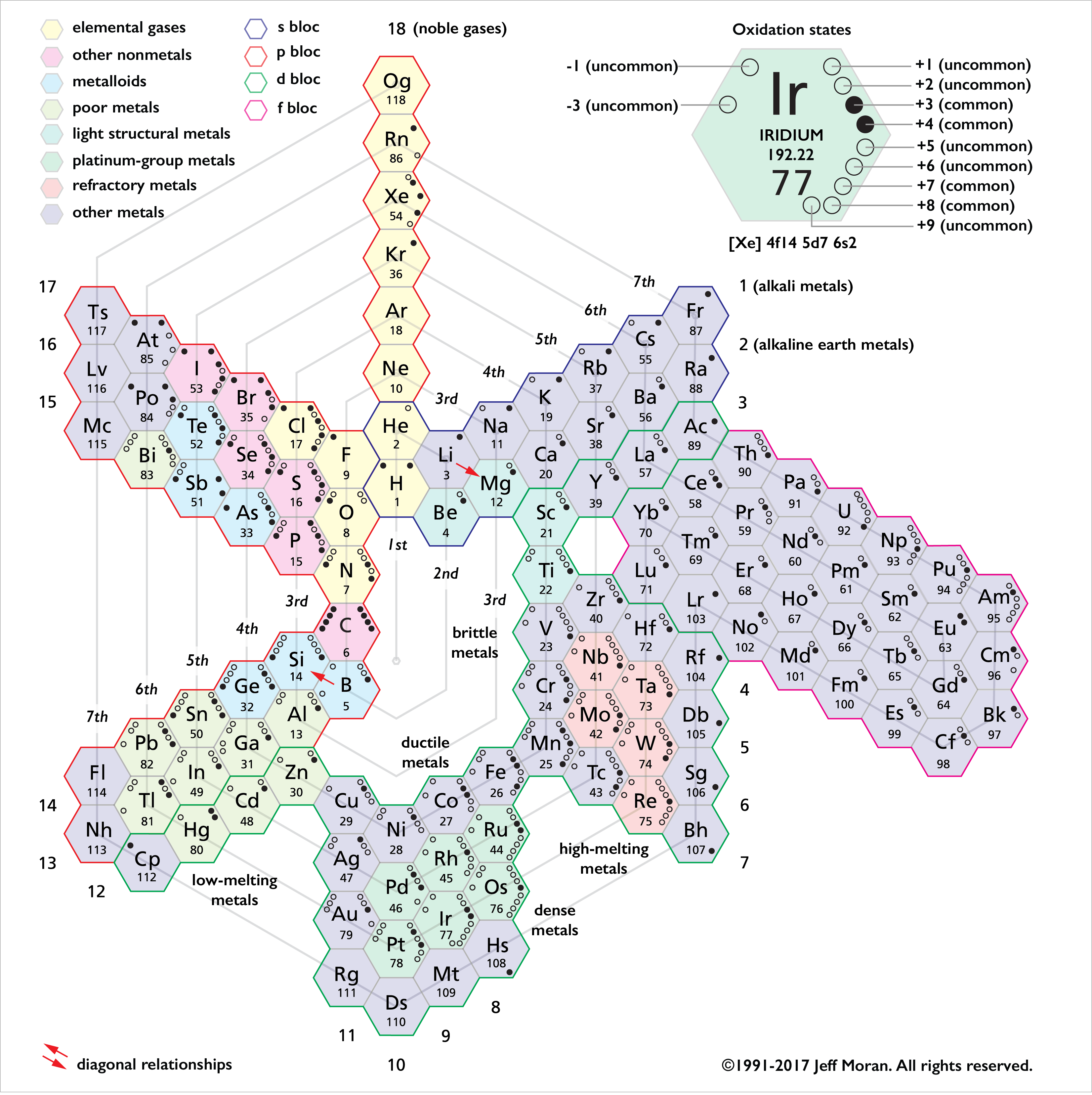
Achimof's System
Van Spronsen, on p. 157, says:
"Achimov's system took the form of a cross-section of a pyramid. He based his system on the principle that the lengths of the periods and the analogies in properties between the elements of these periods must be clearly demonstrated."
Achimov EI 1946 Zhur. Obshchei Khim., vol. 16, p. 961
Thanks to René for the tip!
| Year: 1983 | PT id = 50, Type = formulation 3D |
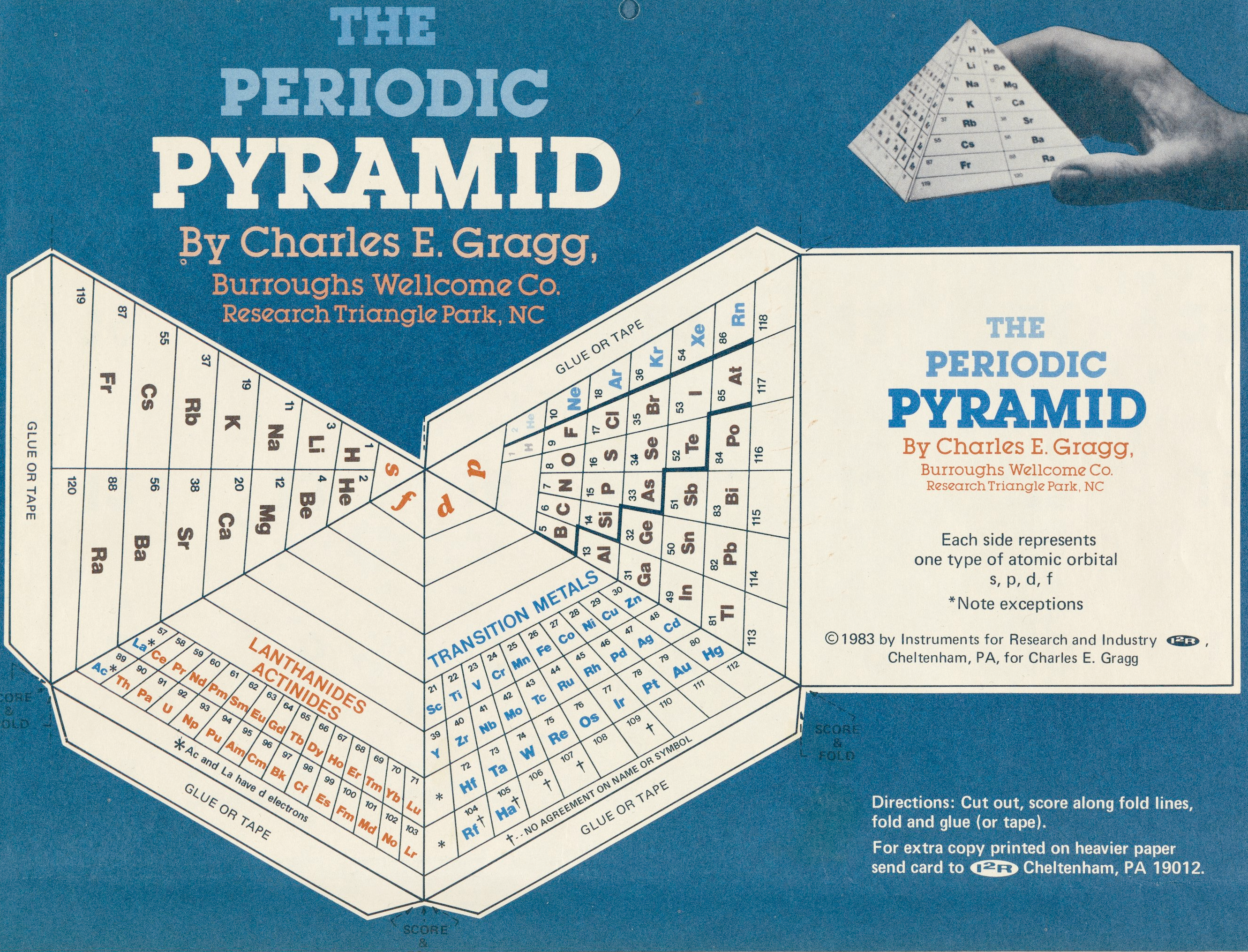
Periodic Pyramid
Periodic table designed in the style of a pyramid by Charles E. Gragg. This table was published by Instruments for Research and Industry and includes instructions for assembly into a 3-D model.
More information, including high resolution files, at the Science History Institute.
Thanks to René Vernon for the tip!
| Year: 1987 | PT id = 1039, Type = formulation |
Step-Pyramid Form of the Periodic Chart
By Bill (William) Jensen, a Step-Pyramid form of the periodic chart.
This formulation is an updated version of the charts by Thomsen (1895) and Bohr (1922) with more elements, including placeholders up to 118, electronic configuration lables, etc. Read more on the Science History Institute website.
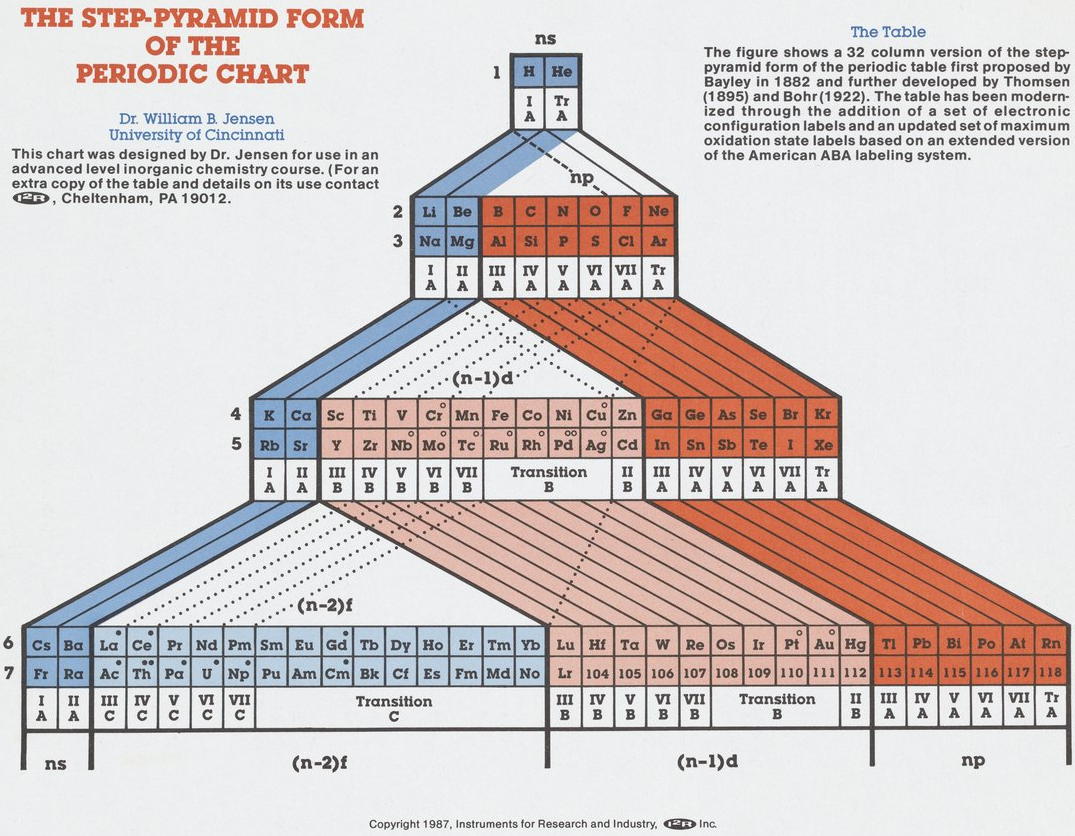
Thanks to René for the tip!
| Year: 2000 | PT id = 449, Type = formulation 3D |
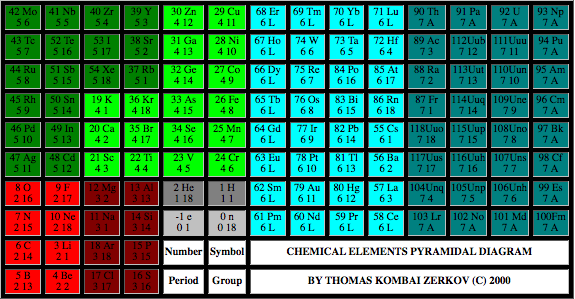
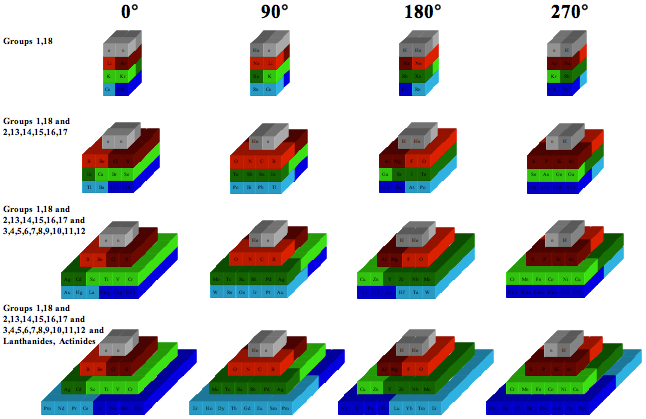
Chemical Elements Pyramidal Diagram
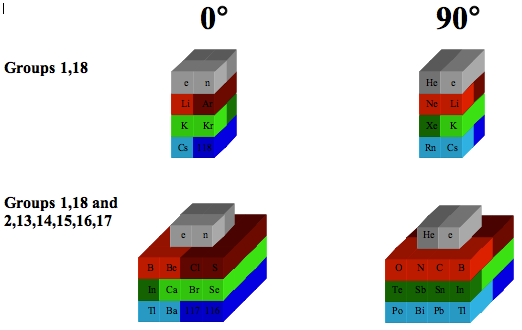
A Chemical Elements Pyramidal Diagram by Thomas Zerkov.
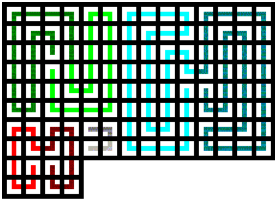
"The present work introduces a new arrangement of the chemical elements. Unlike the most popular existing arrangements, which are two-dimensional, this new arrangement is three-dimensional. It organizes the elements in a pyramidal structure of four levels, giving a clear spatial expression of different relations between the chemical elements. Since the three-dimensional structures are harder to perceive than the two-dimensional ones, the present work also suggests a two-dimensional table representation of the three-dimensional pyramidal diagram, where the four levels are all placed in a single plane, instead of one above the other."
| Year: 2002 | PT id = 714, Type = formulation |
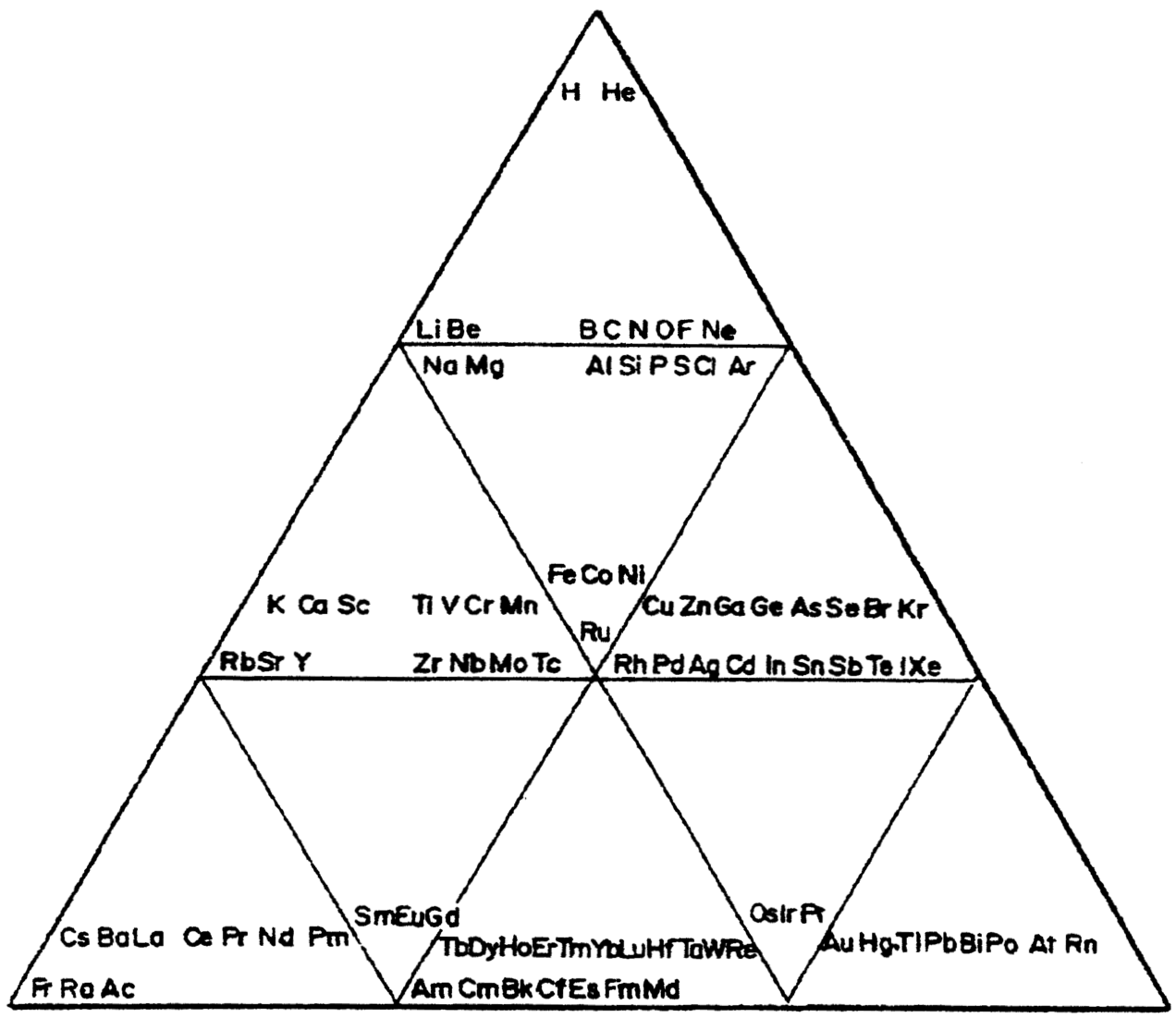
Tetrahedral Twist: Chemistry Puzzle and Teaching Device
A twisting three dimensional puzzle apparatus for the study of chemistry and its history and based upon the Zmaczynski equilateral triangular model of the periodic table of the chemical elements. Each face of the pyramid has a series of equilateral shaped portions bearing portions of the periodic table of elements. The different segments can be rotated around in order to scramble the puzzle. Such portions can be constructed using same or similar technology that was used to design the Meffert PYRAMINX PUZZLE that is similar to the RUBIK'S CUBE design.
From a US Patent.
| Year: 2003 | PT id = 1082, Type = formulation 3D |
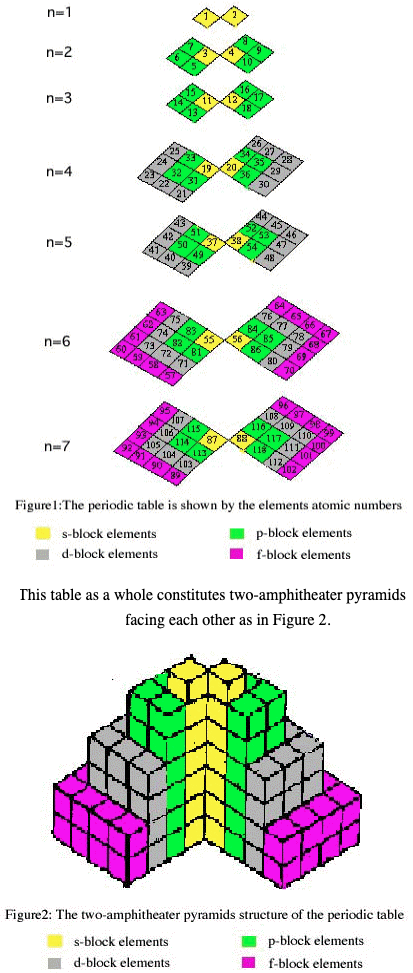
Two-Amphitheater Pyramid Periodic Table
From Chemical Education Journal (CEJ), Vol. 7, No. 2
A Novel Way of Visualization of the Periodic Table of the Elements by Alaa El-Deen Ali Mohamed, Alexandria University, Egypt.
The author writes:
"New form of the periodic table of the elements is given in this paper. This form can be seen as two amphitheater pyramids facing each other. The cubes that meet are s-elements (interior) then the p-elements then d-elements and the f-elements at last (exterior). The table can be represented by X-, Y- and Z-axes, where the Z-axis gives the number of the period that the element occupies. The table can be modeled by colored cubes helping in introducing the periodic table to the pupils early in the primary education."
Thanks to René for the tip!
| Year: 2005 | PT id = 347, Type = formulation spiral 3D |
Pyramid Format Periodic Table
From Wikipedia, this Pyramid Format Periodic Table is Based on a graphic from Scholten J."Secret Lanthanides", 2005, ISBN 90-74817-16-5;

| Year: 2008 | PT id = 156, Type = formulation 3D |
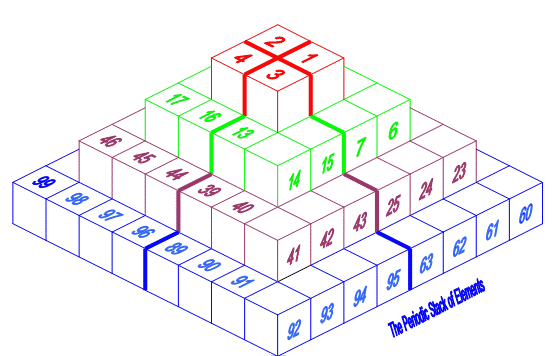
Pyramid (Stack) Periodic Table
The Janet Periodic Table of Elements (1928) may be re-arranged as a series of square matrices.
The matrices are of different sizes and each matrix organizes the atomic orbitals into square concentric rings. Each cell may be assigned an atomic number which also identifies a “most significant electron”. The matrices may be stacked vertically to form a periodic Pyramid Stack of Elements as shown below.
The sub-atomic particles may also be arranged as square matrices. These matrices may be stacked. Read more here.
Please send your comments to: rick_kingstone777@hotmail.com
| Year: 2012 | PT id = 551, Type = formulation |
Piazzalunga's Pyramidal Periodic Table Formulations
Three Pyramidal Periodic Table Formulations, and a Spiral, from Marco Piazzalunga:
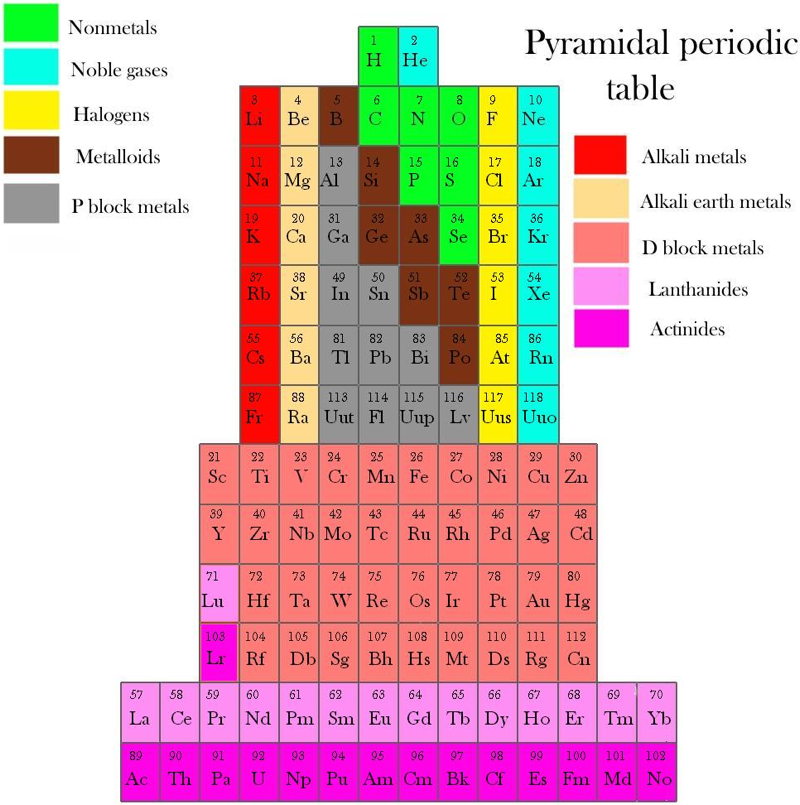
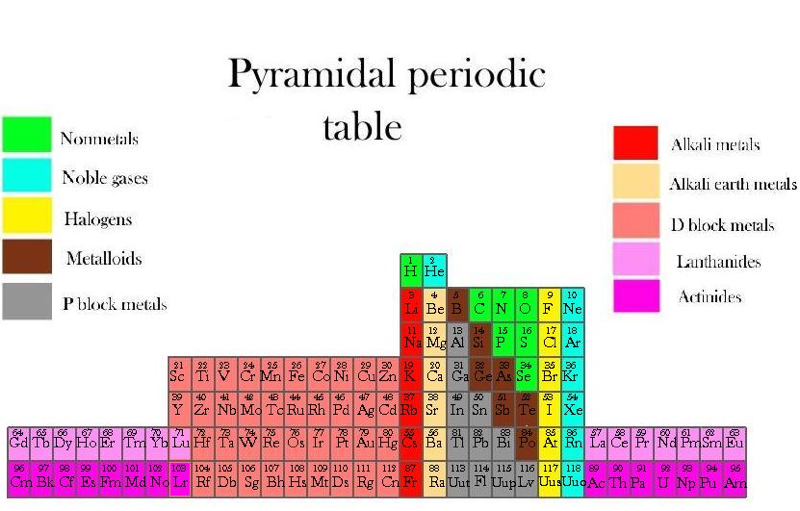
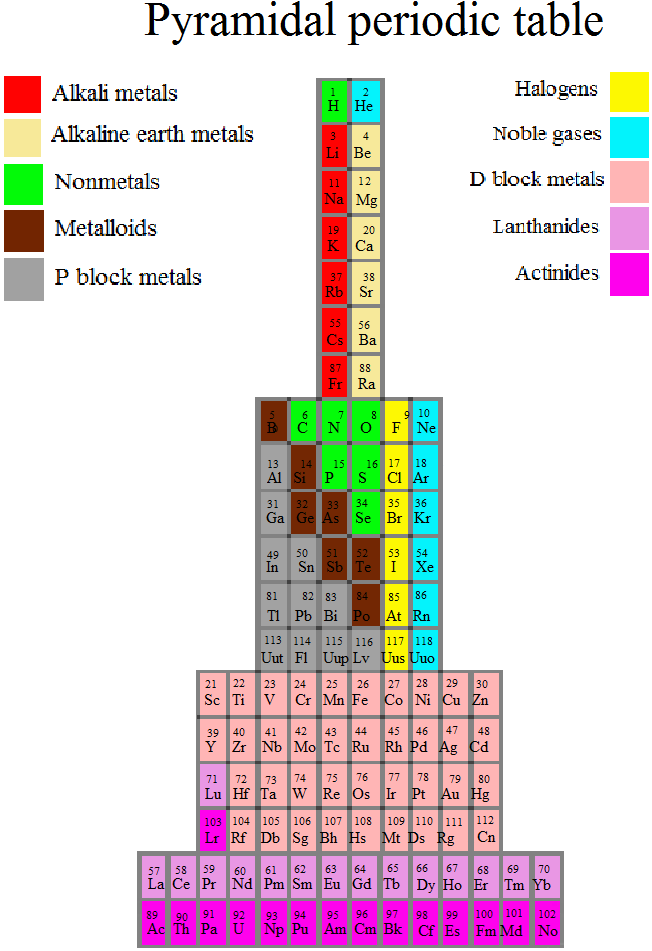
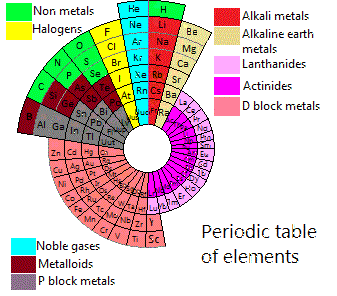
| Year: 2013 | PT id = 567, Type = formulation |
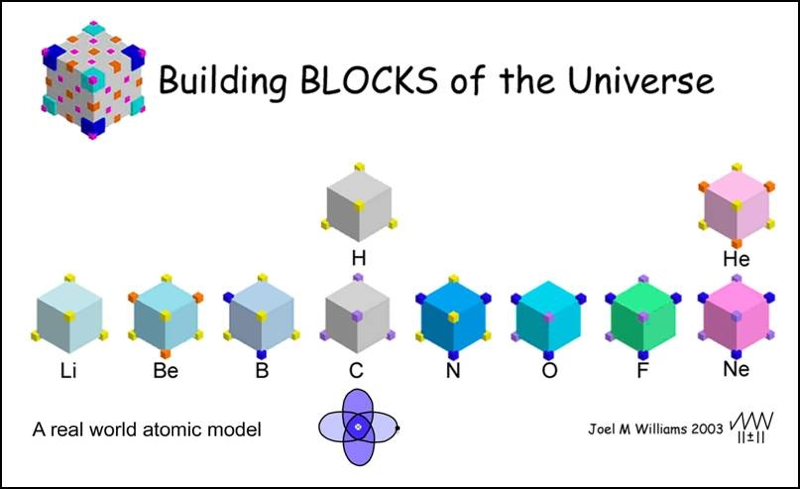
MCAS Electron Orbital Filling
From Joel M Williams:
"While the periodic table arrangement is usefully interpreted in columns of similar behavior, it is erroneous to imply that the underlying orbitals are all the same for all the elements in the columns of a block. Sub-orbital information has been excluded! From the standpoint of chemistry, the rule of eight would have provided better imagery on which to build an orbital system than was Bohr's orb turned-sphere. A sphere is useless from a chemical standpoint. Hybridization should not have to occur to explain the simplest of molecules. Simplicity would have the electrons occupying orbital spaces that are similar in shape. Only three orbital types are actually needed to describe the electron packing of the elements. Octahedral, square-planar, and pyramidal coordination complexes of the transition elements follow logically without the need to hybridize. This brief paper describes a rational packing of electrons around a nucleus that ends up mimicking the familiar periodic table when compressed to similar behavior."
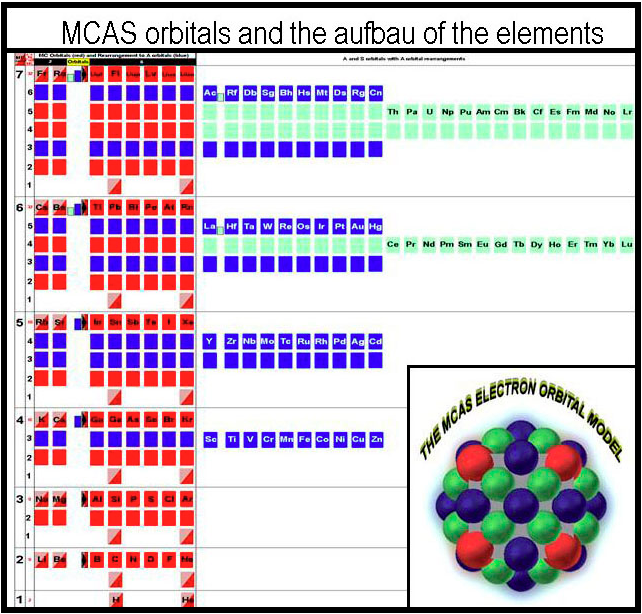
Modeling the MCAS Way describes this concept of "building blocks" and can be found here.
| Year: 2013 | PT id = 597, Type = formulation |
Periodic Pyramid
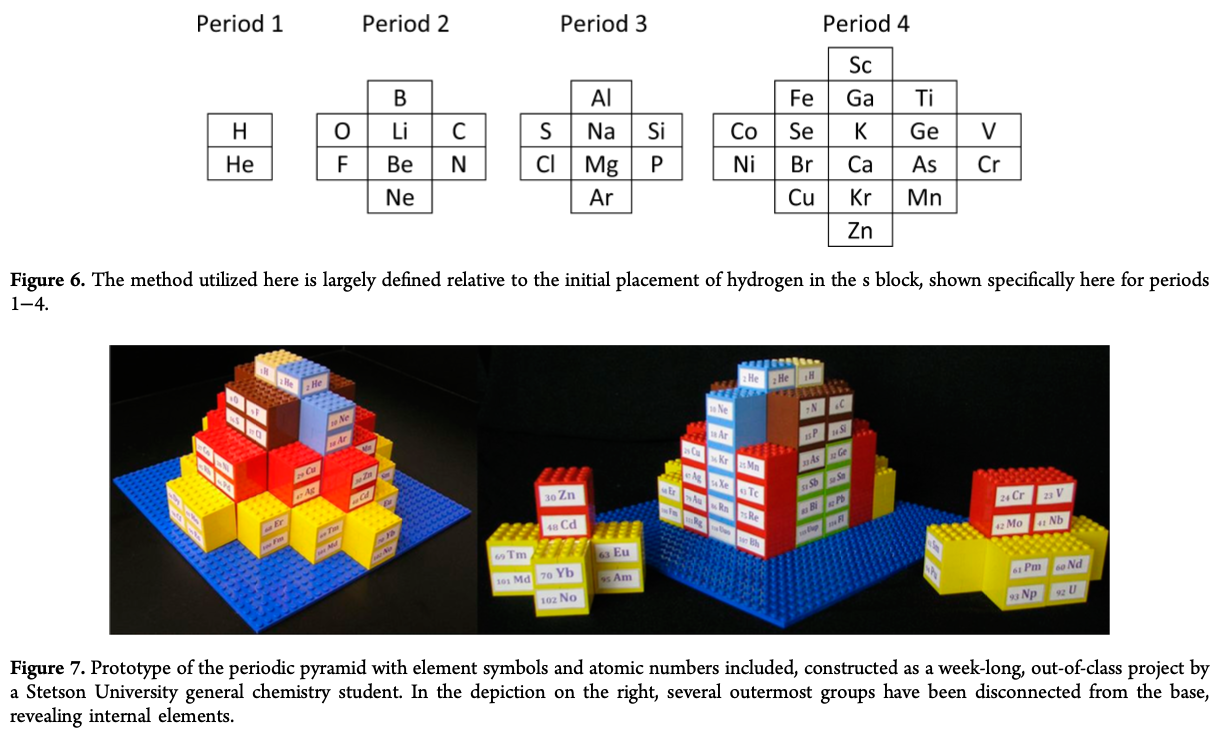
A Periodic Pyramid by Jennifer N. Hennigan and W. Tandy Grubbs * Department of Chemistry, Stetson University, DeLand, Florida 32723, United States
J. Chem. Educ., 2013, 90 (8), pp 1003-1008 DOI: 10.1021/ed3007567 Publication Date (Web): June 21, 2013
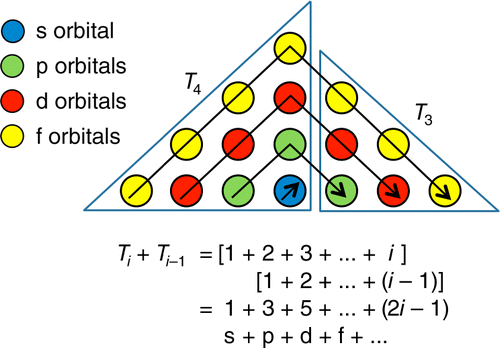
The chemical elements present in the modern periodic table are arranged in terms of atomic numbers and chemical periodicity. Periodicity arises from quantum mechanical limitations on how many electrons can occupy various shells and subshells of an atom. The shell model of the atom predicts that a maximum of 2, 8, 18, and 32 electrons can occupy the shells identified by the principle quantum numbers n = 1, 2, 3, and 4, respectively. The numbers 2, 8, 18, and 32 are shown in this work to be related to the triangular numbers from mathematical number theory. The relationship to the triangular numbers, in turn, suggests an alternate method for arranging elements in terms of periodicity. The resulting three-dimensional "periodic pyramid" is highly symmetric in shape. Just as is true in the modern periodic table, each layer of the periodic pyramid can be separated into shell and subshell contributions. Examining the pyramid's structure is arguably a pedagogically useful activity for college-level introductory or physical chemistry students, as it provides an opportunity to further ponder the shell model of the atom and the origins of periodicity. The connections to number theory are used to show that the outermost subshell of a given shell contains (2n - 1) orbitals.
Thanks to Eric Scerri for the tip!
See the website EricScerri.com and Eric's Twitter Feed.
| Year: 2013 | PT id = 1164, Type = formulation spiral 3D |
Periodic Pyramid
The Periodic Pyramid by Jennifer N. Hennigan and W. Tandy Grubbs, J. Chem. Educ. 2013, 90, 8, 1003-1008, https://doi.org/10.1021/ed3007567.
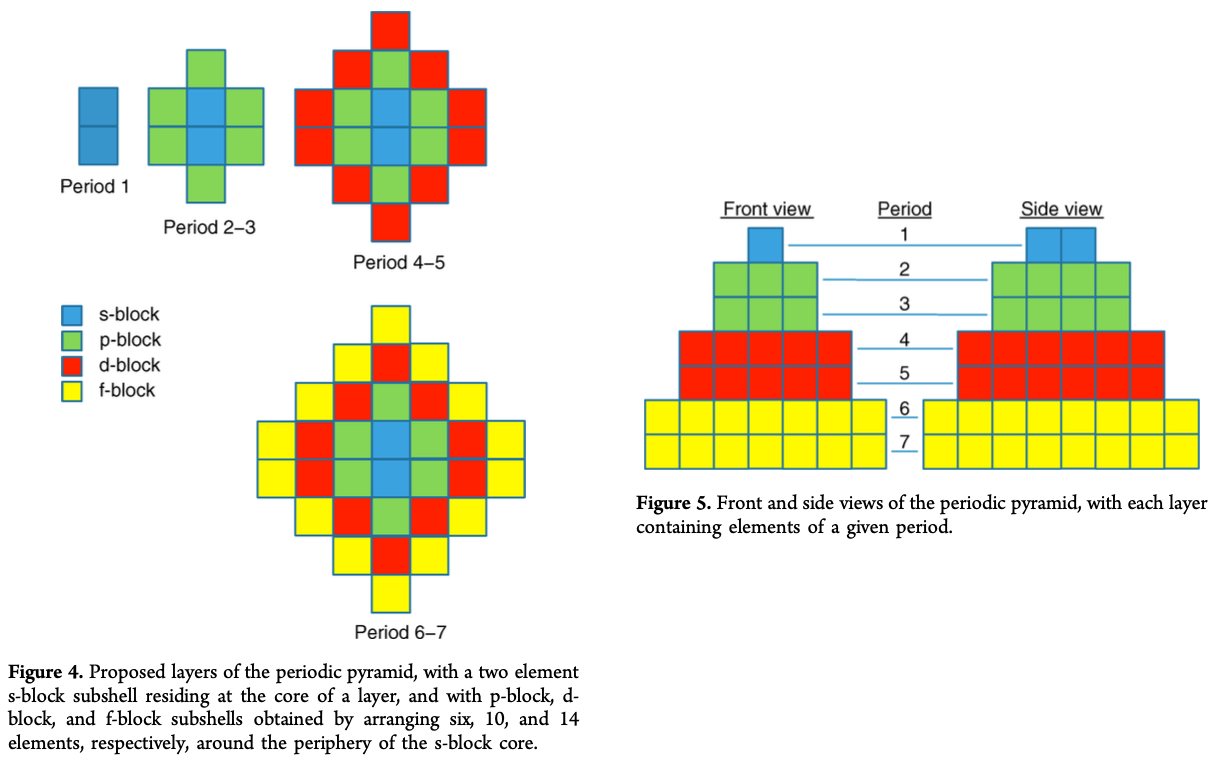
"The chemical elements present in the modern periodic table are arranged in terms of atomic numbers and chemical periodicity. Periodicity arises from quantum mechanical limitations on how many electrons can occupy various shells and subshells of an atom. The shell model of the atom predicts that a maximum of 2, 8, 18, and 32 electrons can occupy the shells identified by the principle quantum numbers n = 1, 2, 3, and 4, respectively.
The numbers 2, 8, 18, and 32 are shown in this work to be related to the triangular numbers from mathematical number theory. The relationship to the triangular numbers, in turn, suggests an alternate method for arranging elements in terms of periodicity. The resulting three-dimensional 'periodic pyramid' is highly symmetric in shape. Just as is true in the modern periodic table, each layer of the periodic pyramid can be separated into shell and subshell contributions. Examining the pyramid's structure is arguably a pedagogically useful activity for college-level introductory or physical chemistry students, as it provides an opportunity to further ponder the shell model of the atom and the origins of periodicity. The connections to number theory are used to show that the outermost subshell of a given shell contains (2n – 1) orbitals."
| Year: 2017 | PT id = 916, Type = misc |
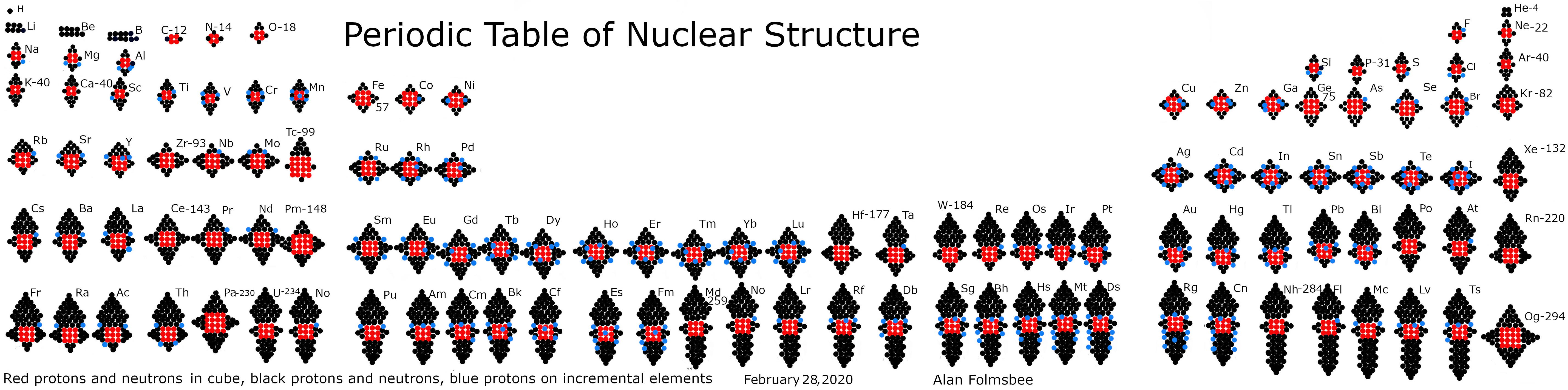
Atomic Nuclei Periodic Table
From the Pyramids on Nuclei of Elements blog, a periodic table of atomic nuclei using 'pyramidal cube theory':
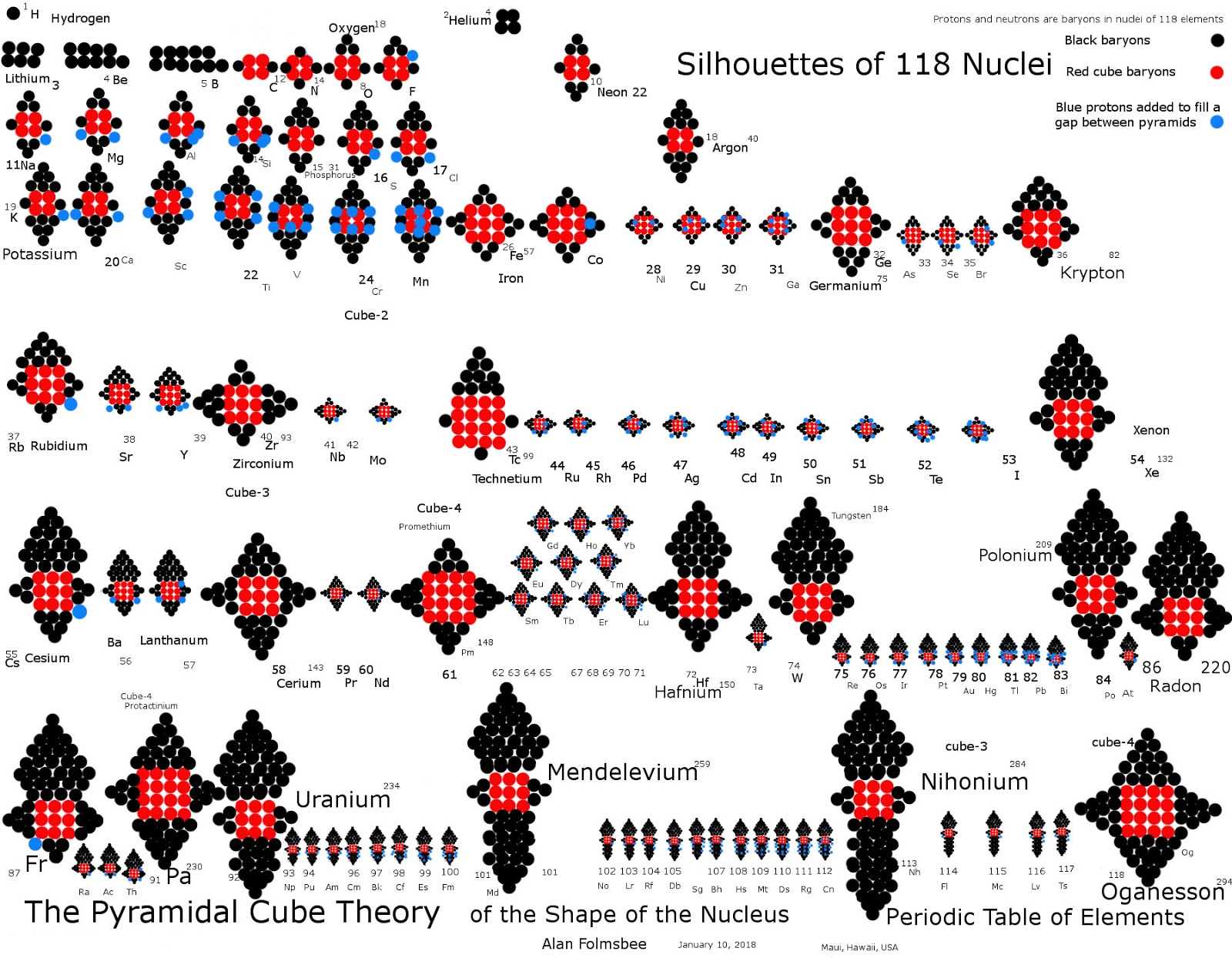
Click image below (updated in 2020) to enlarge:
| Year: 2019 | PT id = 982, Type = formulation misc |
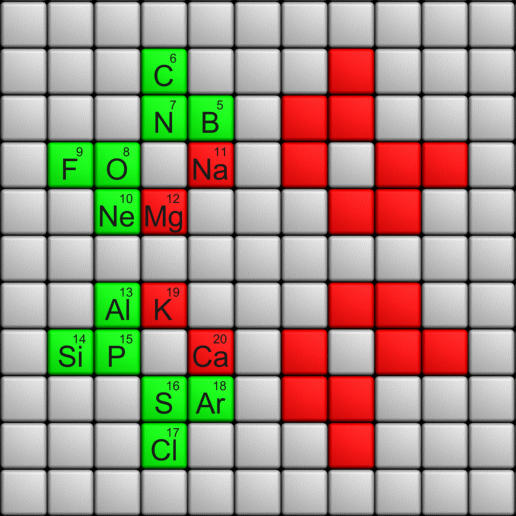
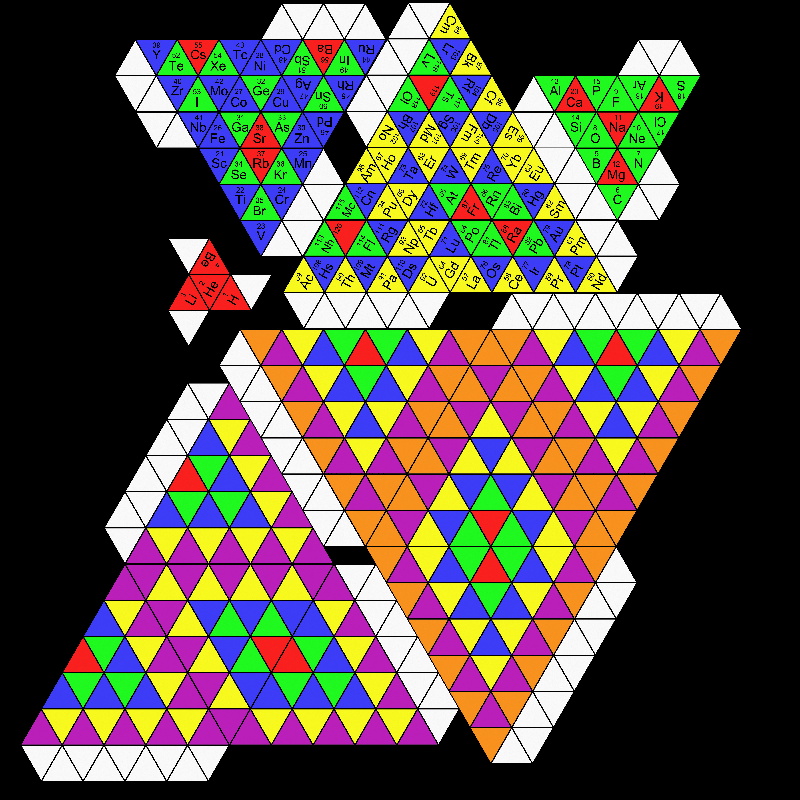
Archetypes of Periodic Law
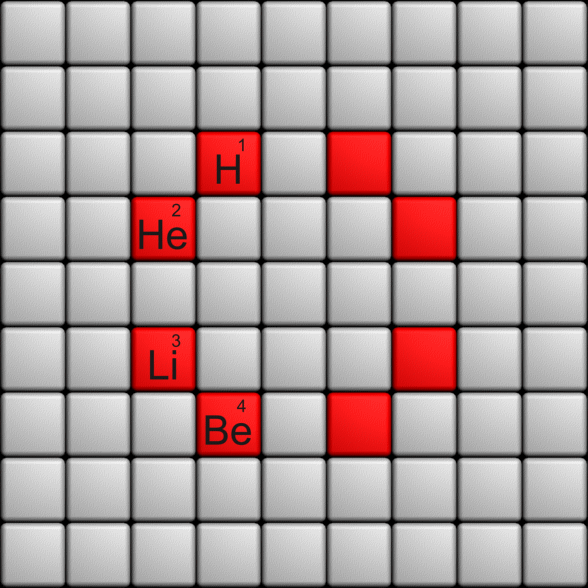
Archetypes of Periodic Law by Dmitry Weise, read more on the website.
One of the creators of quantum mechanics Wolfgang Ernst Pauli wrote in his work The Influence of Archetypal Ideas on the Scientific Theories of Kepler (1948):
"The process of understanding nature as well as the happiness that man feels in understanding – that is, in the conscious realization or new knowledge – seems thus to be based on a correspondence, a 'matching' of inner images pre-existent in the human psyche with external objects and their behavior. This interpretation of scientific knowledge, of course, goes back to Plato and is, as we shall see, advocated very clearly by Kepler. These primary images, which the soul can perceive with the aid of an innate 'instinct', are called by Kepler archetypal. Their agreement with the 'primordial images' or archetypes introduced into modern psychology by C. G. Jung and functioning as 'instincts of imagination' is very extensive. A true spiritual descendant of the Pythagoreans, he attached the utmost importance to geometric claiming that its theorems 'have been in the spirit of God since eternity'. His basic principle was: 'Geometria est archetypus pulchritudinis mundi' (Geometry is the archetype of the beauty of the world)."
Dmitry writes:
"The key archetype, in our opinion, is the concept of the square and its gnomon. This is due to the well-known fact that the electron filled shell contains 2n2 electrons, and the number of electrons on the subshell is twice the odd number; the gnomon of the square. Triangle, tetrahedron, square pyramid, octahedron, pyramid-like figures composed of square layers are also considered. The methodical concept for these constructions is the figurate numbers, actively studied by the Pythagoreans. The tables of the periodic law built on the motifs of ancient folk and modern ornaments take a special place. They include not only geometric archetypes, but also magic-symbolic, cultural and religious archetypes of the collective unconscious. Note that the periodic law table, built on the basis of the Native American ornament, surpasses the modern Mendeleev table in the parameter reflecting quantum numbers in its structure."
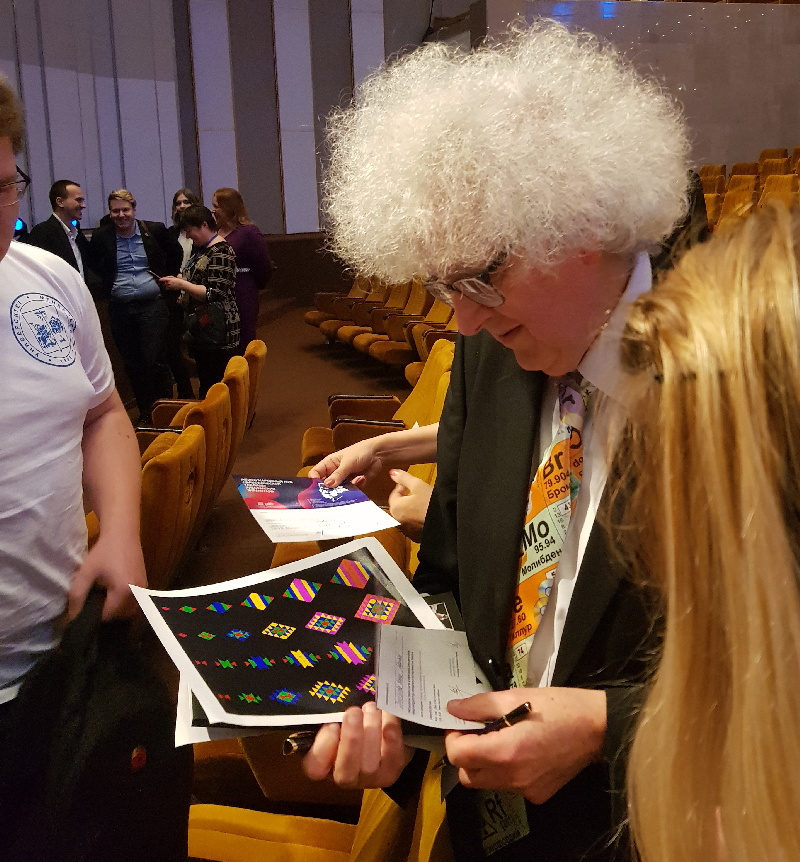
Note the final photograph below shows Prof. Martyn Poliakoff of The University on Nottingham and Periodic Videos:
| Year: 2019 | PT id = 1001, Type = review |
Kultovoy's Periodic Table Book
Nicolay Kultovoy, website, as sent me a copy of his Periodic Table book, entitled [Google Translate]: Book 5. Part 11-08. A single quantum mechanical model of the structure of the atomic nucleus and the periodic table of chemical elements of D.I. Mendeleev.
In a mixture of Russian & English, the PDF of the book can be viewed here.
Chapter 1. Triune (electrons, nucleons, chemical elements) quantum mechanical model of Colt. Three
1.1 the Rules of filling of the orbits of electrons.
1.2 Pyramidal lattice.
1.3 models with cubic sieve.
1.4 models with face-centered lattice.
1.5 quantum Mechanical form of the periodic table of chemical elements.
1.6 Stowe-Janet-Scerri Periodic Table.
Chapter 2. A lattice model of the nucleus. Model 62
2.1 Berezovsky G. N.
2.2 I. Boldov
2.4 Konovalov.
2.5 Manturov V.
2.6 Semikov S. A.
2.7 alpha-partial model of the atomic nucleus.
2.8 Burtaev V.
Chapter 3. Various lattice (crystal) model of the nucleus of an atom. One hundred five
3.0 Luis Pauling.
3.1 Valery Tsimmerman. ADOMAH Periodic Table. Model 3-2.
3.2 Klishev B. V. Model 3-1.
3.3 Garai J. Model 3-1.
3.4 Winger E Model 4-2.
3.5 Norman D. Cook. Model 4-1.
3.6 Gamal A. Nasser. Model 4-1.
3.7 D. Asanbaeva Model 4-1.
3.8 Datsuk V. K.
3.9 Bolotov B.
3.10 Djibladze M. I.
3.11 Dyukin S. V.
3.12 A. N. Mishin.
3.13 M. M. Protodyakonov
3.14 Dry I. N.
3.15 Ulf-G. Meißner.
3.16 Foreign works.
Chapter 4. Long-period periodic table. One hundred eighty one
4.1 long-Period representation of the periodic table.
4.2 Artamonov, G. N.
4.3 Galiulin R. V.
4.4 E. K. Spirin
4.5. Khoroshavin L.
4.6 Step form proposed by Thomsen and Bohr.
4.7 Symmetrical shape of the periodic table.
Chapter 5. Construction of a periodic table based on the structure of orbitals. Two hundred twenty one
5.1 construction of the periodic table on the basis of orbitals.
5.2 Short V. M.
5.3 Kulakov, the Novosibirsk table of multiplets.
Chapter 6. Atomic structure. Two hundred forty eight
6.1 Table of isotopes.
6.2 the structure of the orbitals.
| Year: 2026 | PT id = 1413, Type = formulation |
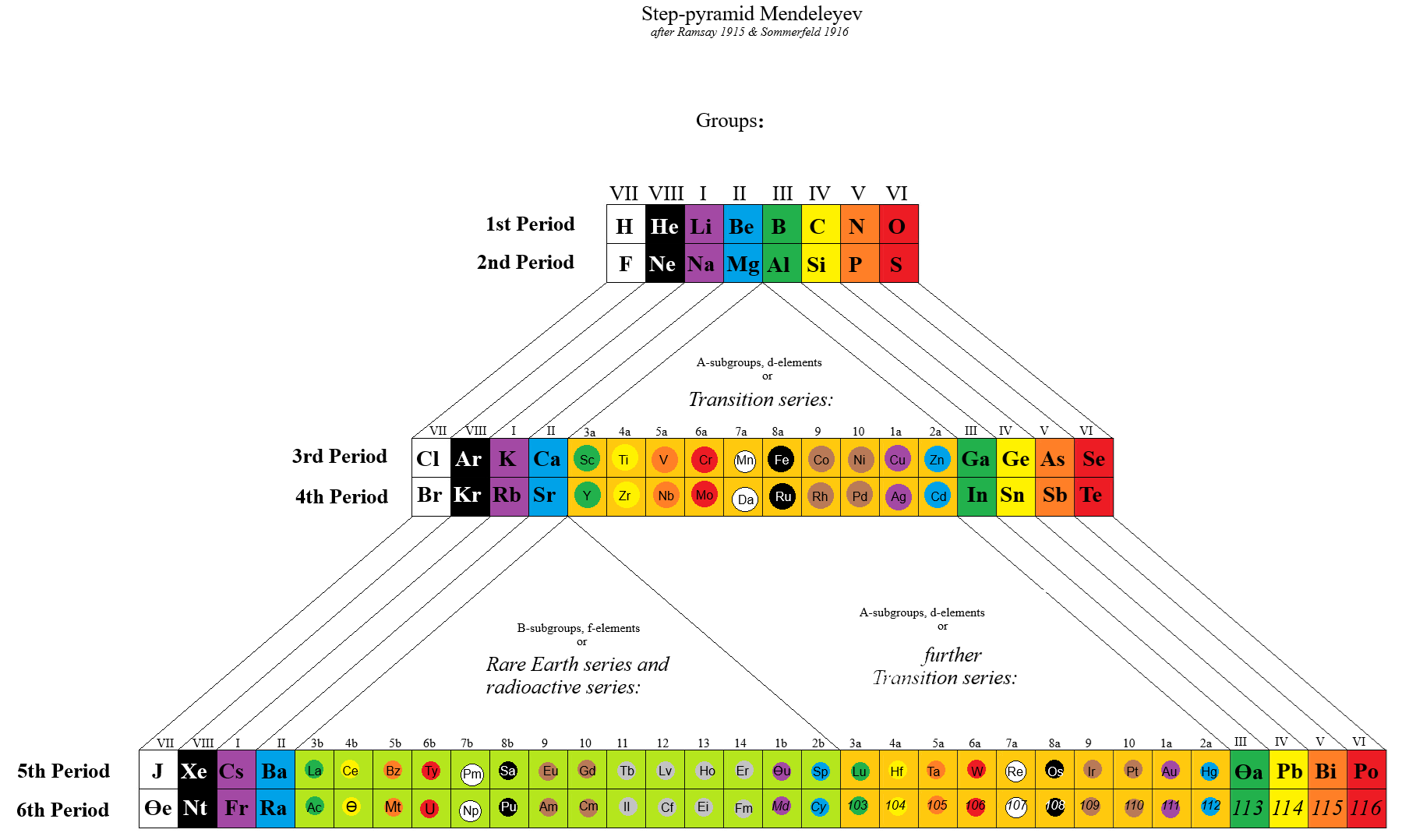
Marks: Step-Pyramid Mendeleyev
A periodic table highlighting Mendeleyev´s periodic law by John Marks.
It further follows Bohuslav Brauner (1855-1935), a keen disciple of Mendeleyev, in searching for internal periodicity, well demonstrated in the A-subgroups (d-elements), but his attempts to show this in the B-subgroups (f-elements) met with frustration. Ironically, had many of the actinides been available for his examination, he would have had more success than with the lanthanides. The periods comprise two initial sets of octets, followed by two of 18 and then two of 32, the last being incomplete because of spontaneous fission.
Within the periods, Brauner´s internal periodicity is clear to see. After the octets, new elements are added in the middle, between groups VIII (0) and I, yet follow the rhythm of the octets. K and Ca (groups I and II) are followed by Sc, group IIIA. This continues with the additional elements added at groups 9 and 10 (IXA and XA) and then recapitulated with Cu and Zn as groups IA and IIA before continuing the rhythm with Ga (group III). The same phenomenon occurs with the rare-earth and radioactive series. Brauner´s hypothesis would be corroborated by discovery of hexavalent Ty or monovalent θu.
Notes on Nomenclature:
A standard text saw fit to write: "Lanthanum has only one important oxidation state in aqueous solution, the +3 state. With few exceptions, this tells the whole boring story about the other lanthanides." [Pimentel, G., Spratley, R.: "Understanding chemistry", Holden-Day, San Francisco (1971), p. 862]. Others wrote similarly, explaining it as a consequence of the current convention of removing the f-block elements from the body of the periodic table.
However, undoubtedly ugly names like dysprosium and neodymium and confusing ones like terbium, ytterbium and erbium, aggravate this. The problem is not confined to the lanthanoids, with unimaginative examples like technetium, protoactinium and astatine.
The set of chemical canasta cards renames many of the worst offenders. Since the village of Ytterby has four elements named after it (five, if one includes holmium), I have reduced this to yttrium (cf. strontium, after Strontian) plus erbium and terbium to reflect the historical confusion: between 1843 and 1878 erbium and terbium even swapped names! I have replaced neodymium and praseodymium with names both more euphonious and relevant, often pairing a lanthanoid with its corresponding actinoid.
I have left the initiator of the series, lanthanum (Gk. for ‘hidden’) as appropriate and familiar.
Among the actinoids, since the same laboratory in America is represented in three elements, this has been replaced by Am (americum), Il (illinium, after the Argonne national laboratory, Illinois) and Cf (californium). Other alternatives are offered with names that are equivalent contemporary (at the time and place of discovery) metaphors, both more euphonious and more memorable:
Danubium, Da, Z=43 cf Rhenium, Z=75, the other northern boundary of the Roman empire, but the Danube is divided by many cataracts and rapids, reflecting danubium's radioactivity.
Berzelium, Bz, Z=59 and Meitnerum, Mt, Z=91 After Berzelius, the discoverer of a lanthanoid and the difficult properties (especially separation) of the lanthanoids and after Meitner, the discoverer of an actinoid and of many peculiar properties (especially nuclear fission) of the actinoids.
Tyrium, Ty, Z=60 After Tyr (cf uranium, Z=92 after the Greek god, Uranus) and for its tyrian (purple) coloured salts and the Norse god, Tyr.
Spectrium, Sp, Z=70 and Cyclonium, Cy, Z=102 Spectrium after the spectroscope which identified many lanthanoid elements and cyclonium after the cyclotron which identified many actinoid elements. (Cy is not included in the chemical canasta set, which covers only the first hundred elements)
Therine, θe, Z=85 After Thera, the unstable volcanic isle of classical mythology, a metaphor for instability. Niton, Nt, Z=86 From the Latin 'nitens' = shining, the name given it by Ramsay on account of its spontaneous luminescence. 'Radon' is short for 'radium emanation', Nt-222, and is thus merely an isotope of niton. Similarly thoron is Nt-220 and actinon is Nt-219. Lavoisium, Lv, Z=66 is named for Lavoisier, the founder of modern chemistry, replacing the ugly “dysprosium”.
I have also named Mendeleyev´s groups: VII (or -1) Cavendish's; VIII (or 0) Ramsay's; I Davy's; II Döbereiner's; III Mendeleyev's; IV Dalton's; V Boyle's; VI Lavoisier's.
Many recently named elements have had "-ium" added unthinkingly without realizing that "-um" is equally valid and more appropriate for the prosody of many names. Aluminum seems to be the etymologically correct derivative of alumina. Reasons of prosody have chosen "-um" in meitnerum, americum and platinum.
The symbol J for iodine reflects the consonantal nature of the initial. Since science is familiar with the Greek alphabet, θu, θa, θe and θ are suggested for Z = 69, 81, 85 and 90. This would also ease the pressure on finding suitable Berzelian symbols for new superheavy elements.
| Year: 2026 | PT id = 1418, Type = formulation |
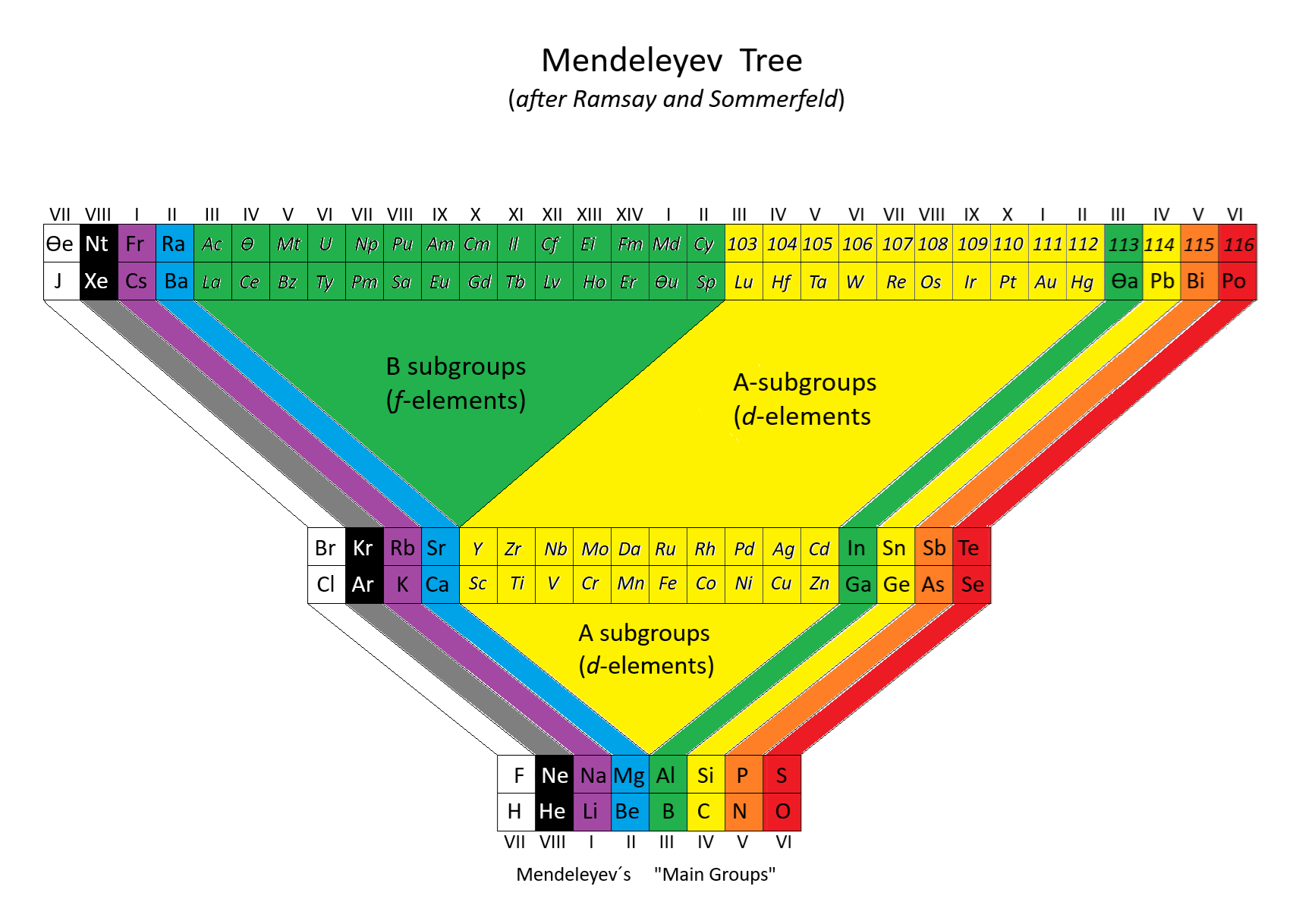
Mendeleyev Tree
The Mendeleyev Tree by John Marks.
John says: "Many folk say to me the properties of the elements grow out of the previous elements and that the PT grows like a plant.
To accommodate this (rather popular) perspective, I offer the Mendeleyev Tree (which is really is just an inverted Step Pyramid):"
|
|
|
| What is the Periodic Table Showing? | Periodicity |
© Mark R. Leach Ph.D. 1999 –
Queries, Suggestions, Bugs, Errors, Typos...
If you have any:
Queries
Comments
Suggestions
Suggestions for links
Bug, typo or grammatical error reports about this page,please contact Mark R. Leach, the author, using mark@meta-synthesis.com
This free, open access web book is an ongoing project and your input is appreciated.