Periodic Table |
 |
 |
 |
 |
 |
 |
 |
| What is the Periodic Table Showing? | Periodicity |
The INTERNET Database of Periodic Tables
There are thousands of periodic tables in web space, but this is the only comprehensive database of periodic tables & periodic system formulations. If you know of an interesting periodic table that is missing, please contact the database curator: Mark R. Leach Ph.D. The database holds information on periodic tables, the discovery of the elements, the elucidation of atomic weights and the discovery of atomic structure (and much, much more).
The 10 most recent entries to the database:
| Year: 2026 | PT id = 1418, Type = formulation |
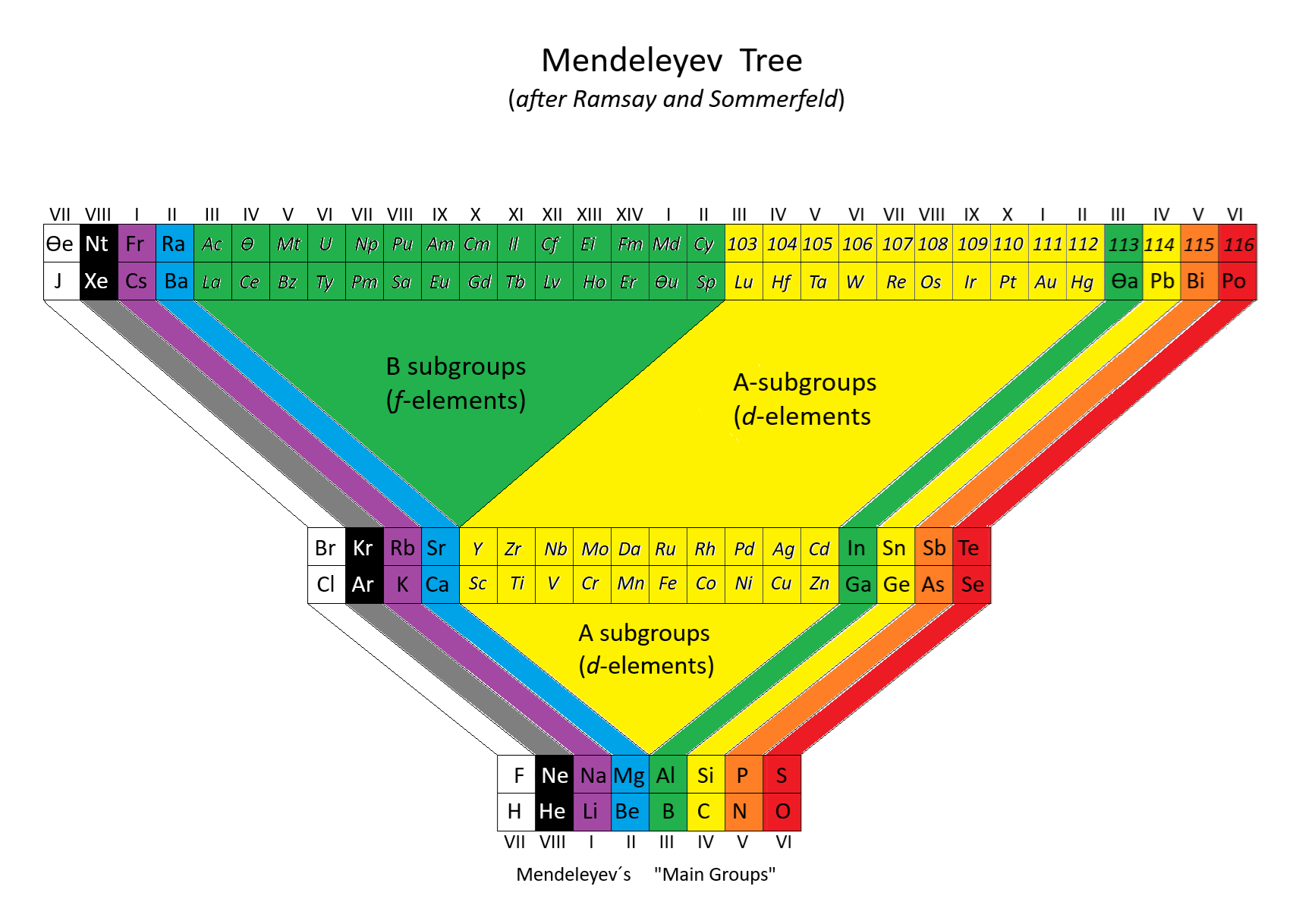
Mendeleyev Tree
The Mendeleyev Tree by John Marks.
John says: "Many folk say to me the properties of the elements grow out of the previous elements and that the PT grows like a plant.
To accommodate this (rather popular) perspective, I offer the Mendeleyev Tree (which is really is just an inverted Step Pyramid):"
| Year: 2026 | PT id = 1417, Type = misc |
UCL Group 18
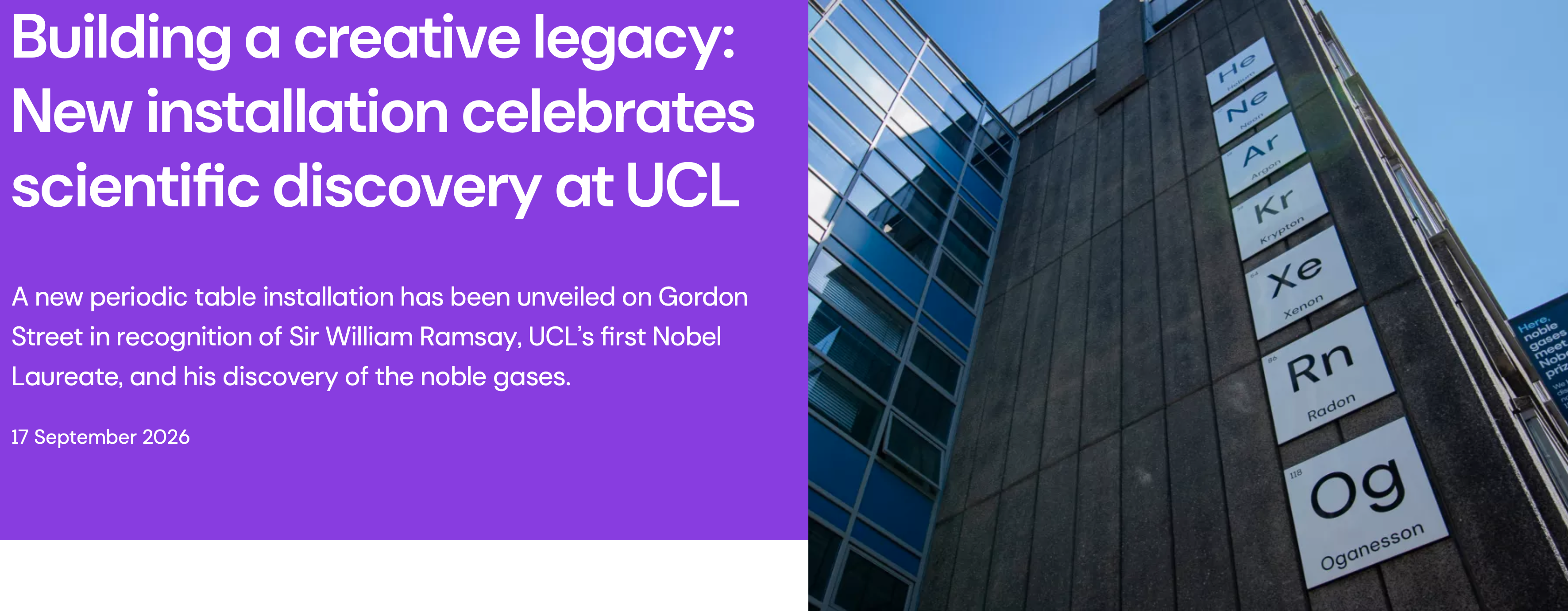
Building a creative legacy: New installation celebrates scientific discovery at UCL (University College London). A new periodic table installation has been unveiled on Gordon Street in recognition of Sir William Ramsay, UCL’s first Nobel Laureate, and his discovery of the noble gases. 17 September 2026.
Thanks to Eric Scerri for the tip!
| Year: 2026 | PT id = 1416, Type = formulation data |
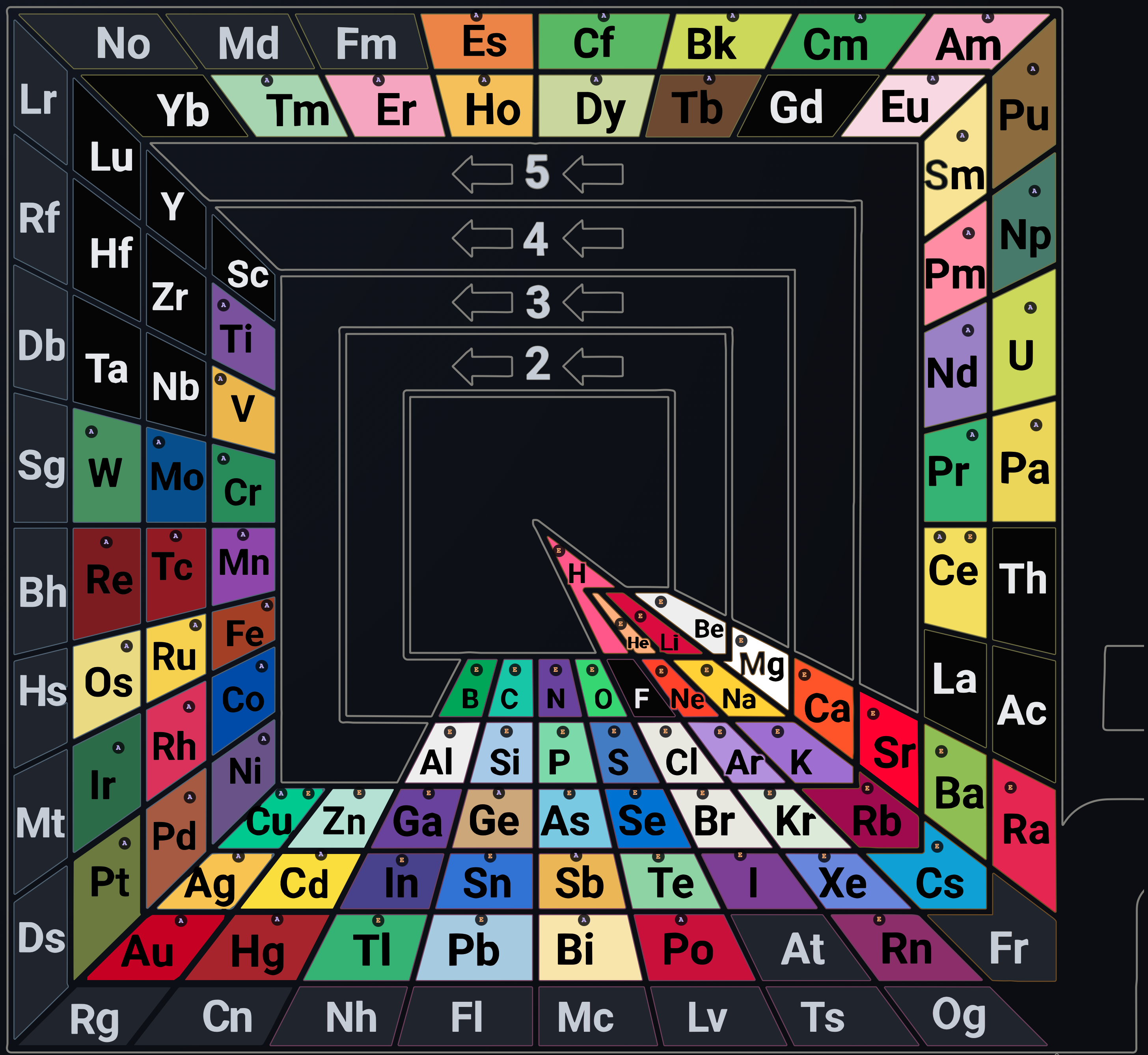
Characteristic Colour of the Elements: Absorption (Salts / Glass) and Emission (Flame / Spectrum)
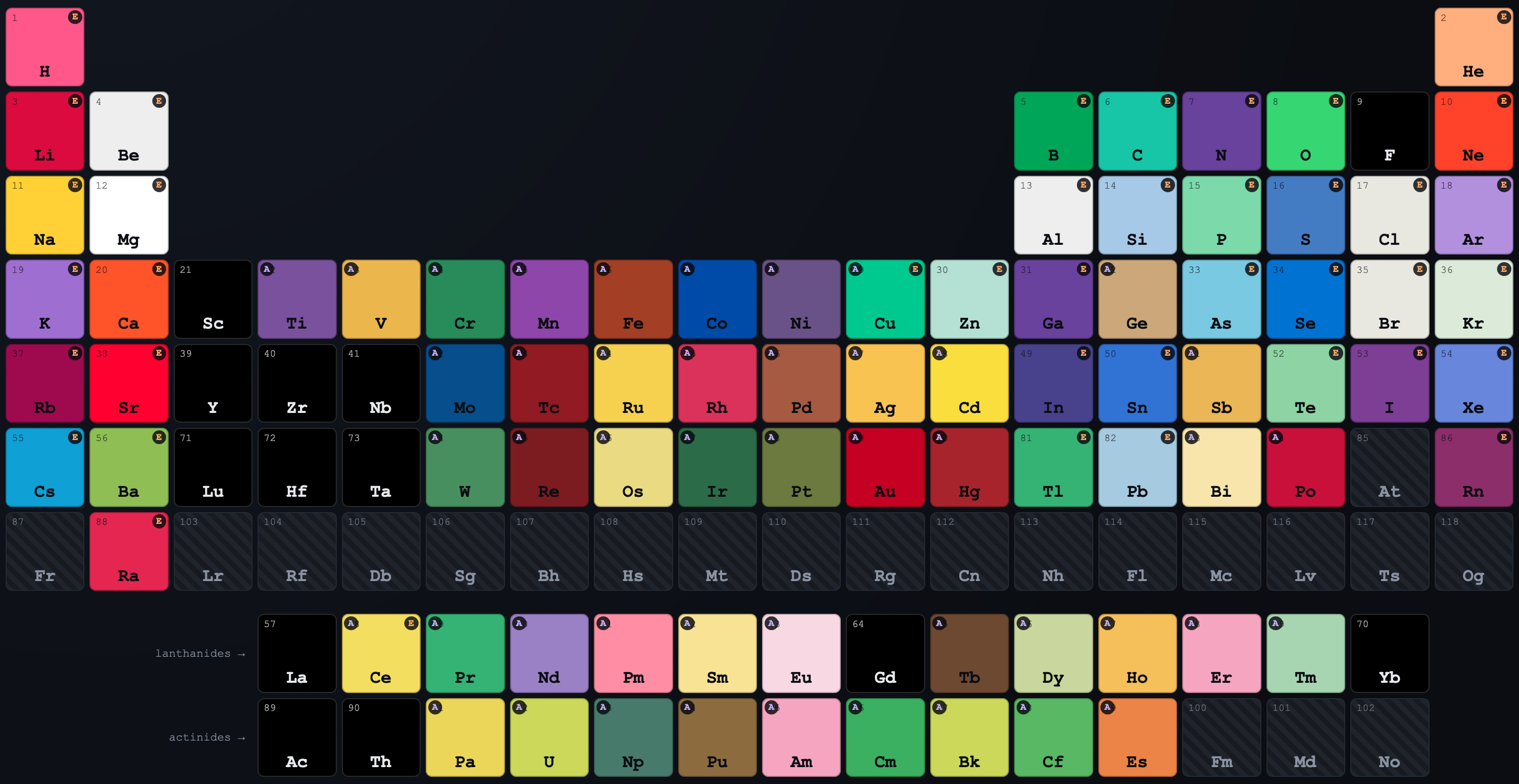
The Characteristic Colour of the Elements: Absorption (Salts / Glass) and Emission (Flame / Spectrum) - Mario Rodríguez Peña Each cell shows a colour of absorption (glass/oxide/salt, label "A") or of emission (flame/spectrum, label "E").
The first image below uses Mario Rodríguez Peña's 2024 formulation.
Go to Mario Rodríguez Peña website to see the dynamic PTs.
| Year: 2026 | PT id = 1415, Type = formulation |
Osman's Developed Models of Periodic Table of Elements
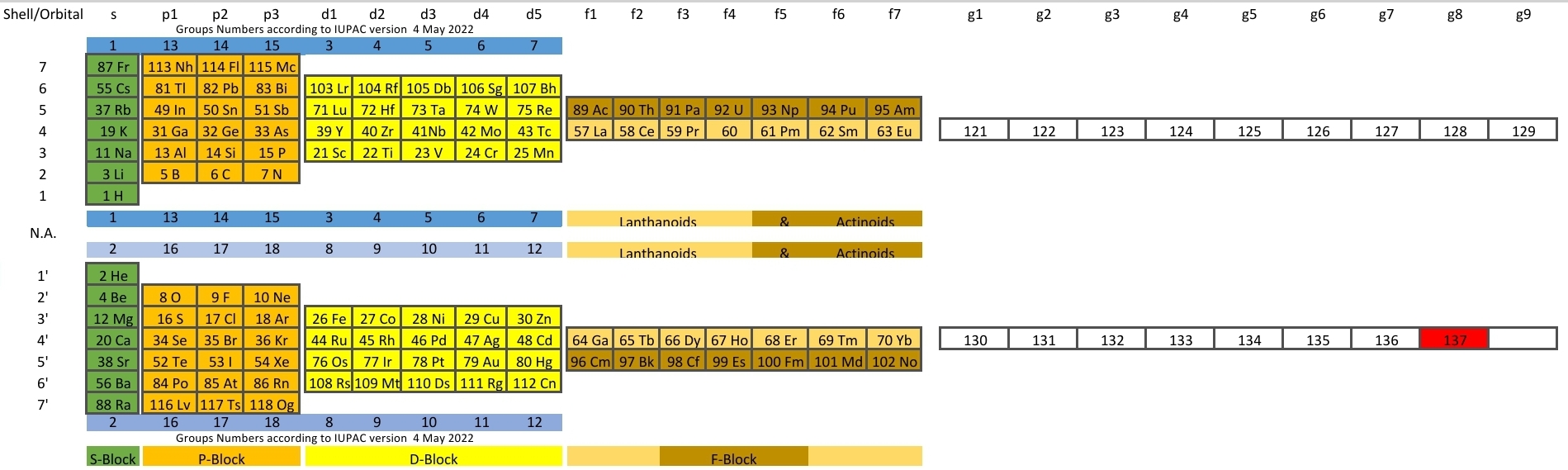
Developed Models of Periodic Table of Elements Dr. Khalid Abdel Fattah M. Osman, Associate Professor at Merowe Institute of Technology Merowe University of Technology, Sudan.
My latest 2026 research in periodic table of elements, titled "Developed Models of Periodic Table of Elements", introduces an innovative mathematical simulation that addresses some of the long-standing structural challenges in the modern periodic law [1.3.1، 1.3.4].
Unlike traditional models, the model leverages parabolic properties to map atomic shells and subshells, simulating an electronic configuration based on symmetrical circular orbits with a two-electron capacity each. This mathematical symmetry results in a highly coherent Extended Periodic Table, which elegantly accommodates predicted super heavy elements (beyond element 118) and offers a potential resolution to the debate surrounding the end of the periodic table.
| Year: 2026 | PT id = 1414, Type = formulation spiral |
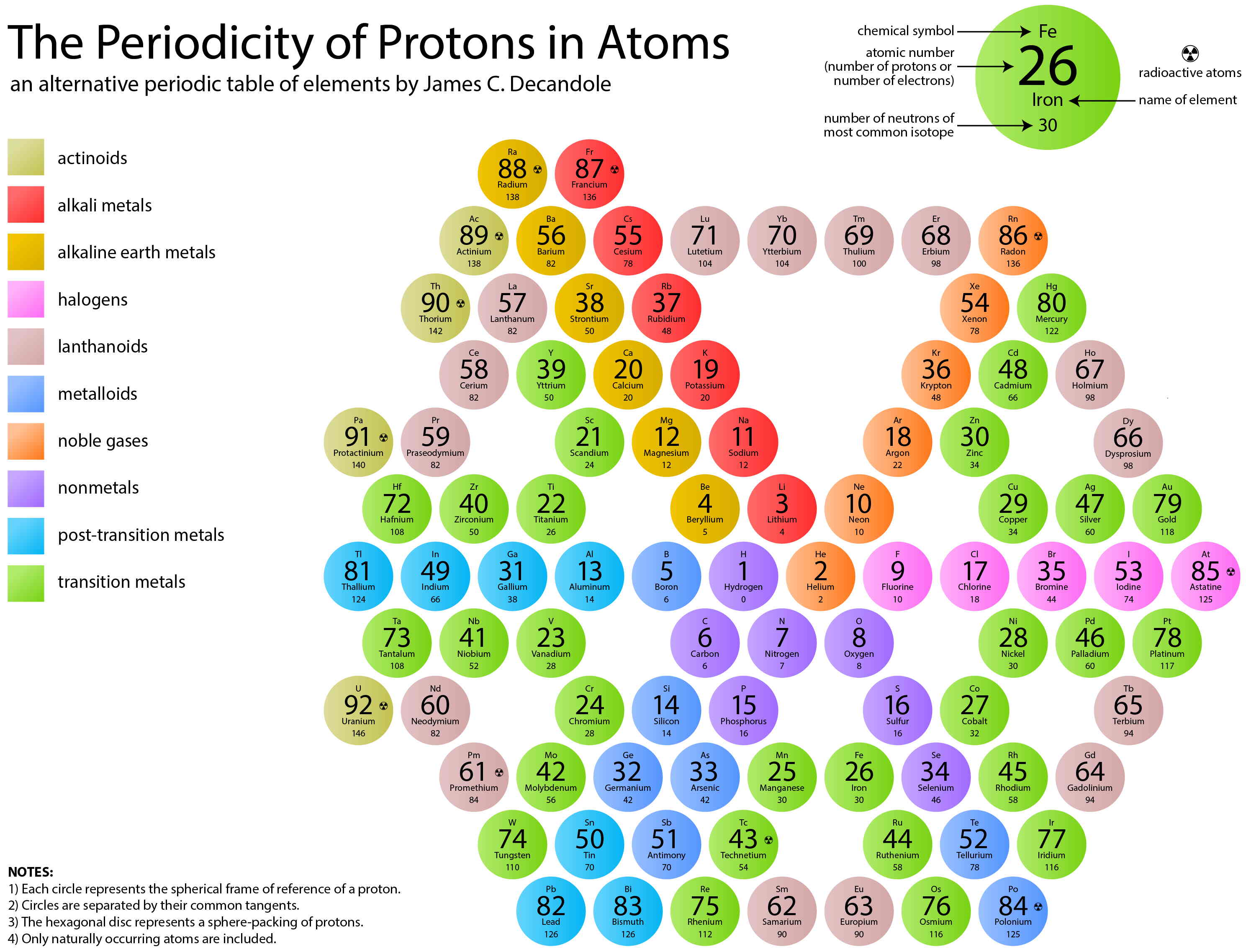
Periodicity of Protons in Atoms
The Periodicity of Protons in Atoms by James C. Decandole.
| Year: 2026 | PT id = 1413, Type = formulation |
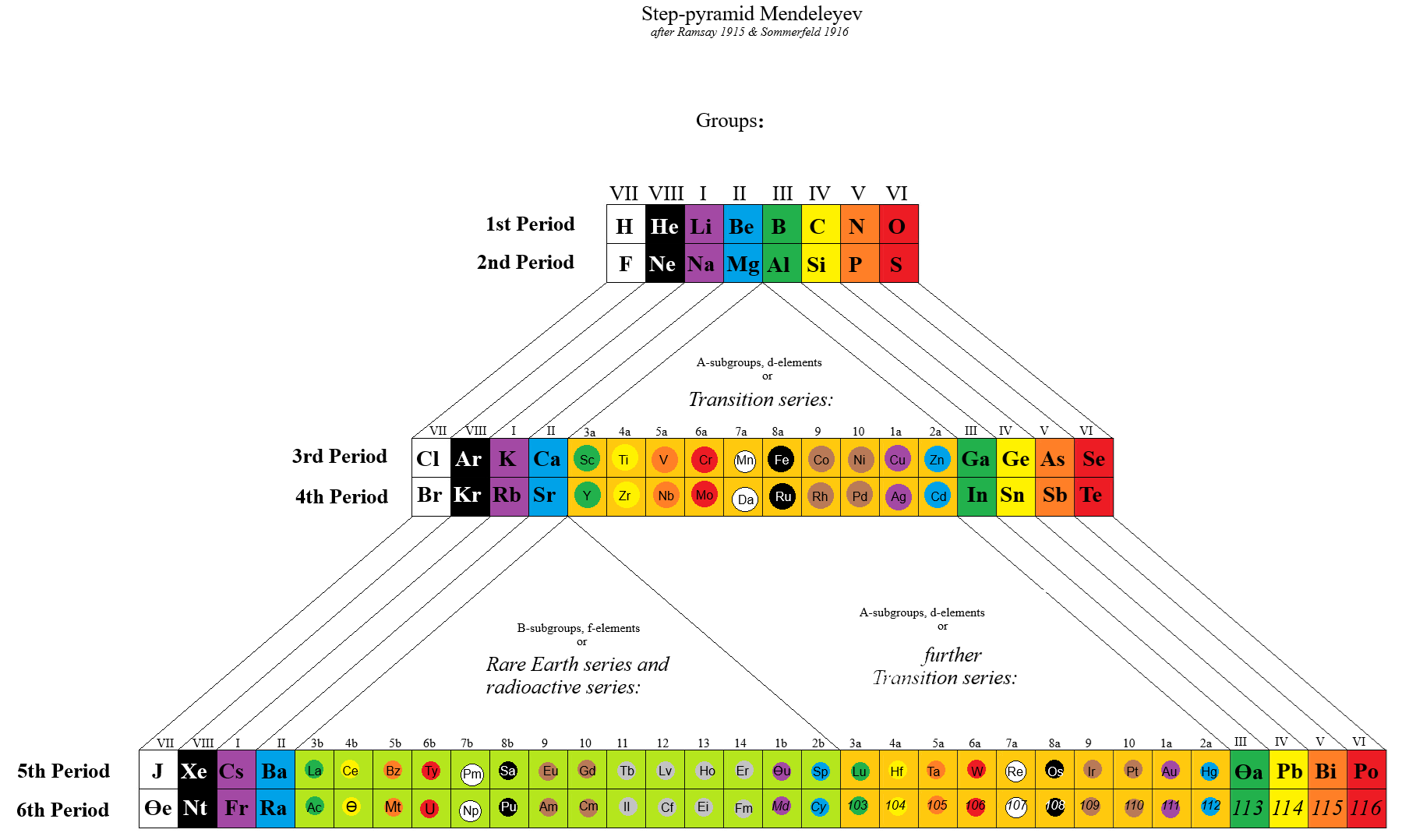
Marks: Step-Pyramid Mendeleyev
A periodic table highlighting Mendeleyev´s periodic law by John Marks.
It further follows Bohuslav Brauner (1855-1935), a keen disciple of Mendeleyev, in searching for internal periodicity, well demonstrated in the A-subgroups (d-elements), but his attempts to show this in the B-subgroups (f-elements) met with frustration. Ironically, had many of the actinides been available for his examination, he would have had more success than with the lanthanides. The periods comprise two initial sets of octets, followed by two of 18 and then two of 32, the last being incomplete because of spontaneous fission.
Within the periods, Brauner´s internal periodicity is clear to see. After the octets, new elements are added in the middle, between groups VIII (0) and I, yet follow the rhythm of the octets. K and Ca (groups I and II) are followed by Sc, group IIIA. This continues with the additional elements added at groups 9 and 10 (IXA and XA) and then recapitulated with Cu and Zn as groups IA and IIA before continuing the rhythm with Ga (group III). The same phenomenon occurs with the rare-earth and radioactive series. Brauner´s hypothesis would be corroborated by discovery of hexavalent Ty or monovalent θu.
Notes on Nomenclature:
A standard text saw fit to write: "Lanthanum has only one important oxidation state in aqueous solution, the +3 state. With few exceptions, this tells the whole boring story about the other lanthanides." [Pimentel, G., Spratley, R.: "Understanding chemistry", Holden-Day, San Francisco (1971), p. 862]. Others wrote similarly, explaining it as a consequence of the current convention of removing the f-block elements from the body of the periodic table.
However, undoubtedly ugly names like dysprosium and neodymium and confusing ones like terbium, ytterbium and erbium, aggravate this. The problem is not confined to the lanthanoids, with unimaginative examples like technetium, protoactinium and astatine.
The set of chemical canasta cards renames many of the worst offenders. Since the village of Ytterby has four elements named after it (five, if one includes holmium), I have reduced this to yttrium (cf. strontium, after Strontian) plus erbium and terbium to reflect the historical confusion: between 1843 and 1878 erbium and terbium even swapped names! I have replaced neodymium and praseodymium with names both more euphonious and relevant, often pairing a lanthanoid with its corresponding actinoid.
I have left the initiator of the series, lanthanum (Gk. for ‘hidden’) as appropriate and familiar.
Among the actinoids, since the same laboratory in America is represented in three elements, this has been replaced by Am (americum), Il (illinium, after the Argonne national laboratory, Illinois) and Cf (californium). Other alternatives are offered with names that are equivalent contemporary (at the time and place of discovery) metaphors, both more euphonious and more memorable:
Danubium, Da, Z=43 cf Rhenium, Z=75, the other northern boundary of the Roman empire, but the Danube is divided by many cataracts and rapids, reflecting danubium's radioactivity.
Berzelium, Bz, Z=59 and Meitnerum, Mt, Z=91 After Berzelius, the discoverer of a lanthanoid and the difficult properties (especially separation) of the lanthanoids and after Meitner, the discoverer of an actinoid and of many peculiar properties (especially nuclear fission) of the actinoids.
Tyrium, Ty, Z=60 After Tyr (cf uranium, Z=92 after the Greek god, Uranus) and for its tyrian (purple) coloured salts and the Norse god, Tyr.
Spectrium, Sp, Z=70 and Cyclonium, Cy, Z=102 Spectrium after the spectroscope which identified many lanthanoid elements and cyclonium after the cyclotron which identified many actinoid elements. (Cy is not included in the chemical canasta set, which covers only the first hundred elements)
Therine, θe, Z=85 After Thera, the unstable volcanic isle of classical mythology, a metaphor for instability. Niton, Nt, Z=86 From the Latin 'nitens' = shining, the name given it by Ramsay on account of its spontaneous luminescence. 'Radon' is short for 'radium emanation', Nt-222, and is thus merely an isotope of niton. Similarly thoron is Nt-220 and actinon is Nt-219. Lavoisium, Lv, Z=66 is named for Lavoisier, the founder of modern chemistry, replacing the ugly “dysprosium”.
I have also named Mendeleyev´s groups: VII (or -1) Cavendish's; VIII (or 0) Ramsay's; I Davy's; II Döbereiner's; III Mendeleyev's; IV Dalton's; V Boyle's; VI Lavoisier's.
Many recently named elements have had "-ium" added unthinkingly without realizing that "-um" is equally valid and more appropriate for the prosody of many names. Aluminum seems to be the etymologically correct derivative of alumina. Reasons of prosody have chosen "-um" in meitnerum, americum and platinum.
The symbol J for iodine reflects the consonantal nature of the initial. Since science is familiar with the Greek alphabet, θu, θa, θe and θ are suggested for Z = 69, 81, 85 and 90. This would also ease the pressure on finding suitable Berzelian symbols for new superheavy elements.
| Year: 2026 | PT id = 1412, Type = non-chem |
Personality Elements, Periodic Table of
A Periodic Table of Personality Elements by Frans Maan.
Click here (or click on the images below) to see the full size version.
Frans gives this web link.


| Year: 2026 | PT id = 1411, Type = formulation |
Johnson’s Quaternionic Periodic Chart of the Elements
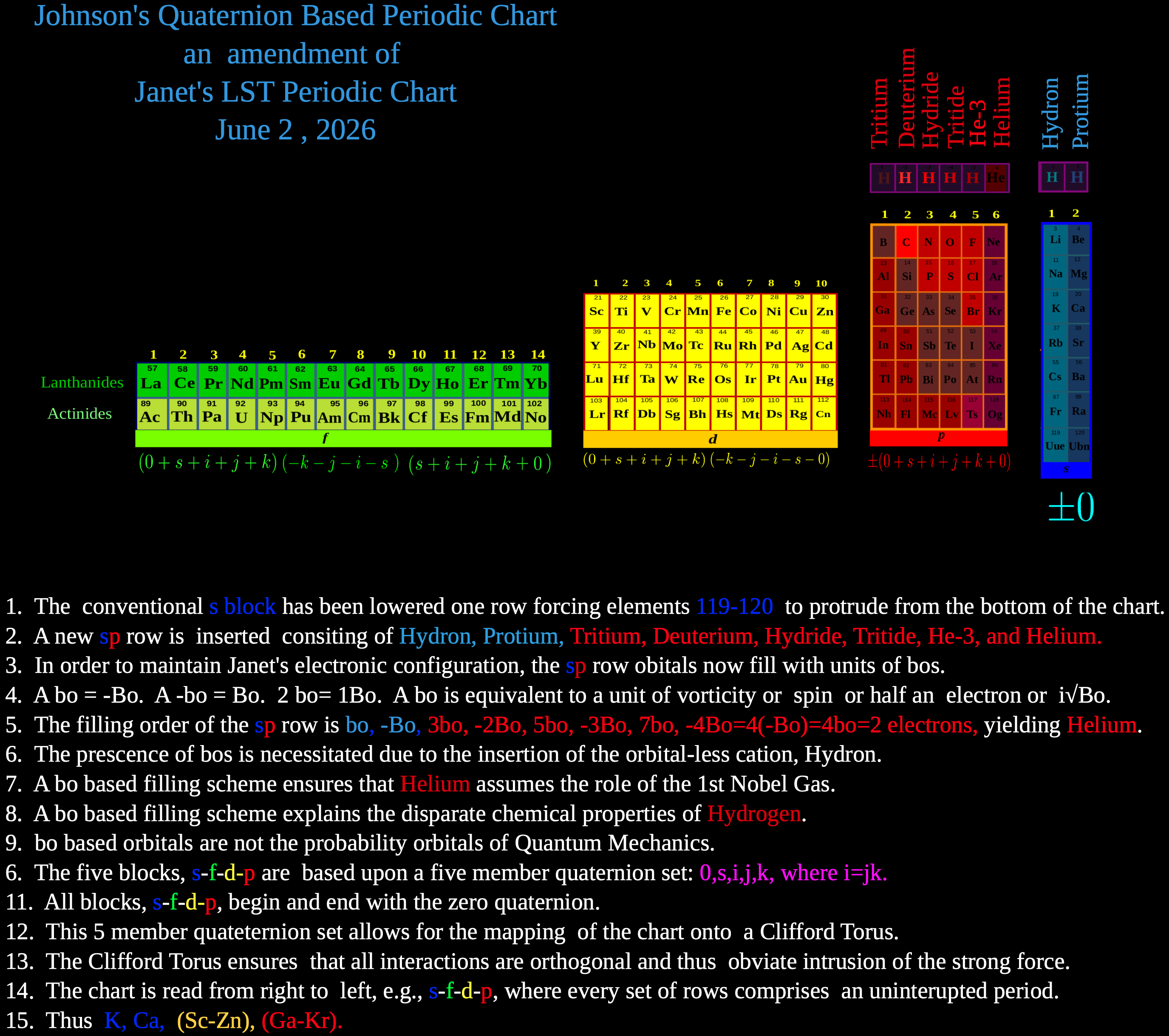
Johnson’s Quaternionic Periodic Chart of the Elements: An Amendment to Janet’s Left Step Periodic Chart by Willie Johnson Jr.
What sets the formulation apart is:
- The chart is structured such that helium legitimately assumes it rightful place as the 1st noble gas.
- The chart accounts for the disparate chemical properties of Hydrogen.
- The chart is based upon a five quaternion set: 0, s, i, j, k.
- The entire chart is mapped to a Clifford Torus. This ensure all interactions are orthogonal.
- It is found that by interacting moving electrons orthogonally we engender a new chemical bond called the Tovacian Bond thus obviating any undo electrostatic repulsion.
Read the full paper.pdf.
| Year: 1957 | PT id = 1410, Type = review |
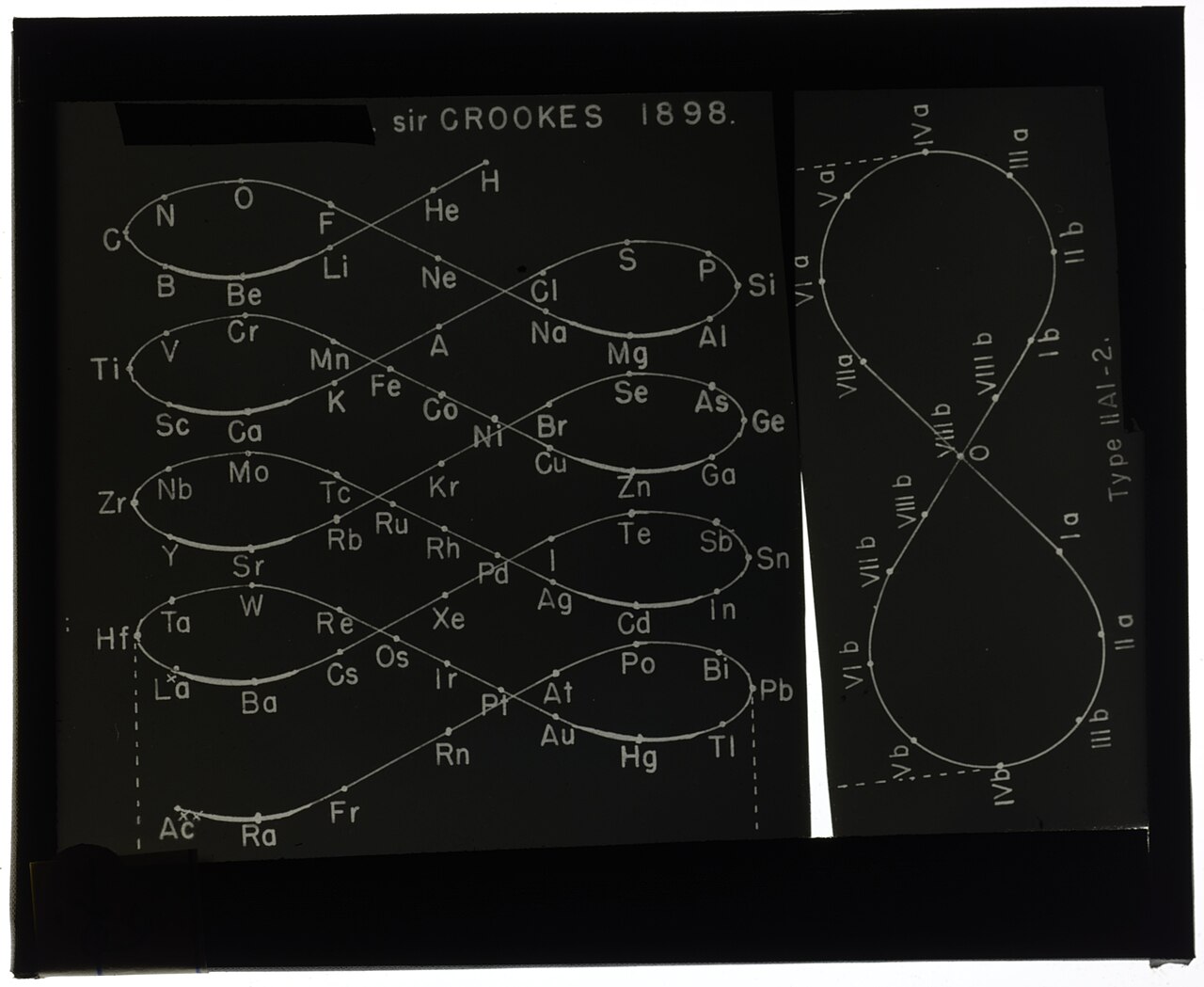
Mazurs: Types of graphic representation of the periodic system of chemical elements
Types of graphic representation of the periodic system of chemical elements is a 1957 self-published book by Edward G. Mazurs. The book was updated, and re-titled, to the much better known Graphic Representations of the Periodic System During One Hundred Years (University of Alabama Press) in 1974.
Edward G. Mazurs (1894–1983) was a chemist who wrote a history of the periodic system of the chemical elements which is still considered a "classic book on the history of the periodic table". Originally self-published as Types of graphic representation of the periodic system of chemical elements (1957), it was reviewed by the ACS in 1958 as "the most complete survey of the range of human imagination in representing graphically the Mendeleev periodic law."
Mark Leach writes:
Unfortunately, Mazurs re-draws all of the periodic tables in both his books; he adds elements that were not known at the time of formulation and sometimes takes great liberties by rotating images by 90° (without comment), including Mendeleev's formulations of 1869. His classification system is confusing. As Wikipedia says: "Mazurs's books are difficult to use because the references are divided into 146 corresponding sections, and the index refers to the types and not to pages. Nevertheless, his references are the most comprehensive and accurate ever compiled for the period covered. He cited authors writing in at least 24 languages and from fifty countries."
| Year: 1857 | PT id = 1409, Type = weight |
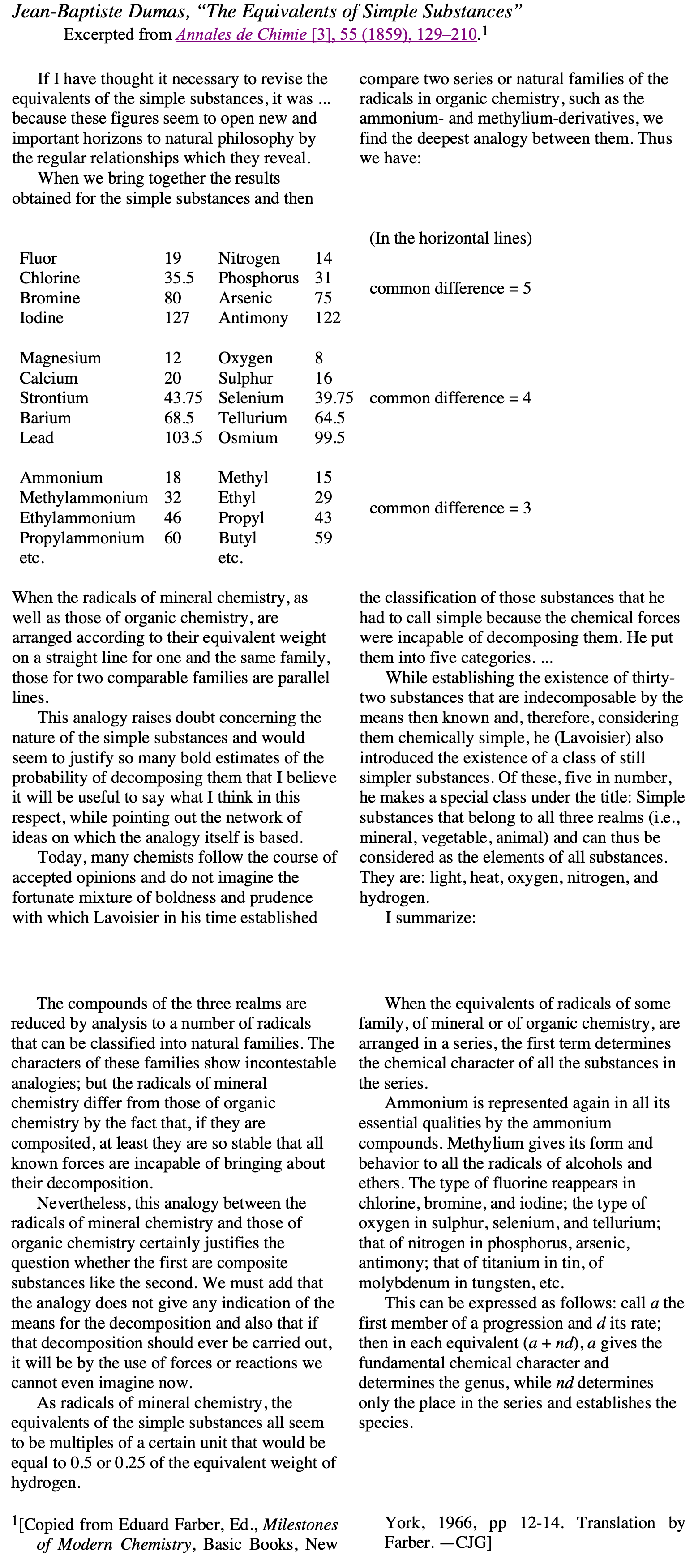
Dumas's Study of Atomic Weight ("The Equivalents of Simple Substances")
Cannizzario cited Dumas in his letter or 'Sumto' of 1858.
Annales de Chimie [3], 55 (1858), 129–210:

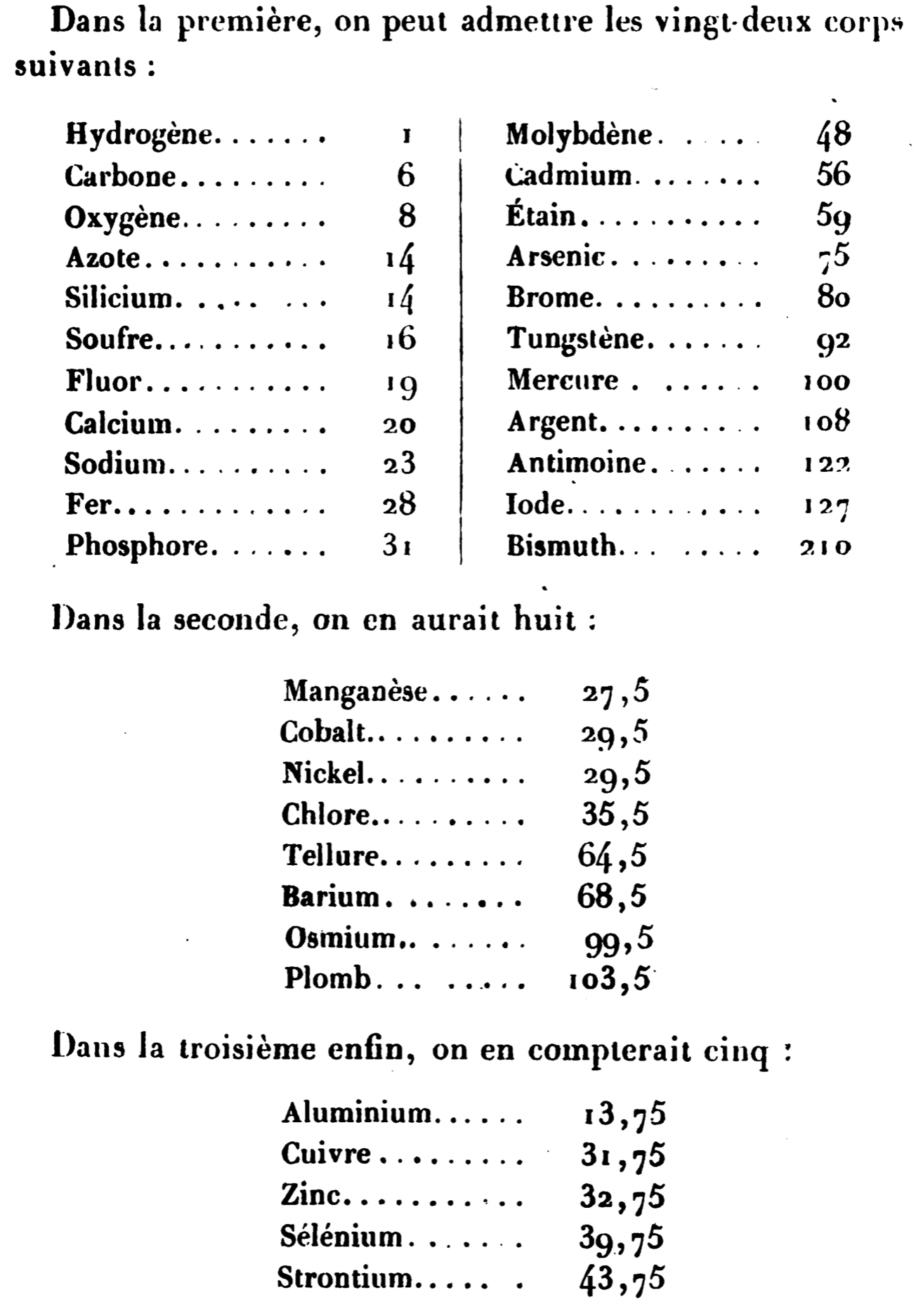
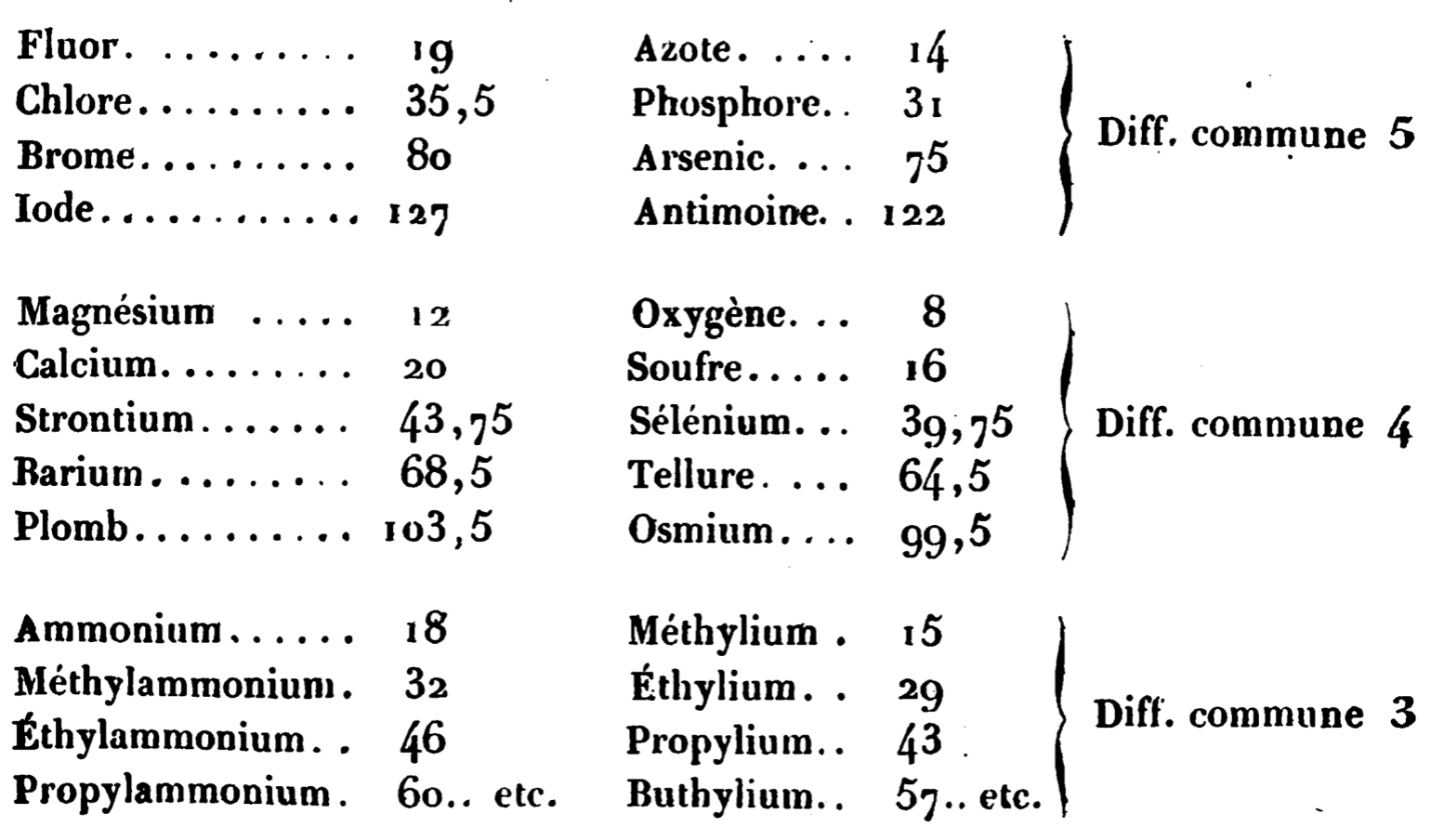
There is an English tranlation of the important passage from the Carmen Giunta website:
|
|
|
| What is the Periodic Table Showing? | Periodicity |
© Mark R. Leach Ph.D. 1999 –
Queries, Suggestions, Bugs, Errors, Typos...
If you have any:
Queries
Comments
Suggestions
Suggestions for links
Bug, typo or grammatical error reports about this page,please contact Mark R. Leach, the author, using mark@meta-synthesis.com
This free, open access web book is an ongoing project and your input is appreciated.