Periodic Table |
 |
 |
 |
 |
 |
 |
 |
| What is the Periodic Table Showing? | Periodicity |
The INTERNET Database of Periodic Tables
There are thousands of periodic tables in web space, but this is the only comprehensive database of periodic tables & periodic system formulations. If you know of an interesting periodic table that is missing, please contact the database curator: Mark R. Leach Ph.D. The database holds information on periodic tables, the discovery of the elements, the elucidation of atomic weights and the discovery of atomic structure (and much, much more).
| Year: 2010 | PT id = 352, Type = formulation |
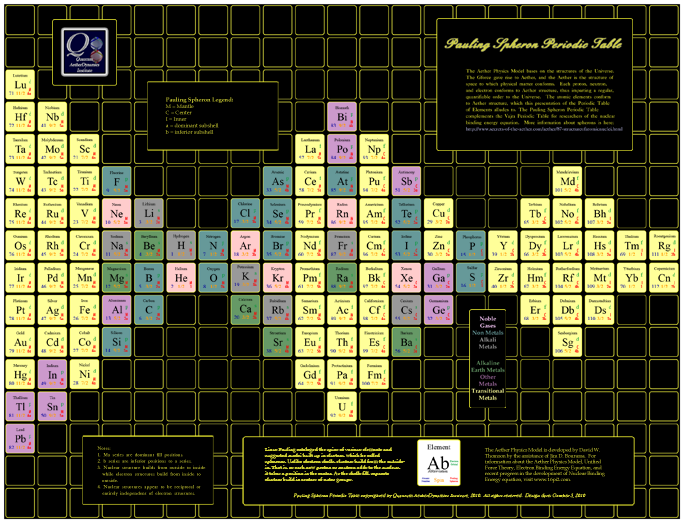
Pauling Spheron Periodic Table
The Pauling Spheron Periodic Table, can be found at APM Periodic Tables.
Linus Pauling was a brilliant physicist who tended to think outside the mainstream. One of his many contributions to science was his spheron model for the nucleus. The word "spheron" does not mean the nucleus is spherical (although it may be), it refers to Pauling's idea that clusters might form in the nucleus. For example, a nucleus may contain a stable helium nucleus within a larger uranium nucleus. Thus, when uranium decays, it releases a helium atom. Other elements, such as oxygen, may also cluster within larger elements. This makes sense since certain atoms like helium and oxygen are more strongly bound than other elements:
|
|
|
| What is the Periodic Table Showing? | Periodicity |
© Mark R. Leach Ph.D. 1999 –
Queries, Suggestions, Bugs, Errors, Typos...
If you have any:
Queries
Comments
Suggestions
Suggestions for links
Bug, typo or grammatical error reports about this page,please contact Mark R. Leach, the author, using mark@meta-synthesis.com
This free, open access web book is an ongoing project and your input is appreciated.