Periodic Table |
 |
 |
 |
 |
 |
 |
 |
| What is the Periodic Table Showing? | Periodicity |
The INTERNET Database of Periodic Tables
There are thousands of periodic tables in web space, but this is the only comprehensive database of periodic tables & periodic system formulations. If you know of an interesting periodic table that is missing, please contact the database curator: Mark R. Leach Ph.D. The database holds information on periodic tables, the discovery of the elements, the elucidation of atomic weights and the discovery of atomic structure (and much, much more).
| Year: 2010 | PT id = 523, Type = misc |
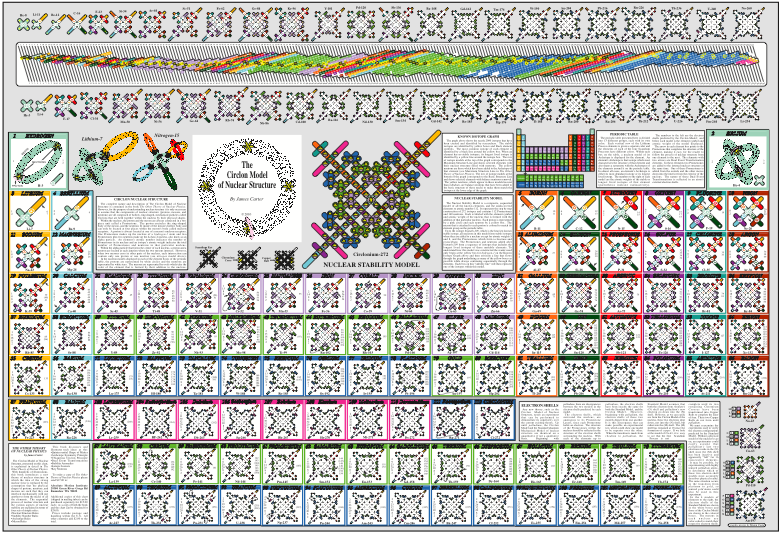
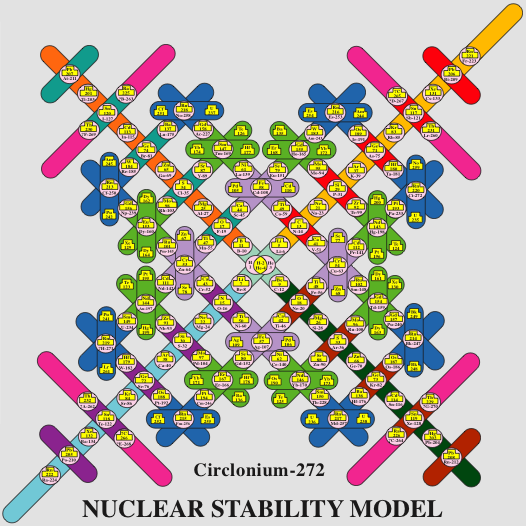
Circlon Model of Nuclear Structure & Periodic Table
The complete nature and description of The Circlon Model of Nuclear Structure is contained in the book The Other Theory of Nuclear Physics available from www.living-universe.com. However, for the purpose of understanding nuclear structure it is only necessary to assume that the components of nuclear structure (protons, mesons, and neutrons) are all composed of hollow, ring-shaped, mechanical particles called Circlons that are held together within the nucleus by their physical shapes.
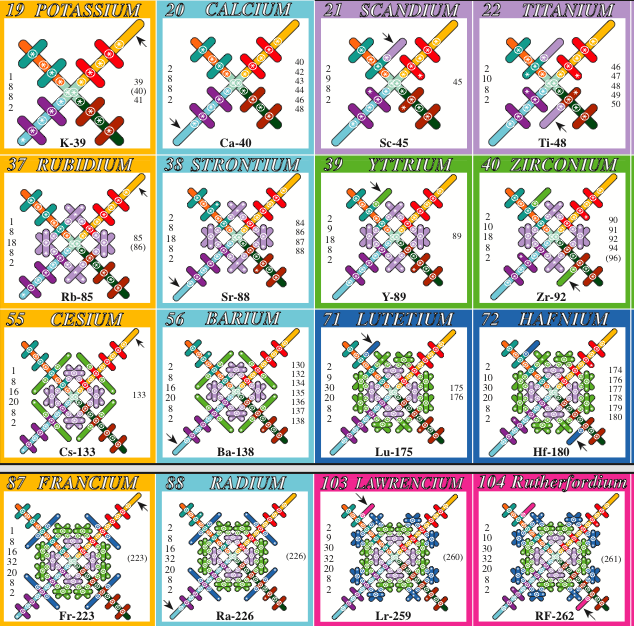
Within the nucleus, the proton and the meson are always connected in a two piece unit called a Promestone. The proton encircles the ring-shaped body of the meson, and the neutrons fit inside of the meson's hollow body and can only be located at four places within the meson's body called nucleon receptors. A proton is always located at one of a meson's nucleon receptors. One Promestone makes up the nucleus of a hydrogen-1 atom and two Promestones plus two neutrons make up the helium-4 nucleus, also know as an alpha particle. An element's atomic number indicates the number of Promestones in its nucleus and an isotope's atomic weight indicates the total number of Promestones and neutrons in that particular nucleus.
Within the alpha particle that forms the center of each nucleus, a proton and a neutron are located at each junction where the two mesons intersect. However, when two mesons cross in other parts of the nucleus, each intersection can contain only one proton or one neutron (see nitrogen model above).
In the nucleon models displayed in each of the element boxes of the periodic table, the protons are represented by white circles and the neutrons are represented by white stars. The mesons are represented by ovals which take the color of the element that is formed by their addition to the nucleus:
|
|
|
| What is the Periodic Table Showing? | Periodicity |
© Mark R. Leach Ph.D. 1999 –
Queries, Suggestions, Bugs, Errors, Typos...
If you have any:
Queries
Comments
Suggestions
Suggestions for links
Bug, typo or grammatical error reports about this page,please contact Mark R. Leach, the author, using mark@meta-synthesis.com
This free, open access web book is an ongoing project and your input is appreciated.