Periodic Table |
 |
 |
 |
 |
 |
 |
 |
| What is the Periodic Table Showing? | Periodicity |
The INTERNET Database of Periodic Tables
There are thousands of periodic tables in web space, but this is the only comprehensive database of periodic tables & periodic system formulations. If you know of an interesting periodic table that is missing, please contact the database curator: Mark R. Leach Ph.D. The database holds information on periodic tables, the discovery of the elements, the elucidation of atomic weights and the discovery of atomic structure (and much, much more).
| Year: 1905 | PT id = 64, Type = formulation |
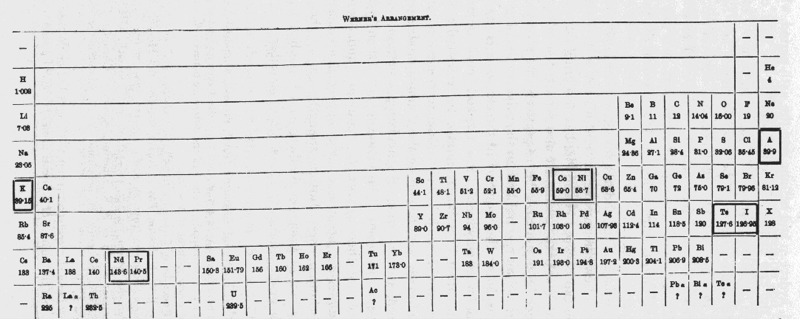
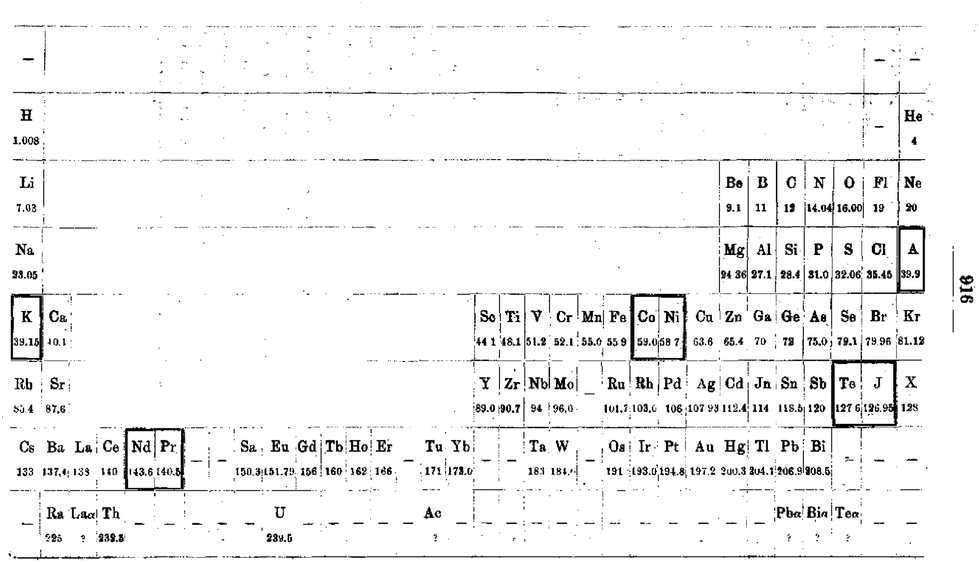
Werner's Arrangement
Werner's Arrangement is the first modern looking PT formulation. It appeared before the structure of the atom was known, before the importance of atomic number was recognised and before quantum mechanics had been developed.
Berichte der Deutschen Chemischen Gesellschaft (1905), 38, 914-21 and J. Chem. Soc., Abstr. 88, II, 308-9 1905:
From Quam & Quam's 1934 review paper.pdf
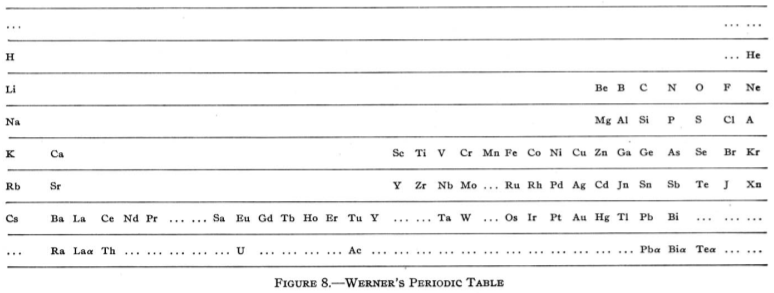
Eric Scerri comments that the interesting features are:
- A remarkably modern looking formulation in that it separates not only the transition metals but also the rare earths into separate blocks to give what we would now call a "long-form 32 column table". Except Werner guessed wrong as to how many rare earths exist, with the result that he shows 33 groups.
- This formulation is also interesting for showing an element between H and He and two elements before H.
- Werner computed the average gaps between atomic weights for the second through the fifth periods as 1.85, 2.4, 2.47 and 2.5, respectively.
- From this he extrapolated the gap for the first period as 1.5, which coincidentally was also half the difference between the atomic weights of H and He. Werner thus predicted a new element with atomic weight 2.5.
- Moseley's work of 1913 showed there were no elements before H and none between H and He.
Thanks to Eric Scerri for the tip!
See the website EricScerri.com and Eric's Twitter Feed.
|
|
|
| What is the Periodic Table Showing? | Periodicity |
© Mark R. Leach Ph.D. 1999 –
Queries, Suggestions, Bugs, Errors, Typos...
If you have any:
Queries
Comments
Suggestions
Suggestions for links
Bug, typo or grammatical error reports about this page,please contact Mark R. Leach, the author, using mark@meta-synthesis.com
This free, open access web book is an ongoing project and your input is appreciated.