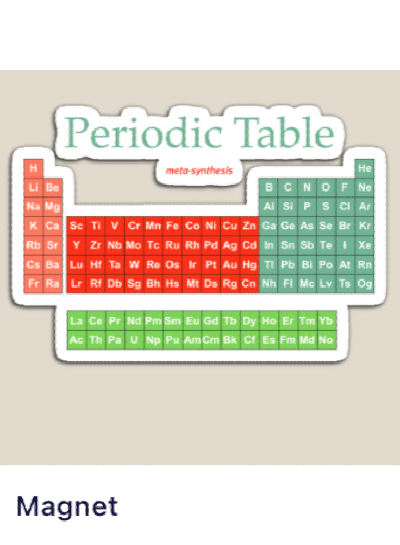
Periodic Table |
 |
 |
 |
 |
 |
 |
 |
| What is the Periodic Table Showing? | Periodicity |
The INTERNET Database of Periodic Tables
There are thousands of periodic tables in web space, but this is the only comprehensive database of periodic tables & periodic system formulations. If you know of an interesting periodic table that is missing, please contact the database curator: Mark R. Leach Ph.D. The database holds information on periodic tables, the discovery of the elements, the elucidation of atomic weights and the discovery of atomic structure (and much, much more).
| Year: 2014 | PT id = 661, Type = formulation spiral |
Chandra's Polar Plot Periodic Table
MONOGRAPH ON ATOMS, BY Dr. N. Naveen Chandra, 543 Bellamy Road North Scarborough, On, M1H1G5, 416 439 6630, chandraalex@hotmail.com >© N.Naveen Chandra, 2014.
Abstract
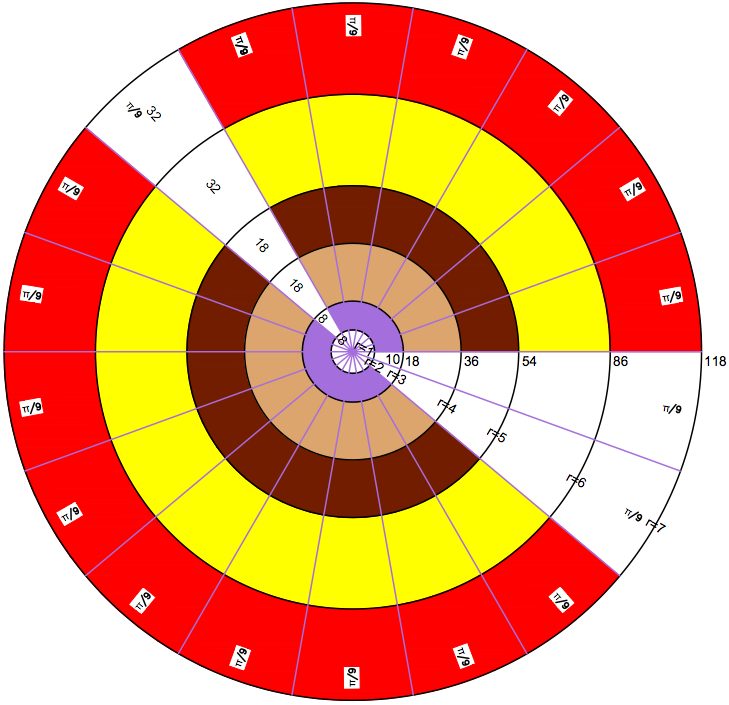
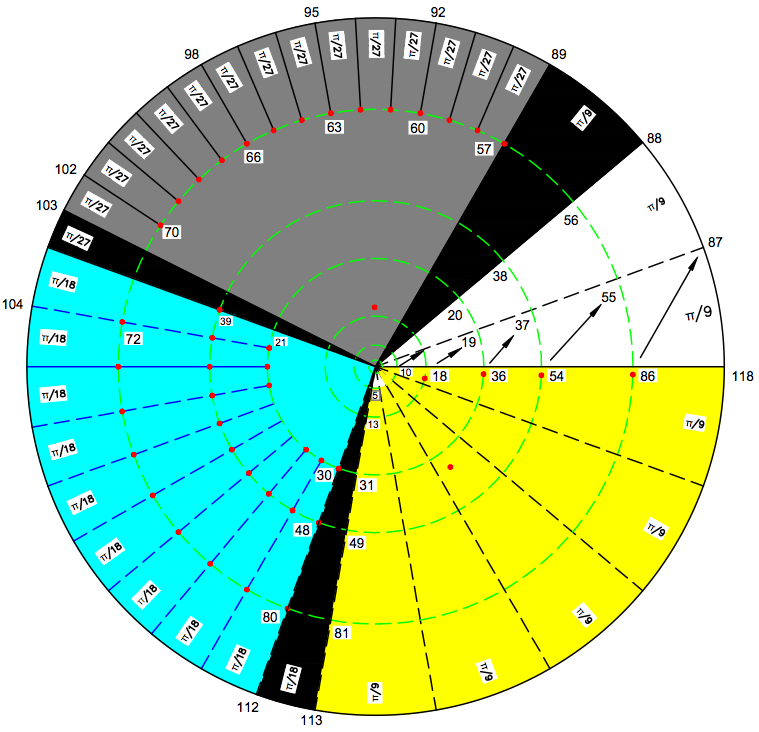
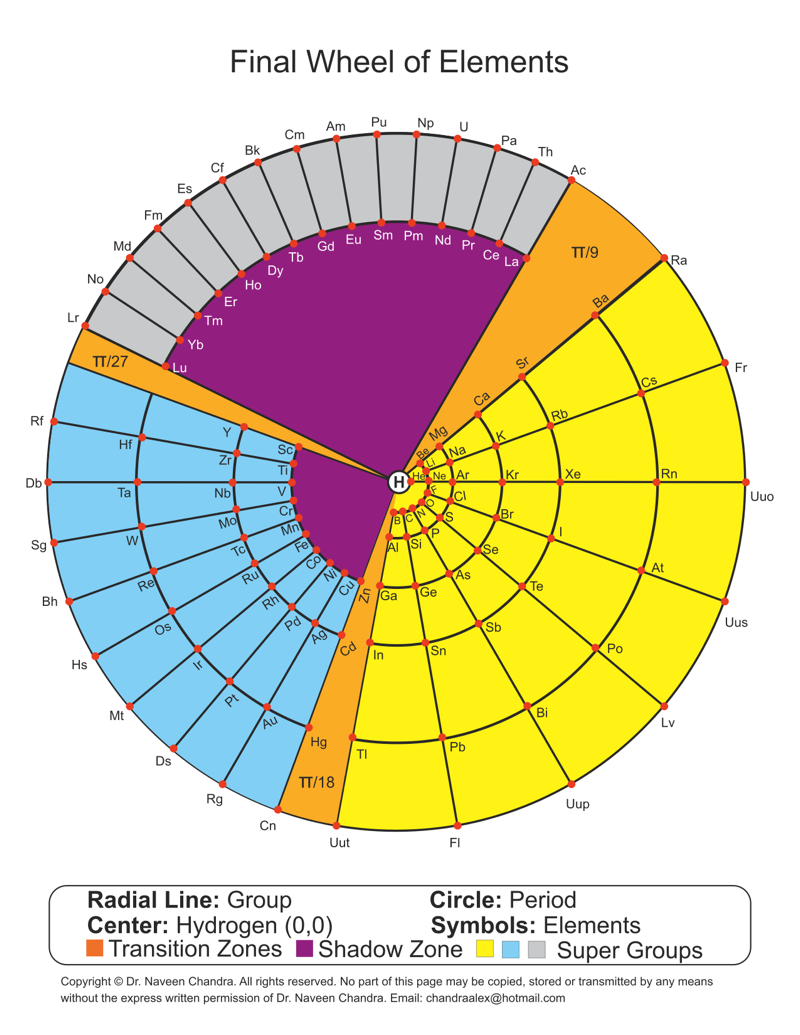
A new way of graphical representation of atoms is developed and presented here. Atoms are recognized as functions of two variables A(r,Θ), where r =2,10,18,36,54,86,118 (given arbitrarily r=1,2,3,4,5,6,7) represents period and Θ representing group, is actually the angle between the groups. A mathematical solution is obtained for Θ having three distinct values of (π /9) radians, (π/18) radians and (π/27) radians which define three super groups satisfying the equation 15(π/27) +10(π/18) +8 (π /9) =2π. 15 groups of two Atoms with a transition zone of (π/27) radians is nominally called Grey Super Group (GSG). 10 groups of which 9 have four Atoms and 1 has two Atoms, also including a transition zone of (π/18) radians, is nominally called Blue Super Group (BSG). 8 groups of which 7 have 6 Atoms and one has 7 Atoms, including a transition zone of (π/9) radians is called Yellow Super Group (YSG). The group with 7 atoms is the so called reference group of Atoms 2, 10, 18,36,54,86 and 118. The GSG has 30 Atoms, the BSG has 38 Atoms and the YSG has 49 Atoms. The Atom 1 is at the centre of the Hub and does not belong to any group or period and has coordinates of (0, 0). Atom 1 having no neutrons is unique.
|
|
|
| What is the Periodic Table Showing? | Periodicity |
© Mark R. Leach Ph.D. 1999 –
Queries, Suggestions, Bugs, Errors, Typos...
If you have any:
Queries
Comments
Suggestions
Suggestions for links
Bug, typo or grammatical error reports about this page,please contact Mark R. Leach, the author, using mark@meta-synthesis.com
This free, open access web book is an ongoing project and your input is appreciated.