Periodic Table |
 |
 |
 |
 |
 |
 |
 |
| What is the Periodic Table Showing? | Periodicity |
The INTERNET Database of Periodic Tables
There are thousands of periodic tables in web space, but this is the only comprehensive database of periodic tables & periodic system formulations. If you know of an interesting periodic table that is missing, please contact the database curator: Mark R. Leach Ph.D. The database holds information on periodic tables, the discovery of the elements, the elucidation of atomic weights and the discovery of atomic structure (and much, much more).
Periodic Tables from the year 1928 :
| Year: 1928 | PT id = 74, Type = formulation spiral |
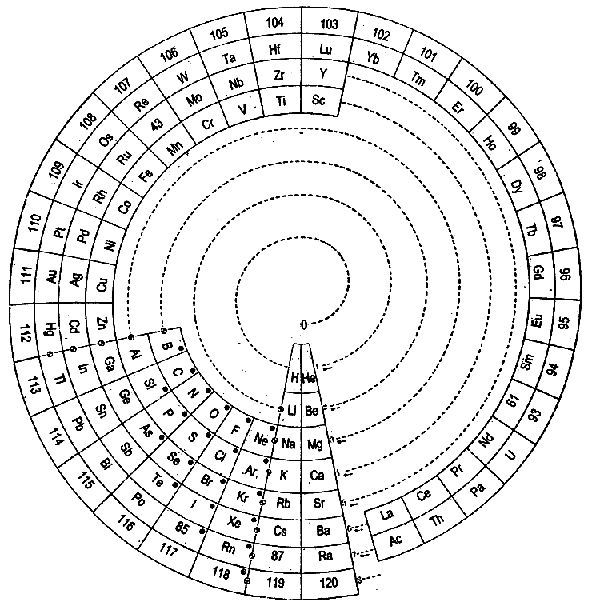
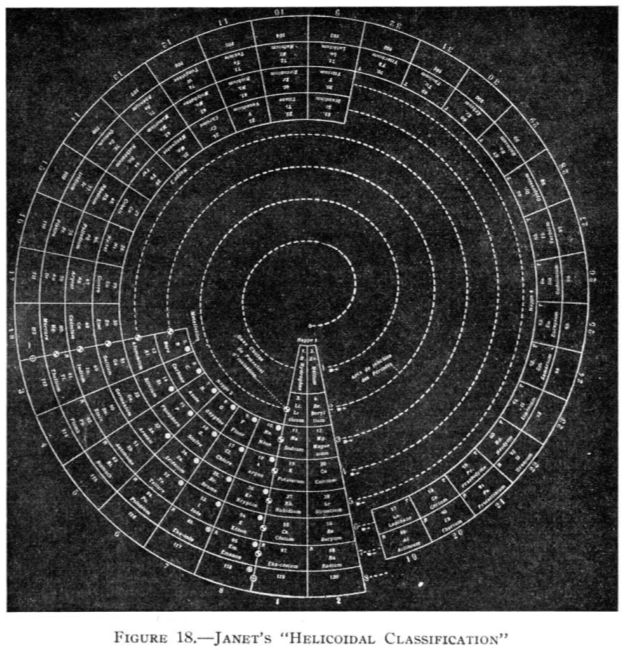
Janet's Helicoidal Classification
Janet's Helicoidal Classification, essentially his left-step formulation in its spiral version (ref. Charles Janet, La Classification Hélicoïdale des Éléments Chimiques. Beauvais: Imprimerie Départementale de l'Oise. 1928). Information supplied by Philip Stewart:
From Quam & Quam's 1934 review paper.pdf
| Year: 1928 | PT id = 152, Type = formulation |
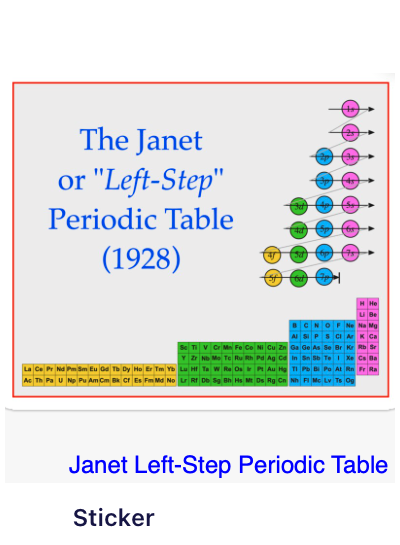
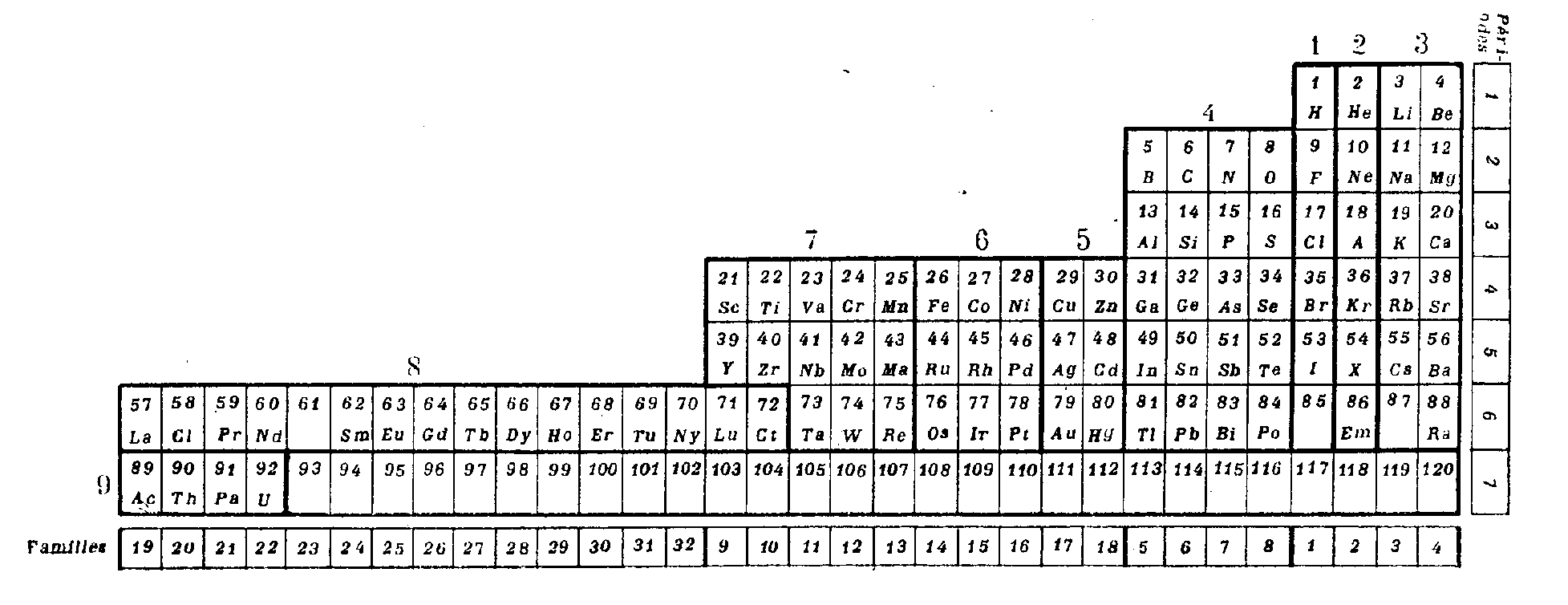
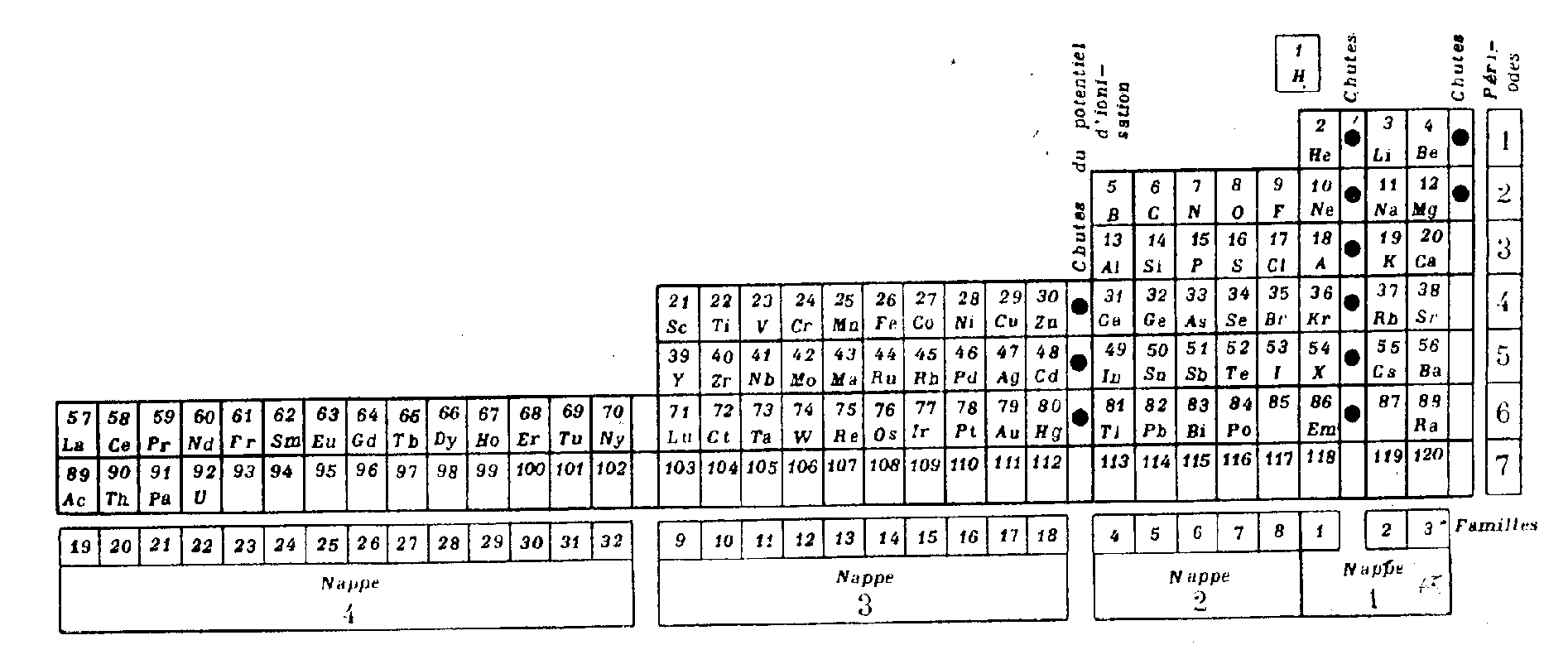
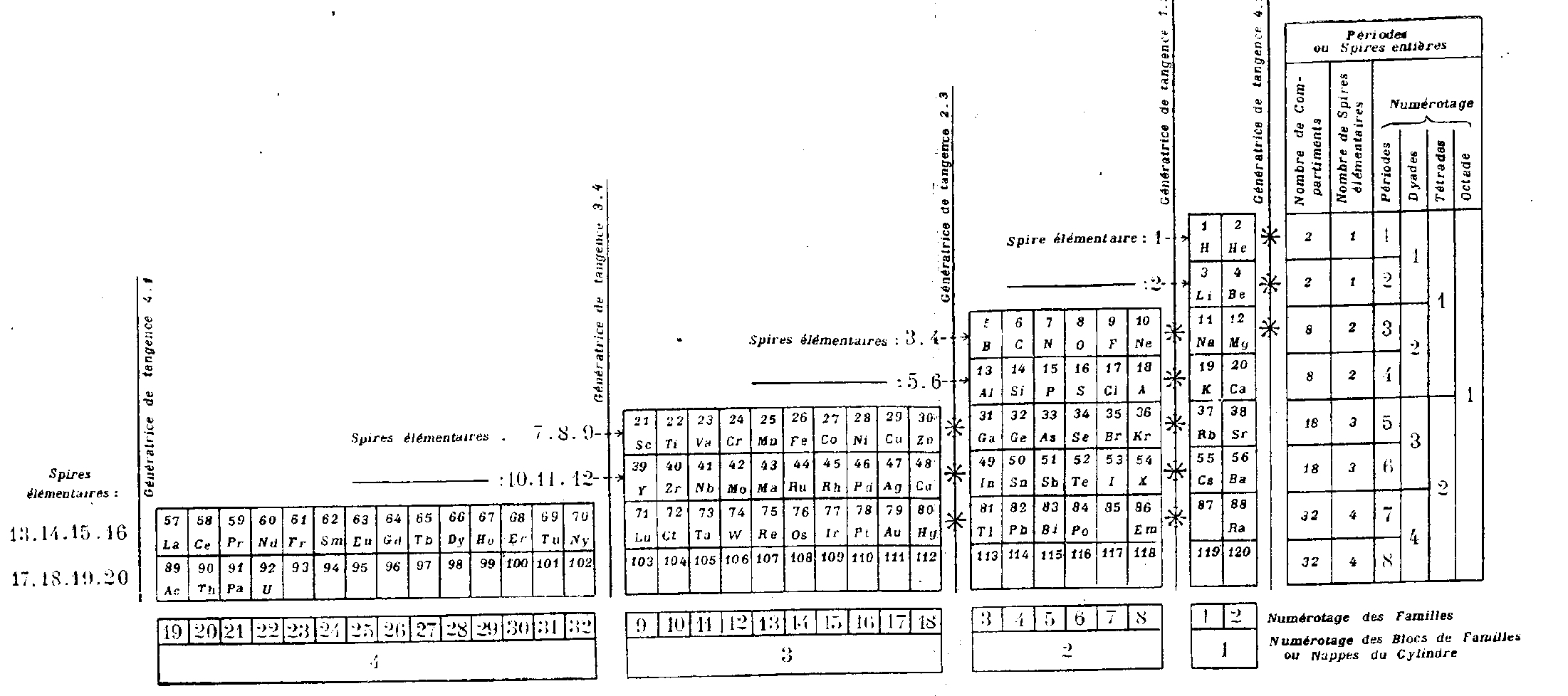
Janet's Left Step Periodic Table
There are the three versions of Janet's left step PT. He tried out versions I and II in his April 1928 paper, and rejected them in favour of version III in his paper of November of the same year. Each one was derived from a helix drawn on nested cylinders. Information supplied by Philip Stewart. Click each image for a larger image:
| Year: 1928 | PT id = 289, Type = formulation spiral 3D |
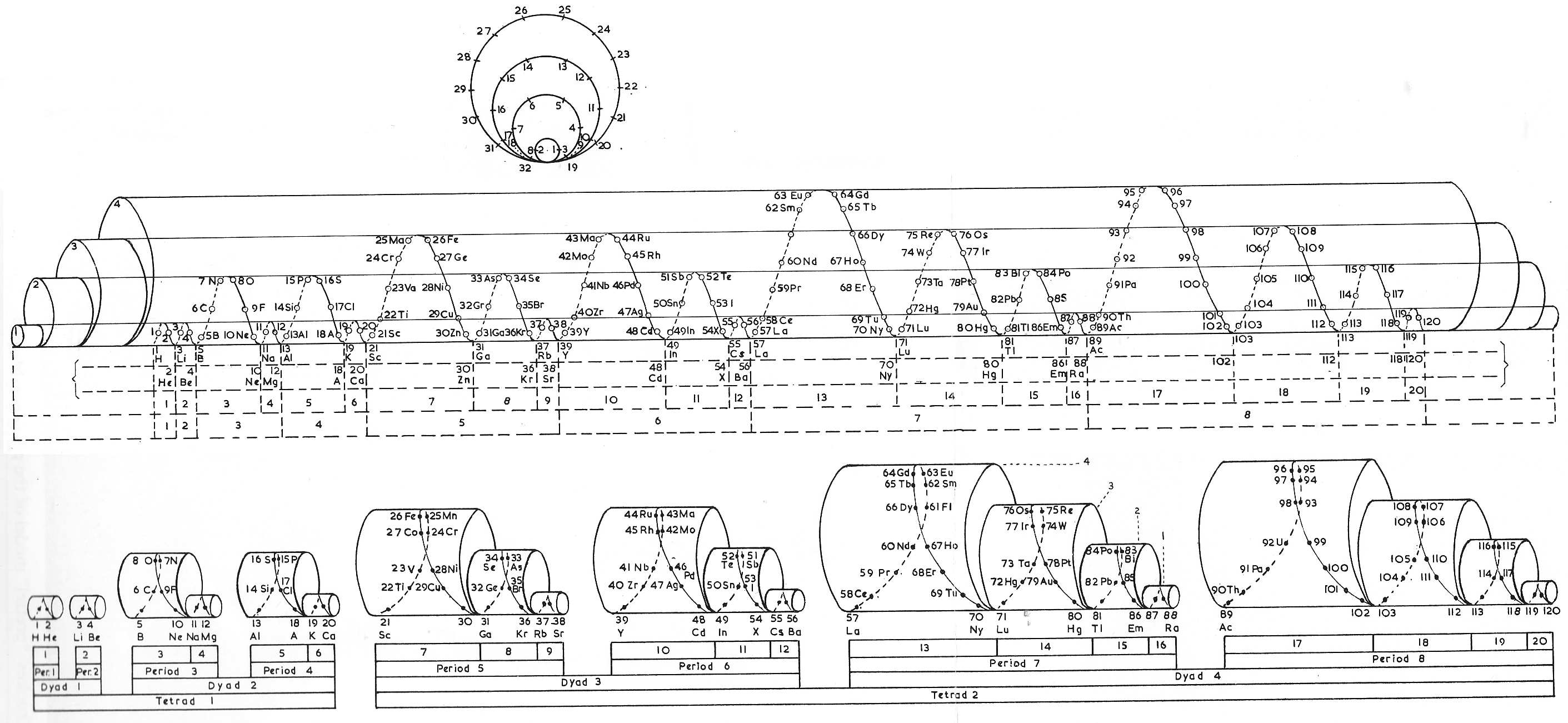
Janet's Three-Dimensional Spiral-Tube System
Janet's Three-Dimensional Spiral-Tube System of 1928 (from van Spronsen):
Click here for large diagram.
| Year: 1928 | PT id = 305, Type = formulation spiral |
Janet's "Lemniscate" Formulation
From in The Helicoidal Classification of the Elements, Chemical News vol. 138, 21 June 1929, Fig. XI, p. 392:
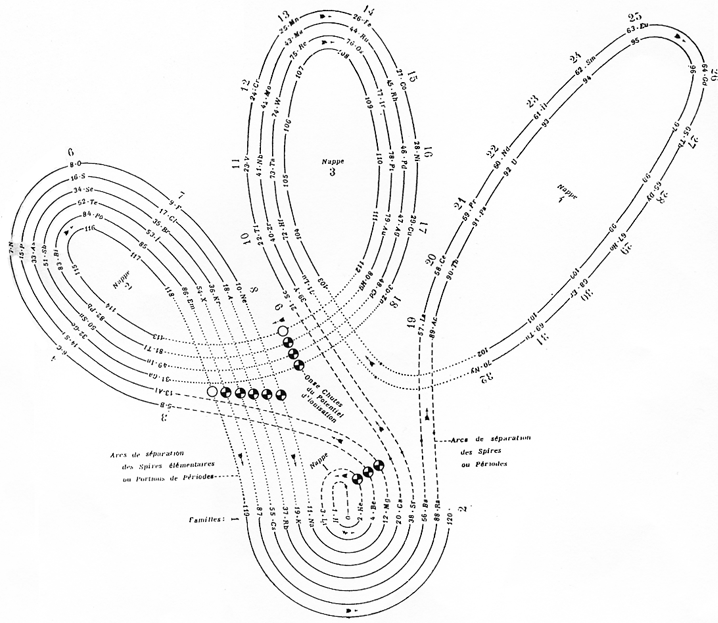
Philip Stewart points out that this formulation is an 'end on' view of the Janet Cylinder or Three-Dimensional Spiral-Tube System formulation, and the term "lemniscate" comes from Mazurs.
| Year: 1928 | PT id = 594, Type = formulation |
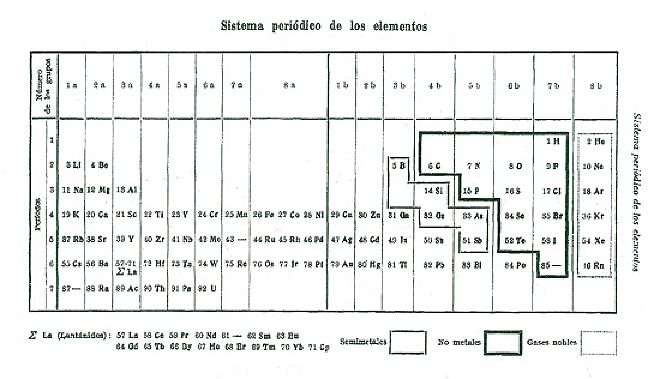
Riesenfeld Periodic Table
From here, using Google Translate:
This table is from the book "Practical Inorganic Chemistry" Publisher EH Riesenfeld Labor, Barcelona (1950). It is a reprint of the second edition (1943) which in turn is a translation of a German edition, its seventh edition in 1928. This suggests that Riesenfeld is himself the author of it.
It is a pre-Seaborg table in the sense that the actinides are known throughout the period July. It also does not include the Tc since it was discovered in 1937. These facts support the dating of the table. But the most interesting thing about it is that to make the separation between subgroups and major groups Be cut after the first period and after the Al in the second. Which leaves isolated in group B without any element 2b below it:
Thanks to Eric Scerri for the tip!
See the website EricScerri.com and Eric's Twitter Feed.
| Year: 1928 | PT id = 989, Type = formulation |
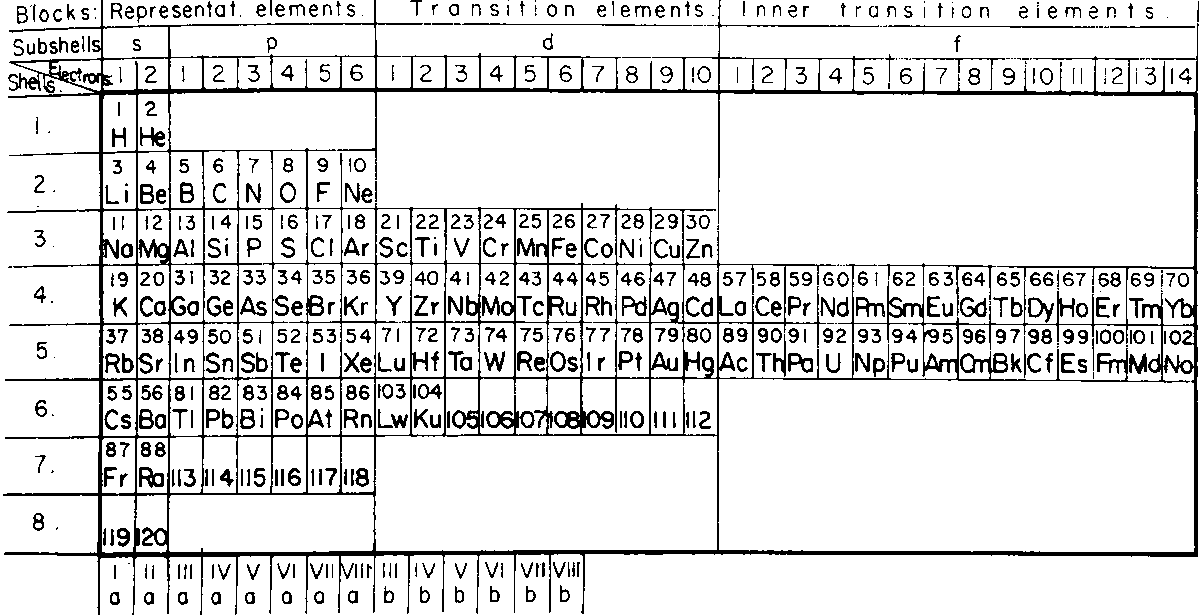
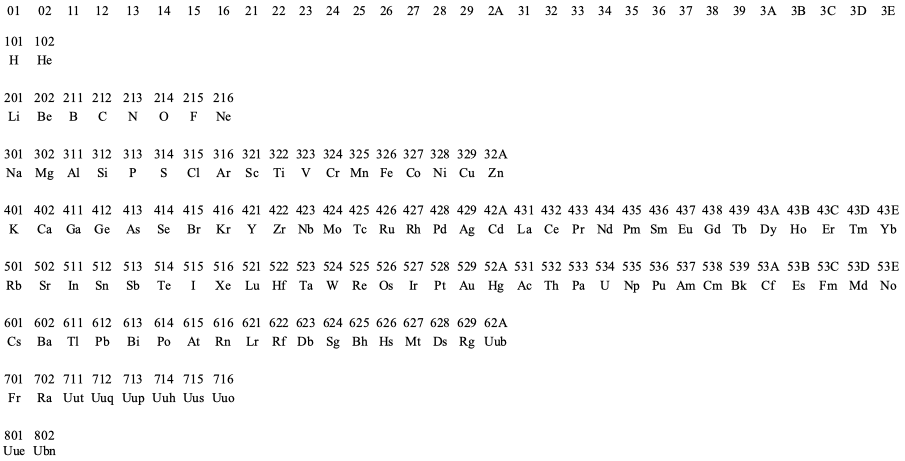
Corbino's Right-Step Periodic Table
Published in the same year as Janet's Left-Step formulation, Corbino OM (1928) Riv Nuovo Cimento 5:LXI (and from here) produced a Right-Step version.
Commenting on this formulation, Valery Tsimmerman writes:
"Corbino saw what Janet failed to see: If blocks shifted by corresponding value of quantum number l, then the rows represent electronic shells and Janet saw what Corbino fained to see, namely the Janet rule, also known as Madelung rule. Both used rectangular boxes, but neither noticed the perimeter rule."
Thanks to Valery T for the tip!
| Year: 1928 | PT id = 1378, Type = structure |
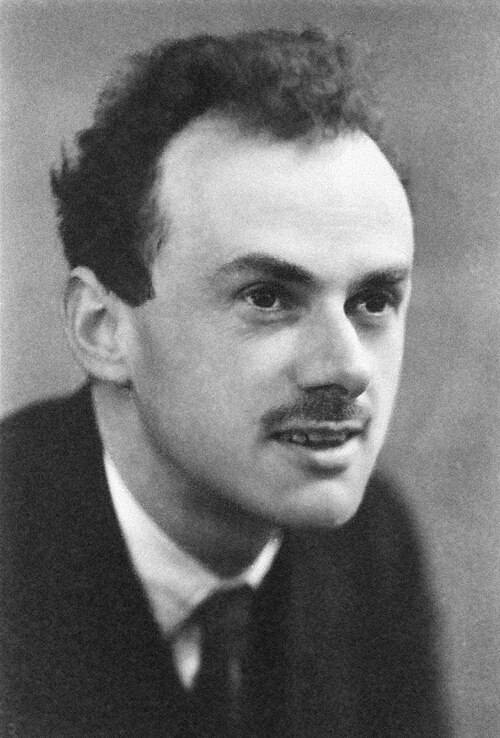
Dirac Equation
Dirac, P. A. M. (1928). "The Quantum Theory of the Electron". Proceedings of the Royal Society A: Mathematical, Physical and Engineering Sciences. 117 (778): 610–624. PDF of paper.
"The Dirac equation is a relativistic wave equation derived by British physicist Paul Dirac in 1928. In its free form, or including electromagnetic interactions, it describes all spin-?1/2? massive particles, called Dirac particles, such as electrons and quarks for which parity is a symmetry. It is consistent with both the principles of quantum mechanics and the theory of special relativity and was the first theory to fully account for special relativity in the context of quantum mechanics. The equation is validated by its rigorous accounting of the observed fine structure of the hydrogen spectrum and has become vital in the building of the Standard Model pf particle physics.
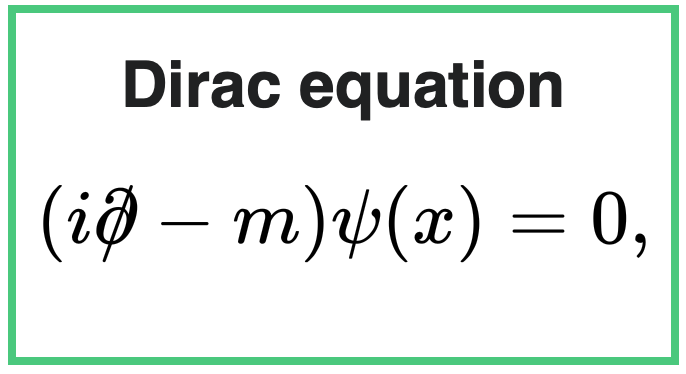
"The equation also implied the existence of a new form of matter, antimatter, previously unsuspected and unobserved. The existence of antimatter was experimentally confirmed several years later. It also provided a theoretical justification for the introduction of several component wave functions in Pauli's phenomenological theory of spin. The wave functions in the Dirac theory are vectors of four complex numbers (known as bispinors), two of which resemble the Pauli wavefunction in the non-relativistic limit, in contrast to the Schrödinger equation, which described wave functions of only one complex value."
If you require deeper dive into quantum spin and the Dirac equation, these two linked videos by Physics Explained will be of interest. The videos discuss the history and the mathematics of the equation. The videos show that the Dirac formulation of the relativistic electron inevitably has four answers or solutions which correspond to the:
- Spin-up electron
- Spin-down electron
- Spin-up positron (anti-electron)
- Spin-down positron
- The result also shows that the spin must be +1/2 or –1/2.
| Year: 1928 | PT id = 1390, Type = formulation spiral |
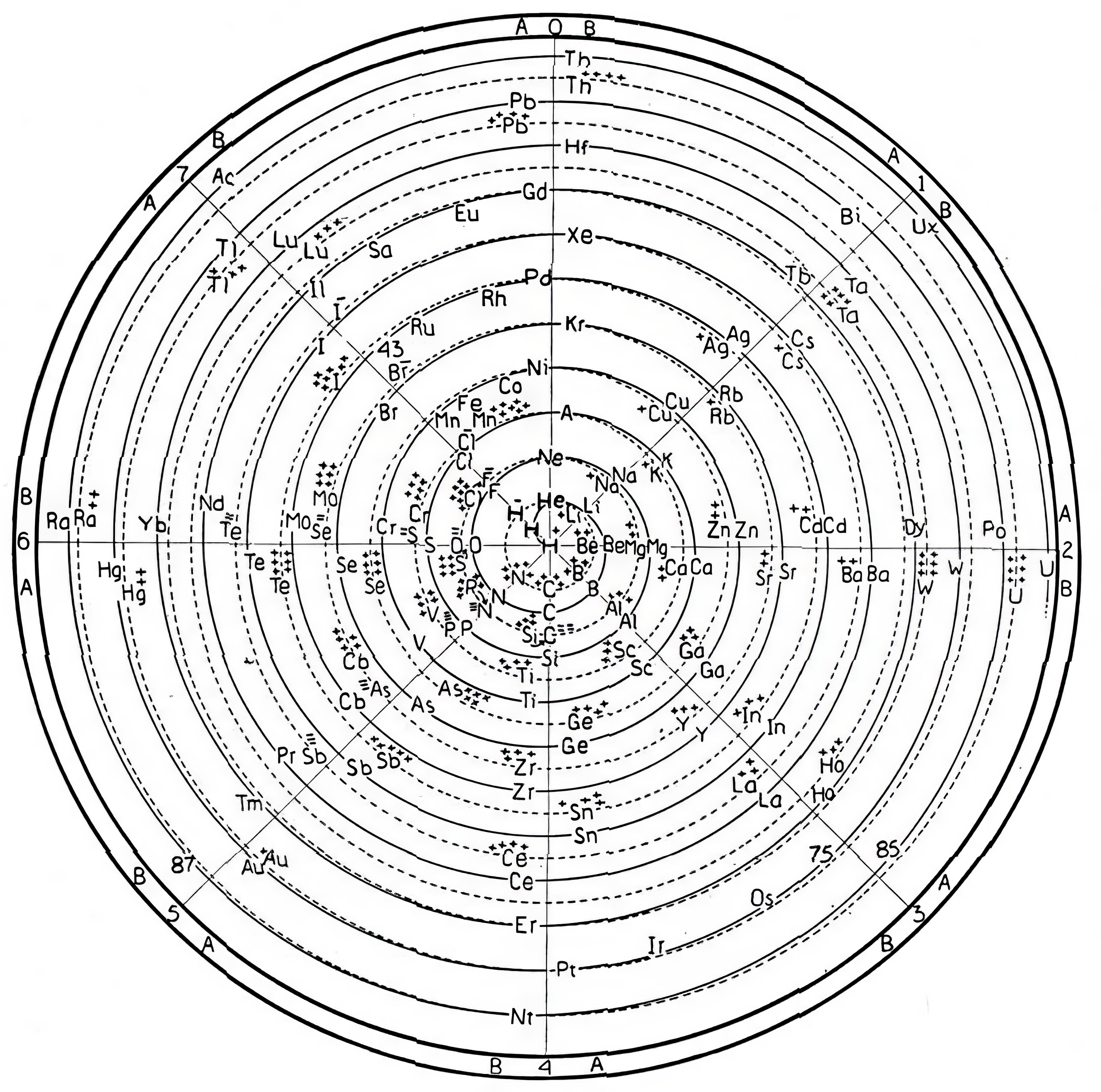
Another Attempt to Base a Classification of The Elements on Atomic Structure
Simpson, O.J., Another Attempt to Base a Classification of The Elements on Atomic Structure, J. Chem. Educ. 1928, 5, 1, 57 doi.org/10.1021/ed005p57:
|
|
|
| What is the Periodic Table Showing? | Periodicity |
© Mark R. Leach Ph.D. 1999 –
Queries, Suggestions, Bugs, Errors, Typos...
If you have any:
Queries
Comments
Suggestions
Suggestions for links
Bug, typo or grammatical error reports about this page,please contact Mark R. Leach, the author, using mark@meta-synthesis.com
This free, open access web book is an ongoing project and your input is appreciated.