Periodic Table |
 |
 |
 |
 |
 |
 |
 |
| What is the Periodic Table Showing? | Periodicity |
The INTERNET Database of Periodic Tables
There are thousands of periodic tables in web space, but this is the only comprehensive database of periodic tables & periodic system formulations. If you know of an interesting periodic table that is missing, please contact the database curator: Mark R. Leach Ph.D. The database holds information on periodic tables, the discovery of the elements, the elucidation of atomic weights and the discovery of atomic structure (and much, much more).
Periodic Tables from the year 2003 :
| Year: 2003 | PT id = 22, Type = formulation spiral |
Philip Stewart's Chemical Galaxy II
Philip Stewart's Chemical Galaxy II periodic table formulation, from here:
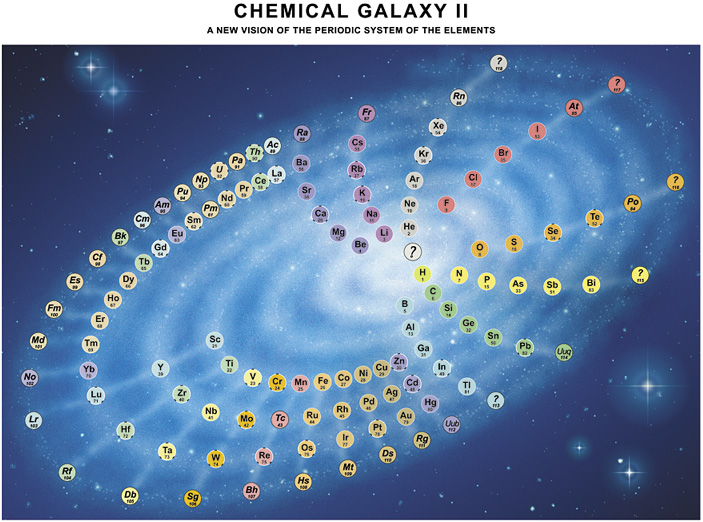
Click here for a larger version.
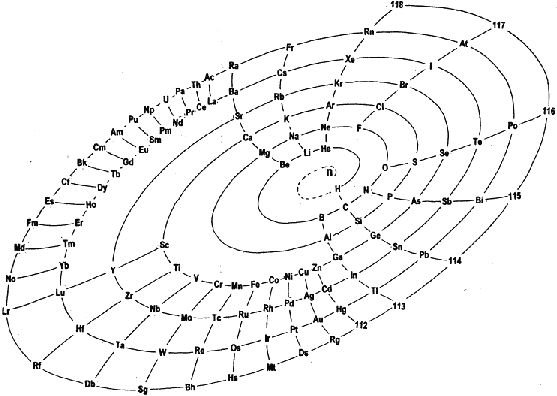
A simplified 'chemical galaxy':
| Year: 2003 | PT id = 44, Type = formulation 3D |
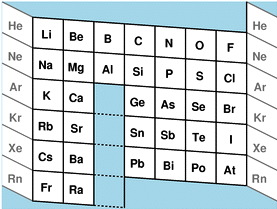
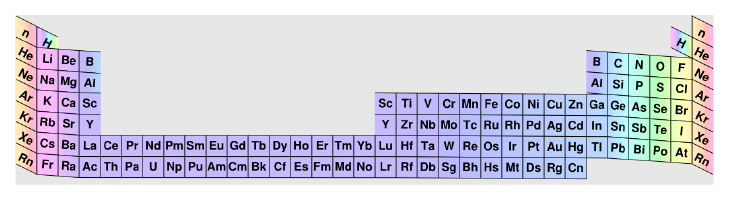
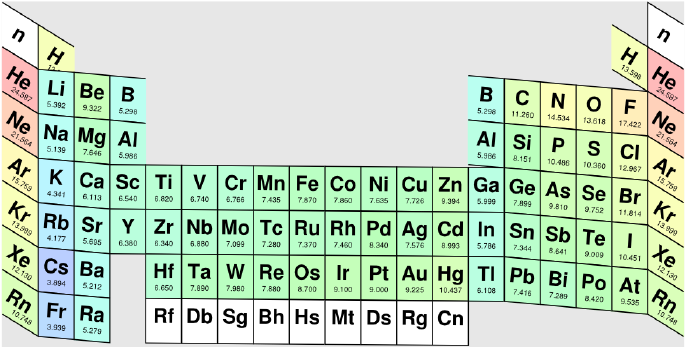
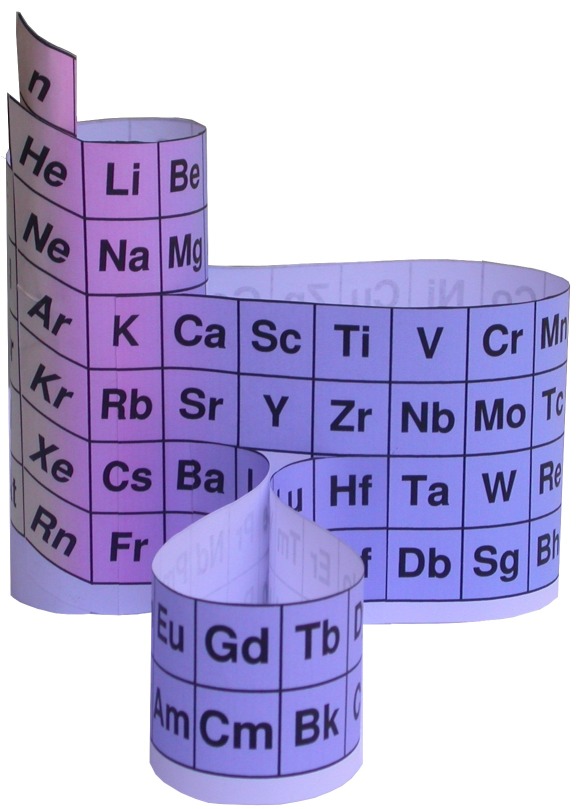
Denker's Cylinder With Bulges
John Denker fully discusses the logic behind a three dimensional periodic table that he describes as a "cylinder with bulges", here:
| Year: 2003 | PT id = 54, Type = formulation 3D misc |
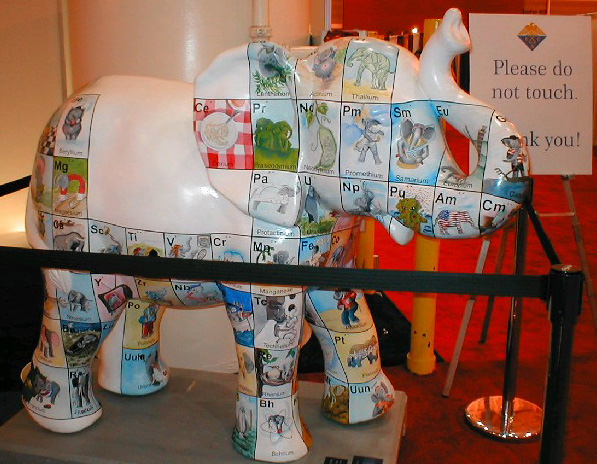
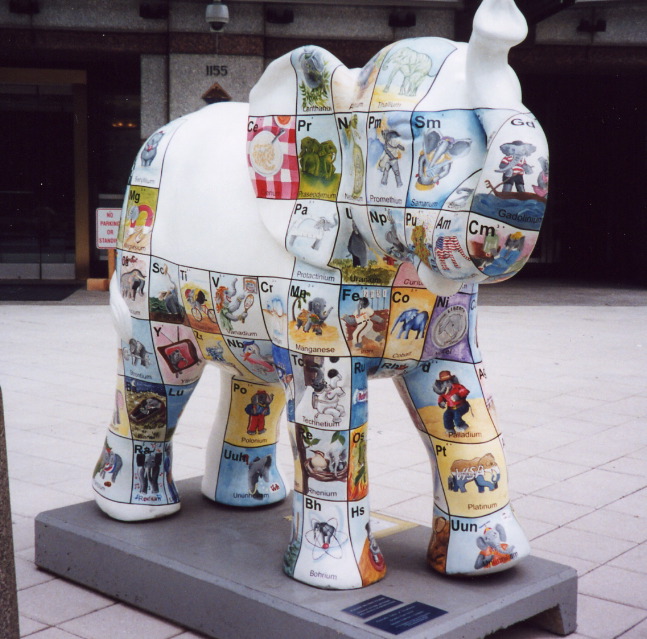
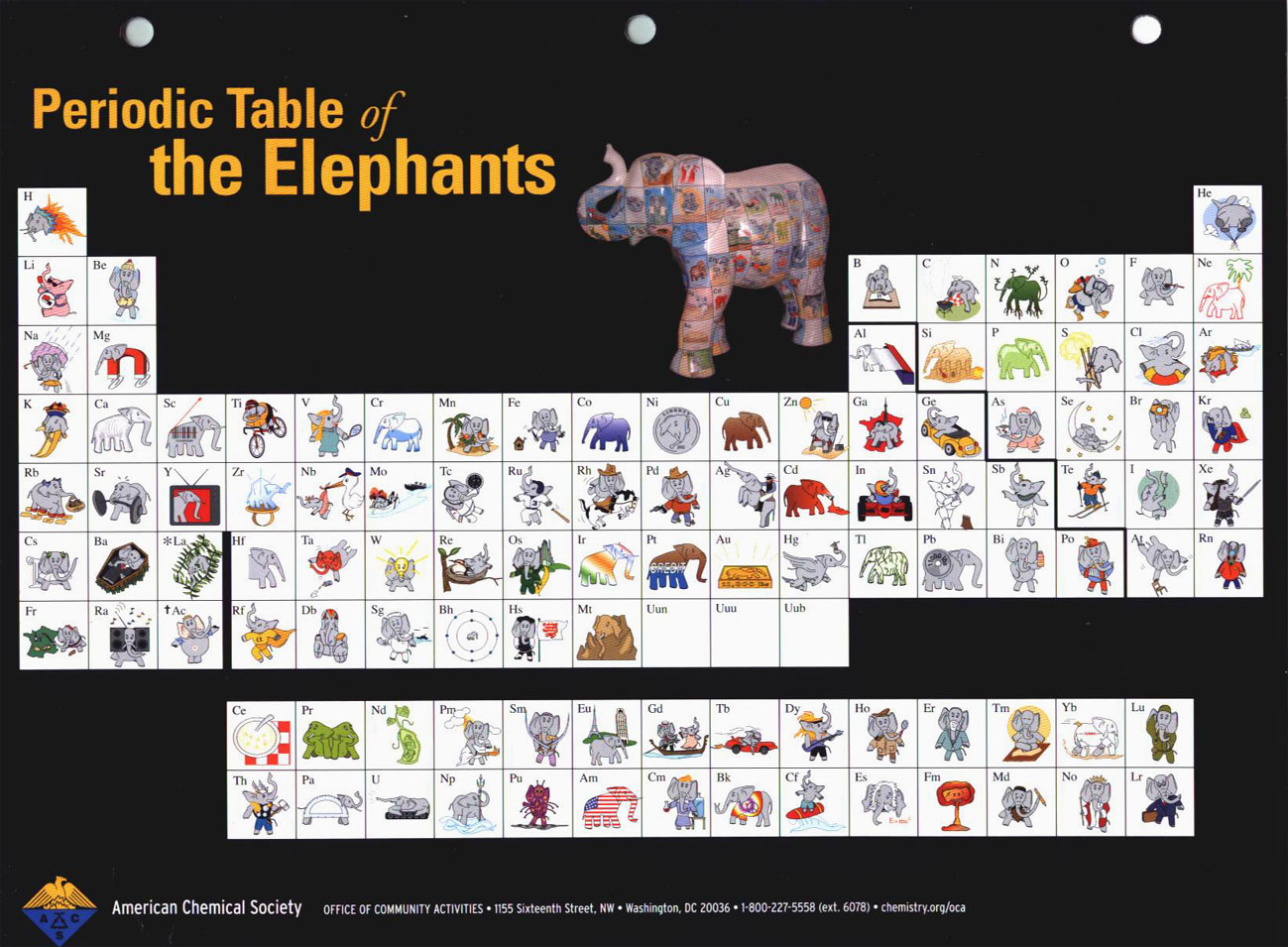
Elephant Periodic Table
The periodic table does not map to an elephant very well:
Click on the poster below to go to a large version:
| Year: 2003 | PT id = 92, Type = non-chem |
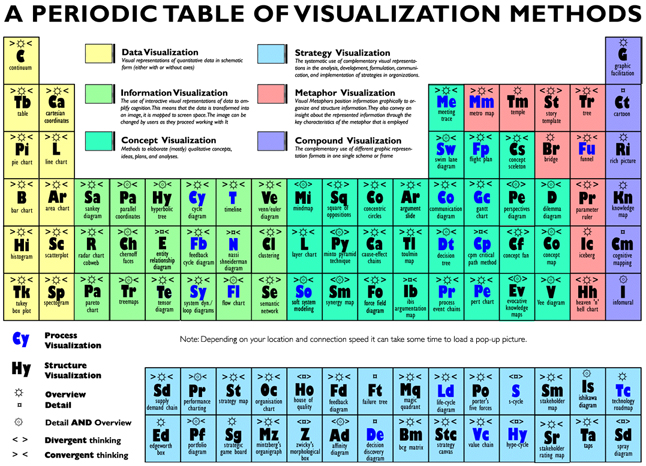
Visualization Methods
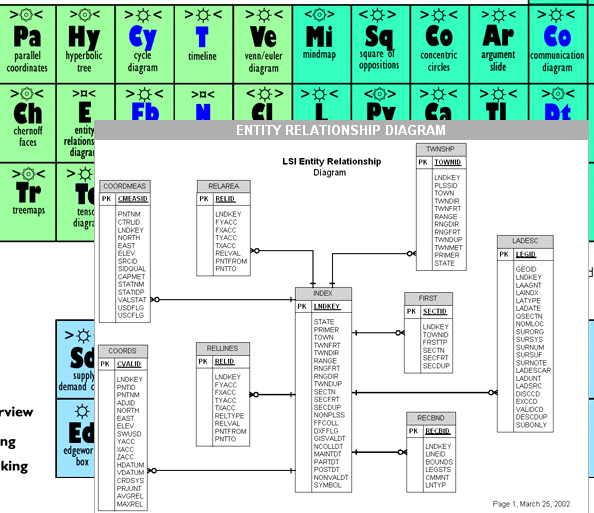
Many visualisation methods and techniques used in science, business and technology, from pie charts to entity relationship diagrams. A large selection of these have been very neatly collected together using the periodic table as an organising metaphor. Recommended:
| Year: 2003 | PT id = 95, Type = non-chem |
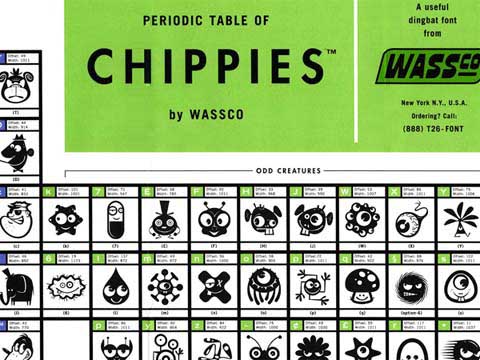
Font
A dingbat font by Scott Stowell and Chip Wass:
| Year: 2003 | PT id = 121, Type = data |
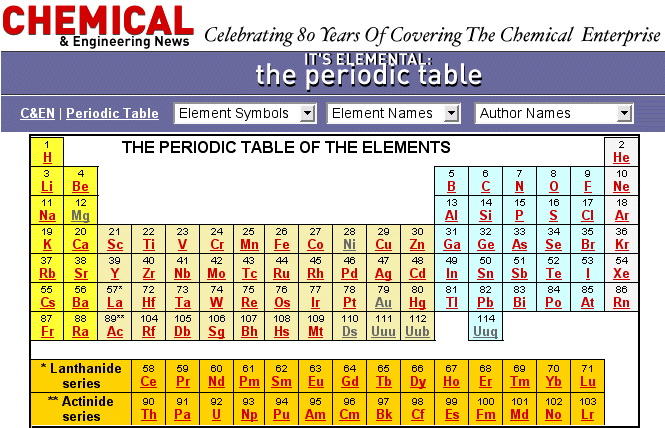
Chemical & Engineering News Periodic Table
A periodic table from C&EN with links to fascinating stories about the chemical elements:
| Year: 2003 | PT id = 123, Type = data |
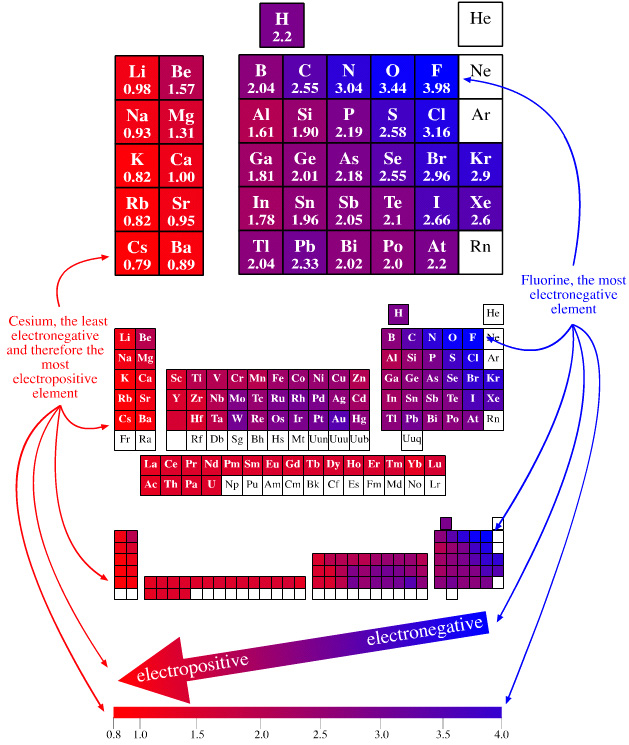
Electronegativity Periodic Table
A periodic table showing electronegativity, "The ability of an atom to attract electron density from a covalent bond" (Linus Pauling). Blue elements are electronegative, red elements are electropositive, and purple elements are intermediate. Notice how hydrogen is intermediate in electronegativity between carbon and boron and is positioned above and between these elements:
By Mark Leach
| Year: 2003 | PT id = 142, Type = data |
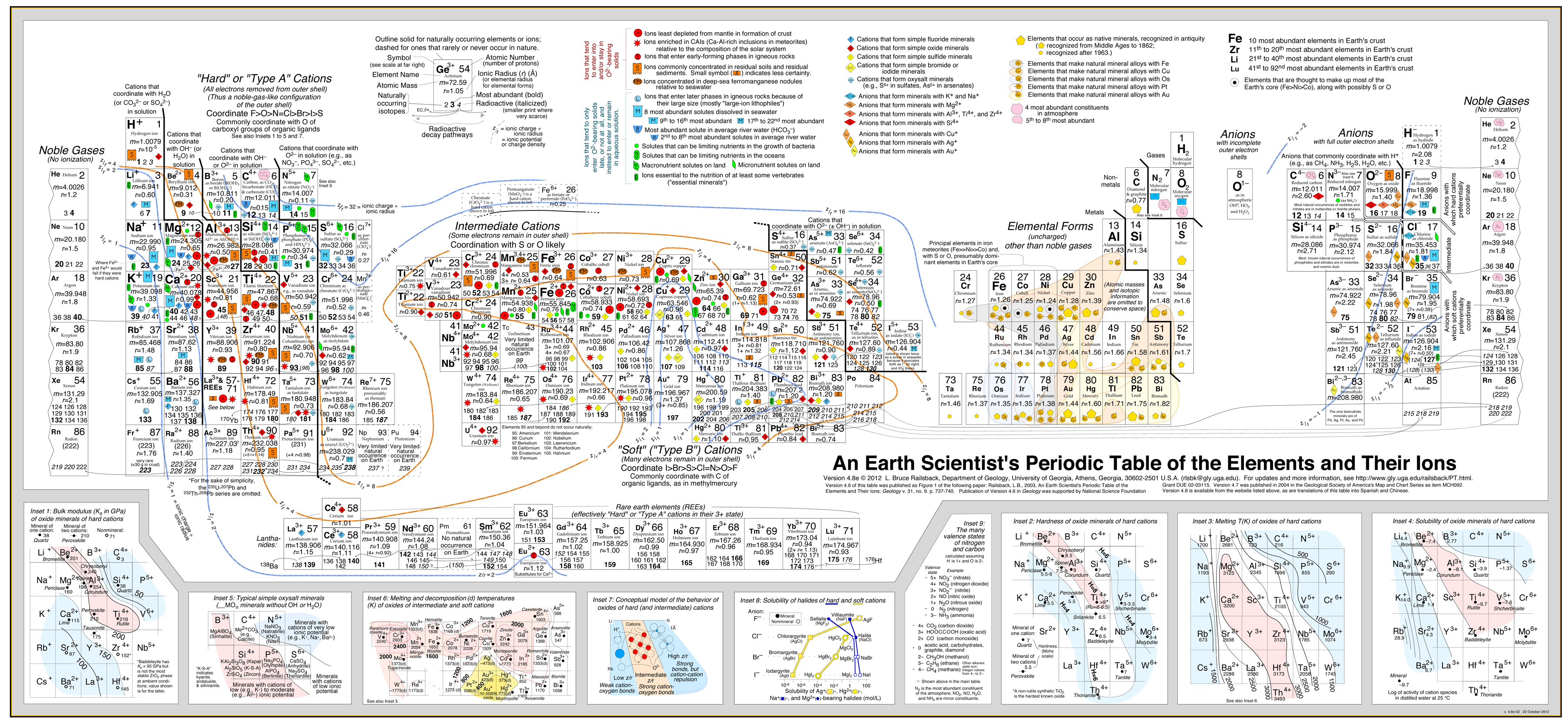
Earth Scientist's Periodic Table of The Elements and Their Ions
by Bruce Railsback.
Click to enlargeThe Earth Scientist's Periodic Table of the Elements and Their Ions is a new periodic table designed to contextualize trends in geochemistry, mineralogy, aqueous chemistry, and other natural sciences. It is fundamentally different from the conventional periodic table in organizing entities by charge and consequently in showing many elements multiple times because of the multiple charges or valence states taken by those elements. These differences make the new table much more effective in showing trends and patterns in geochemistry, mineralogy, aqueous chemistry, and other natural sciences.
Version 4.6 of this table was published in September 2003 as an article in the Geological Society of America's journal Geology and subsequently featured in several news outlets. Version 4.7 was published in May 2004 in the Geological Society of America's Map and Chart Series. Version 4.8 was released in May 2007.
| Year: 2003 | PT id = 198, Type = non-chem |
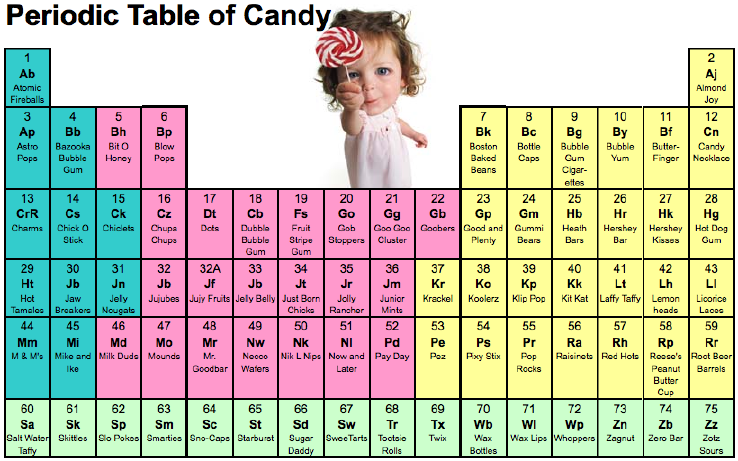
Candy
A periodic table of Candy, "An invaluable scientific tool brought to you by drchinese" :
| Year: 2003 | PT id = 228, Type = formulation misc |
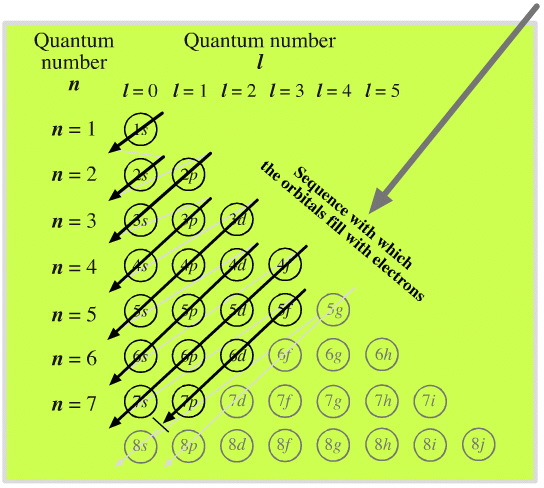
Elements by Orbital
From elsewhere in Mark Leach's Chemogenesis webbook:
Madelung's Rule tells us that the orbitals fill in the order n + l (lowest first). This gives the sequence:
Electronic structure can be illustrated adding electrons to boxes (to represent orbitals). This representation shows the Pauli exclusion principle, the aufbau principle and Hund's rule in action.
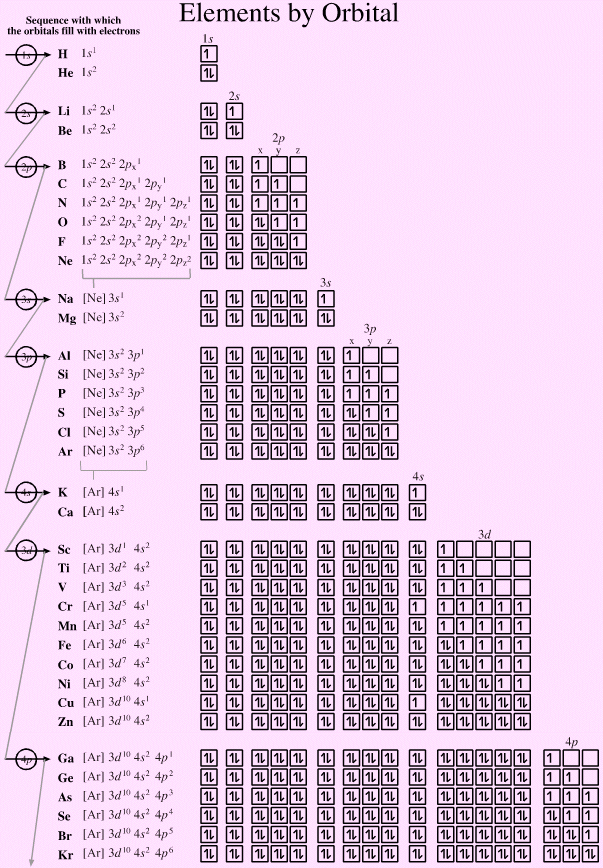
There are some subtle effects with the d block elements chromium, Cr, and copper, Cu. Hund's rule of maximum multiplicity lowers the energy of the 3d orbital below that of the the 4s orbital, due to the stabilisation achieved with a complete and spherically symmetric set of five 3d orbitals containing five or ten electrons. Thus,
- Chromium has the formulation: [Ar] 3d5 4s1 and not: [Ar] 3d4 4s2
- Copper has the formulation: [Ar] 3d10 4s1 and not: [Ar] 3d9 4s2
| Year: 2003 | PT id = 255, Type = non-chem |
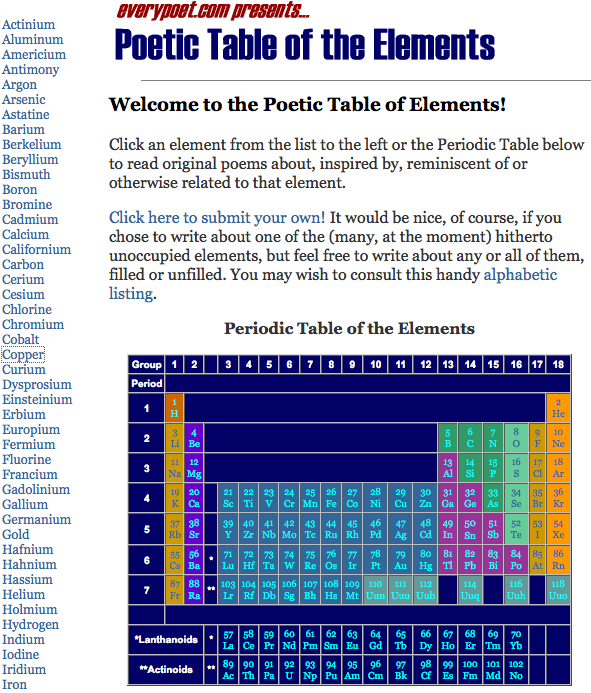
Poetic Table of The Elements
| Year: 2003 | PT id = 311, Type = formulation 3D |
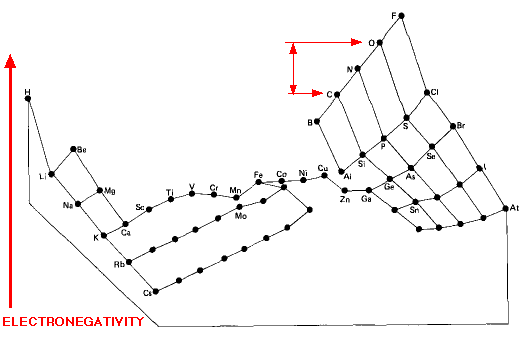
Electronegativity Periodic Table
"This image distorts the conventional periodic table of the elements so that the greater the electronegativity of an atom, the higher its position in the table", here:
| Year: 2003 | PT id = 343, Type = formulation |
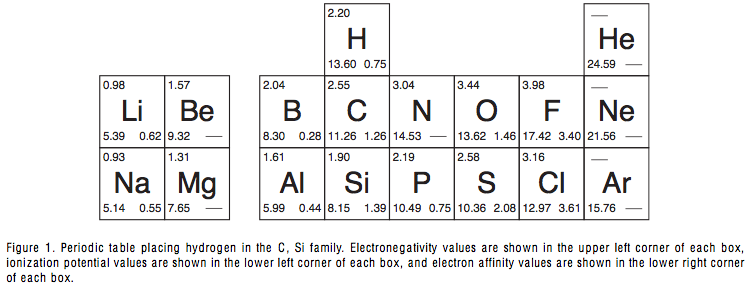
Proper Place for Hydrogen in the Periodic Table
The Proper Place for Hydrogen in the Periodic Table, a paper by Marshall W. Cronyn of the Department of Chemistry, Reed College, Portlland.
Cronin writes in the Journal of Chemical Education Vol. 80, 94 -951: "After more than 130 years of construction, the place of hydrogen in the periodic table is still the subject of doubt, con- fusion, and inadequate explanation that appears to be little more than numerology..." and comes to the conclusion that hydrogen should be positioned above carbon:
| Year: 2003 | PT id = 378, Type = formulation 3D |
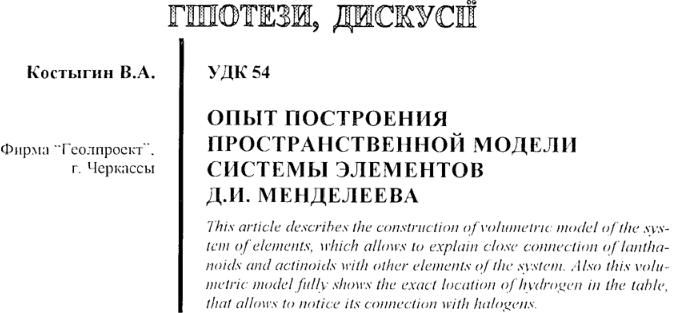
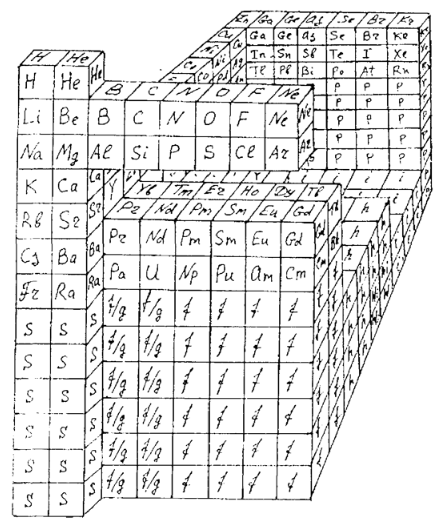
Ukrainian Periodic Table
A Periodic Table from the Ukraine:

| Year: 2003 | PT id = 496, Type = formulation spiral 3D |
Bernard's Periodic Table of The Elements in Three Dimensional Form
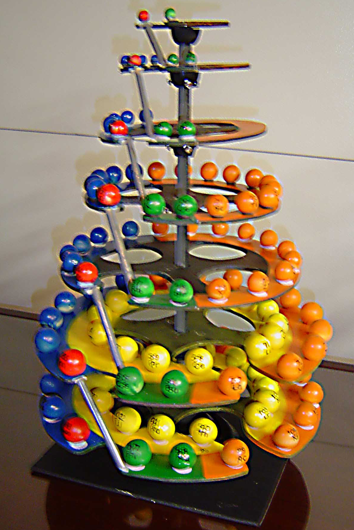
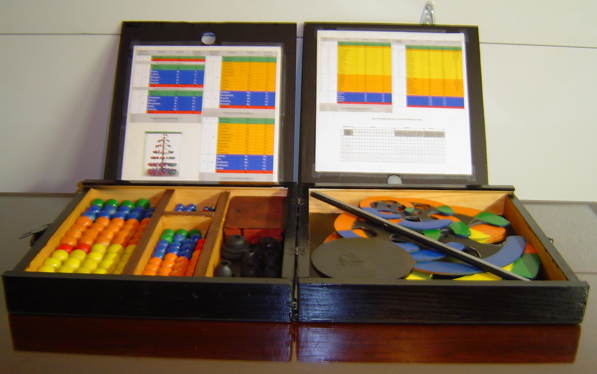
Hinsdale Bernard's Periodic Table of The Elements in Three Dimensional Form, US Patent 7,297,000:

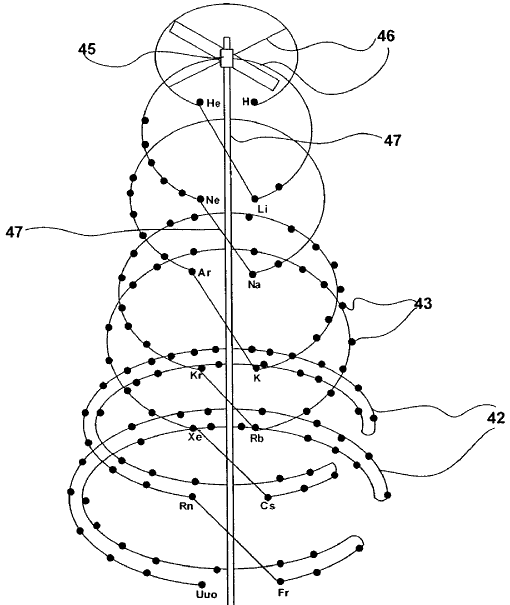
Roy Alexender, of the Desk Topper arrangement, has photoshopped a blurry photograph sent by Bernard along with a product mockup:
| Year: 2003 | PT id = 573, Type = formulation spiral |
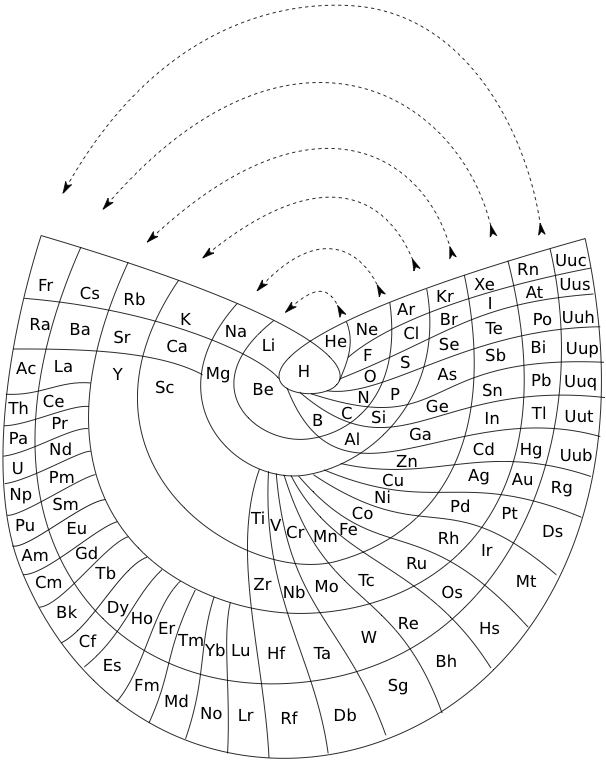
Bird of Prey Periodic Table
From Edmond (Ned) Maurice Peyroux:
"I am a self-taught, underground cartoonist - around the end of 2005 I began studying ether physics, & mid 2006 orgone biophysics. End of 2008 I was going through old note & sketch books while compiling pieces for a poetry book, & came across a sketch I did in 2003 of the first 20 elements of the periodic table in a spiral. I had just begun studying the ether vortex model of the atom & thought a vortex model of the periodicity might be a fun experiment so I played with it more. I didn't remember what inspired the original concept sketch 5 years later, but my guess was I had stayed up too late watching public television again. It probably had to do with some 4-Dimension ring concepts I was playing with, but by 2008 I was thoroughly involved in 3-D biophysics & wasn't thinking back to earlier thought experiments I had done."
"The compositions are largely artistic, naturalistic, & most are like steps on a story board, showing transformation of the table, distorting from from rectangular to spiral, then splitting between metals & noble gases like the wings of a bird, flapping, then joining again to make the spiral (then the spiral inflates to make a flower, wilts into a spider's web) - there are many transitions I have in mind, but I my work is not limited to the periodic table.":
| Year: 2003 | PT id = 600, Type = formulation spiral |
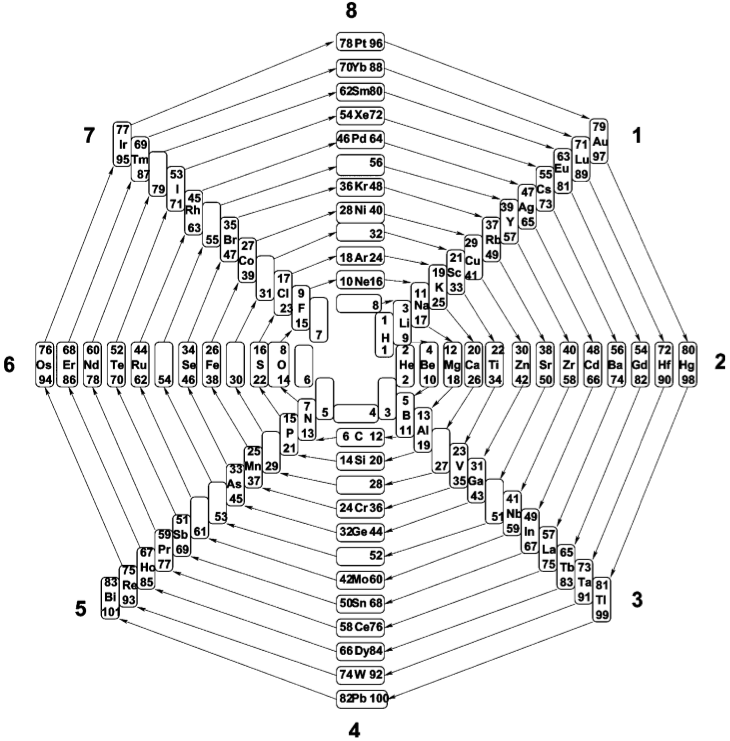
Eight-Group Periodic Table
From Number Patterns in Nature by Jan C.A. Boeyens, Crystal Engineering 6 (2003) 167–185.
The Eight-Group Periodic Table of the 81 stable elements, in spiral form. Available sites on the prime-number cross, starting from zero, number 102.,
| Year: 2003 | PT id = 893, Type = element |
Discovery of Nihonium
Nh 
Nihonium, atomic number 113, has a mass of 284 au.
Synthetic radioactive element.
Nihonium was first observed in 2003 by Y. Oganessian et al. and K. Morita et al.
| Year: 2003 | PT id = 895, Type = element |
Discovery of Moscovium
Mc
Moscovium, atomic number 115, has a mass of 288 au.
Synthetic radioactive element.
Moscovium was first observed in 2003 by Y. Oganessian et al.
| Year: 2003 | PT id = 1082, Type = formulation 3D |
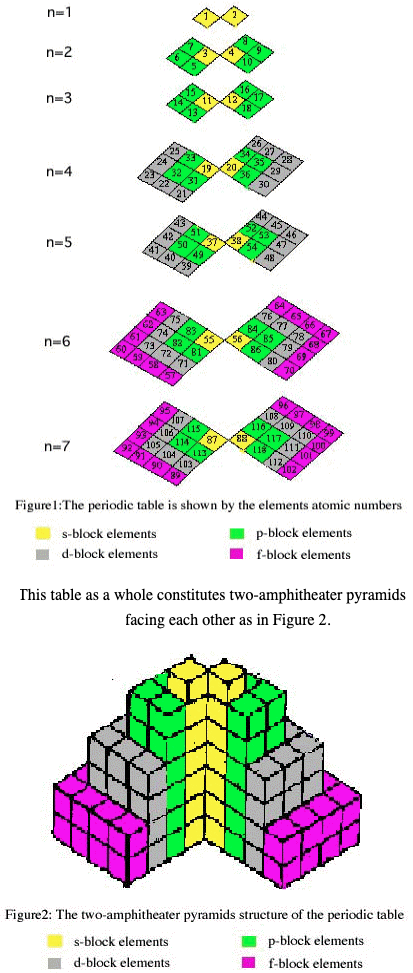
Two-Amphitheater Pyramid Periodic Table
From Chemical Education Journal (CEJ), Vol. 7, No. 2
A Novel Way of Visualization of the Periodic Table of the Elements by Alaa El-Deen Ali Mohamed, Alexandria University, Egypt.
The author writes:
"New form of the periodic table of the elements is given in this paper. This form can be seen as two amphitheater pyramids facing each other. The cubes that meet are s-elements (interior) then the p-elements then d-elements and the f-elements at last (exterior). The table can be represented by X-, Y- and Z-axes, where the Z-axis gives the number of the period that the element occupies. The table can be modeled by colored cubes helping in introducing the periodic table to the pupils early in the primary education."
Thanks to René for the tip!
| Year: 2003 | PT id = 1150, Type = formulation data |
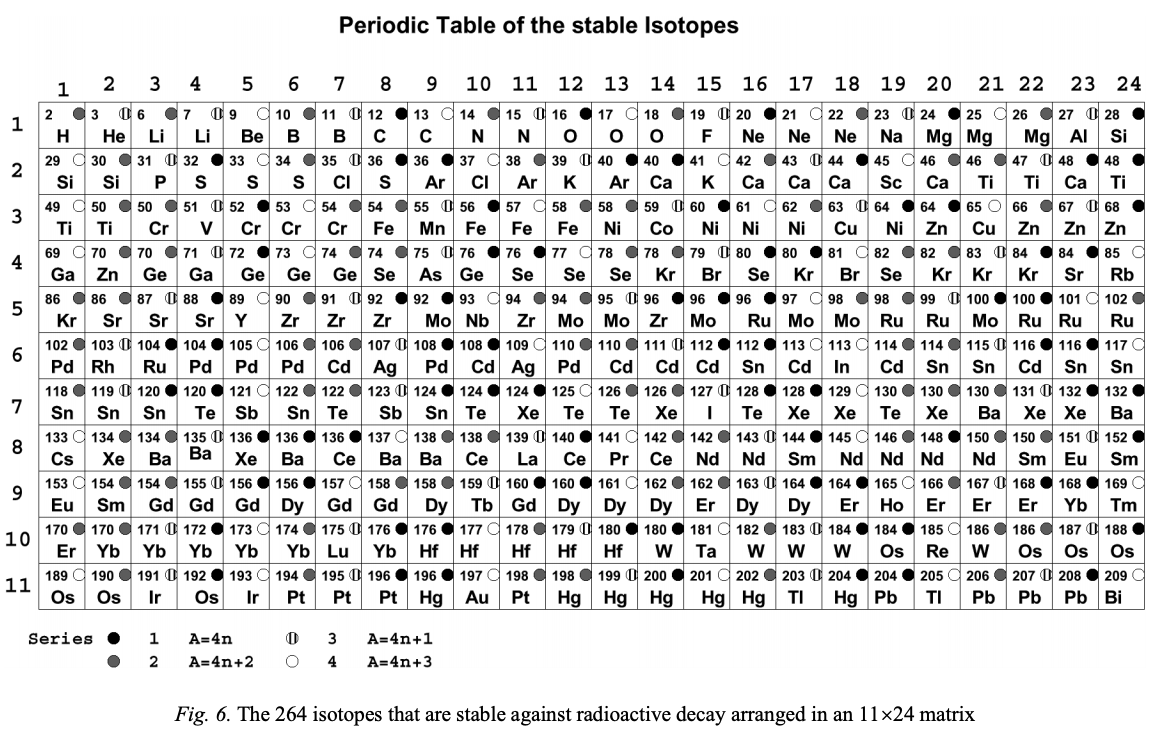
Stable Isotopes, Periodic Table of
From Boeyens, JCA 2003, J. Radioanal. Nucl. Chem., 257, 33 a periodic table of the 264 stable isotopes arranged as an 11 x 24 matrix.
Click the image to enlarge:
Thanks to René for the tip!
|
|
|
| What is the Periodic Table Showing? | Periodicity |
© Mark R. Leach Ph.D. 1999 –
Queries, Suggestions, Bugs, Errors, Typos...
If you have any:
Queries
Comments
Suggestions
Suggestions for links
Bug, typo or grammatical error reports about this page,please contact Mark R. Leach, the author, using mark@meta-synthesis.com
This free, open access web book is an ongoing project and your input is appreciated.