Periodic Table |
 |
 |
 |
 |
 |
 |
 |
| What is the Periodic Table Showing? | Periodicity |
The INTERNET Database of Periodic Tables
There are thousands of periodic tables in web space, but this is the only comprehensive database of periodic tables & periodic system formulations. If you know of an interesting periodic table that is missing, please contact the database curator: Mark R. Leach Ph.D. The database holds information on periodic tables, the discovery of the elements, the elucidation of atomic weights and the discovery of atomic structure (and much, much more).
Periodic Tables from the year 1803 :
| 1803 | Dalton's Postulates About The Elements |
| 1803 | Palladium, Discovery of |
| 1803 | Cerium, Discovery of |
| 1803 | Osmium, Discovery of |
| 1803 | Iridium, Discovery of |
| Year: 1803 | PT id = 4, Type = formulation element weight structure |
Dalton's Postulates About The Elements
Around the year 1803 in Manchester, John Dalton gave a series of lectures in which he presented his postulates:
- Elements are made of tiny particles called atoms.
- The atoms of a given element are different from those of any other element, and the atoms of different elements can be distinguished from one another by their respective relative atomic weigh/mass.
- All atoms of a given element are identical.
- Atoms of one element can combine with atoms of other elements to form chemical compounds, and a given compound always has the same relative numbers of types of atoms.
- Atoms cannot be created, divided into smaller particles, nor destroyed in the chemical process, and a chemical reaction simply changes the way atoms are grouped together.
From a very early notebook from around this time:
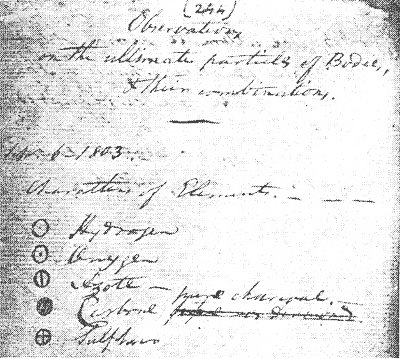
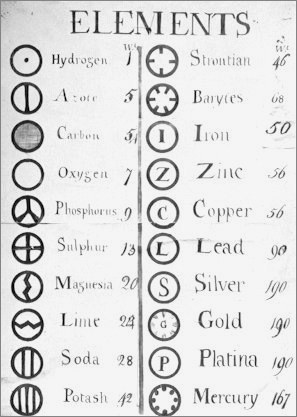
| Year: 1803 | PT id = 826, Type = element |
Discovery of Palladium
Pd
Palladium, atomic number 46, has a mass of 106.42 au.
Palladium was first isolated in 1803 by H. Wollaston.
| Year: 1803 | PT id = 838, Type = element |
Discovery of Cerium
Ce
Cerium, atomic number 58, has a mass of 140.116 au.
Cerium was first observed or predicted in 1803 by H. Klaproth, J. Berzelius, and W. Hisinger and first isolated in 1838 by G. Mosander.
Chronology of chemically the splitting of ceria (mixed oxides) into the pure rare-earth metals:
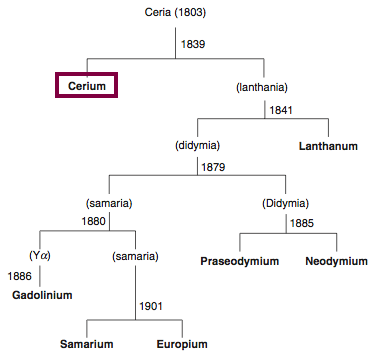
From: CRC Handbook on the Physics and Chemistry of Rare Earths, Chapter 248. Accommodation of the Rare Earths in the Periodic Table: A Historical Analysis
by Pieter Thyssen and Koen Binnemans (ISBN: 978-0-444-53590-0)
| Year: 1803 | PT id = 856, Type = element |
Discovery of Osmium
Os
Osmium, atomic number 76, has a mass of 190.23 au.
Osmium was first isolated in 1803 by S. Tennant.
| Year: 1803 | PT id = 857, Type = element |
Discovery of Iridium
Ir
Iridium, atomic number 77, has a mass of 192.217 au.
Iridium was first isolated in 1803 by S. Tennant.
|
|
|
| What is the Periodic Table Showing? | Periodicity |
© Mark R. Leach Ph.D. 1999 –
Queries, Suggestions, Bugs, Errors, Typos...
If you have any:
Queries
Comments
Suggestions
Suggestions for links
Bug, typo or grammatical error reports about this page,please contact Mark R. Leach, the author, using mark@meta-synthesis.com
This free, open access web book is an ongoing project and your input is appreciated.