Periodic Table |
 |
 |
 |
 |
 |
 |
 |
| What is the Periodic Table Showing? | Periodicity |
The INTERNET Database of Periodic Tables
There are thousands of periodic tables in web space, but this is the only comprehensive database of periodic tables & periodic system formulations. If you know of an interesting periodic table that is missing, please contact the database curator: Mark R. Leach Ph.D. The database holds information on periodic tables, the discovery of the elements, the elucidation of atomic weights and the discovery of atomic structure (and much, much more).
Periodic Tables from the year 1933 :
| Year: 1933 | PT id = 60, Type = formulation |
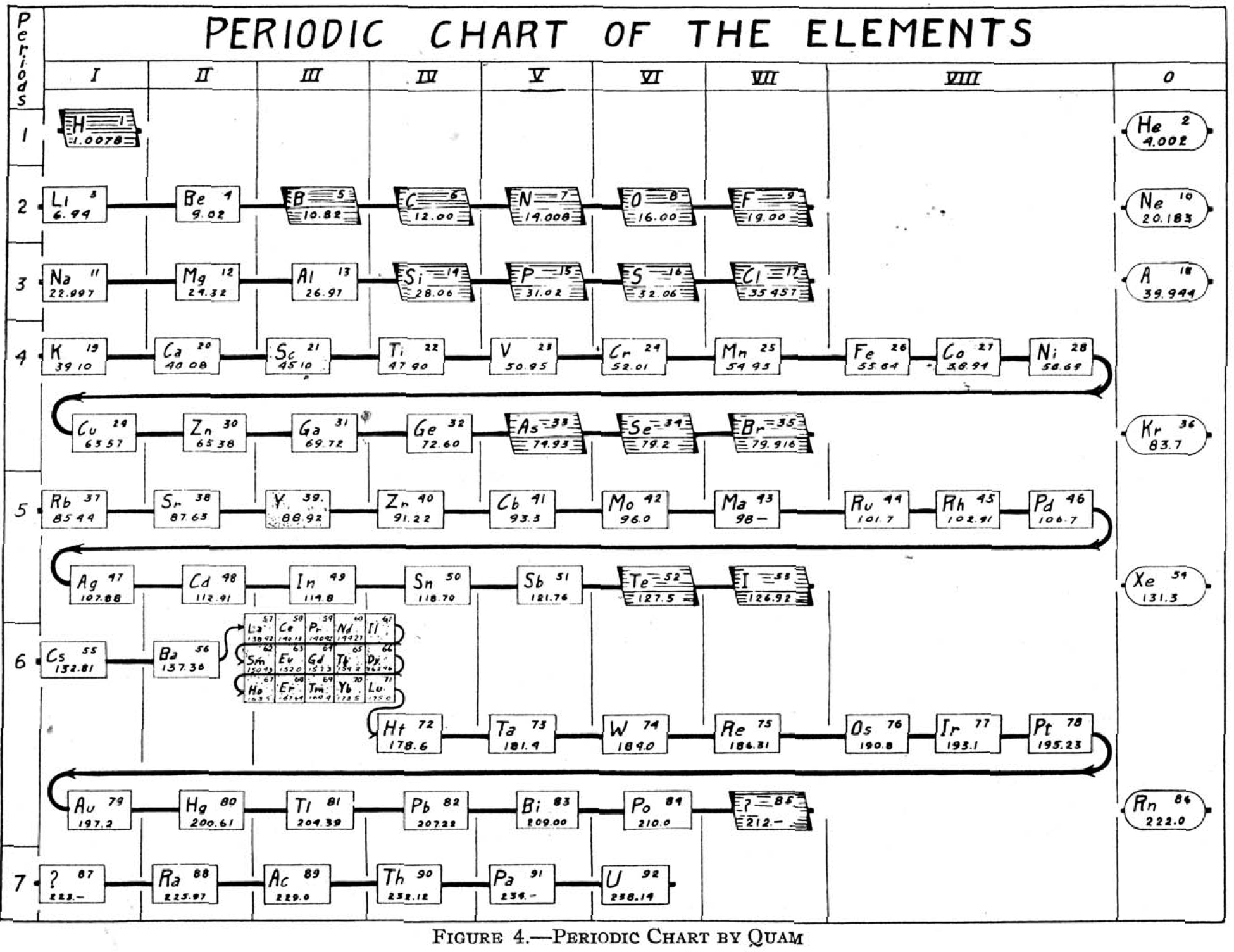
Quam's Periodic Chart
From Quam & Quam's 1934 review paper.pdf who write:
The chart is a modification of the Brauner table.
The heavy black lines maintain the continuity of each period. An effort has been made to indicate families by alignment in each group. Thus the positions of Be and Mg indicate a closer relation to Zn and Cd than to the alkaline-earth elements. The non-metals, other than the zero group elements, are indicated by shading, and the rare-earth elements by the dotted rectangles in group III.
The so-called inert elements are placed in group 0 at the right to show the completion of the stable atomic arrangement, and also to show the transition from the extreme electronegative elements of one period to the extreme electropositive of the next.
| Year: 1933 | PT id = 79, Type = formulation |
Rixon's Diagram of the Periodic Table
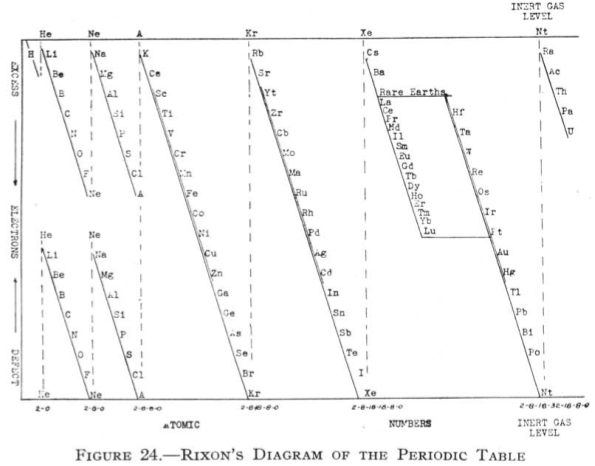
From Quam & Quam's 1934 review paper.pdf
| Year: 1933 | PT id = 86, Type = formulation spiral |
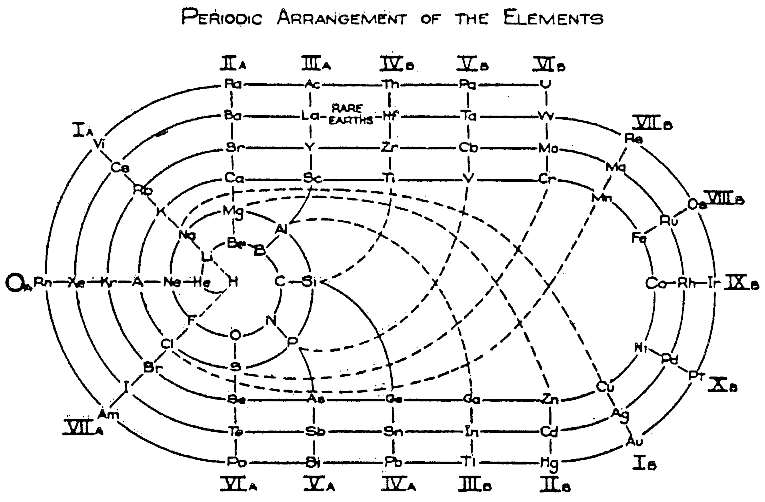
Clark's Periodic Arrangement of The Elements
Origionally developed in 1933:
| Year: 1933 | PT id = 187, Type = formulation 3D |
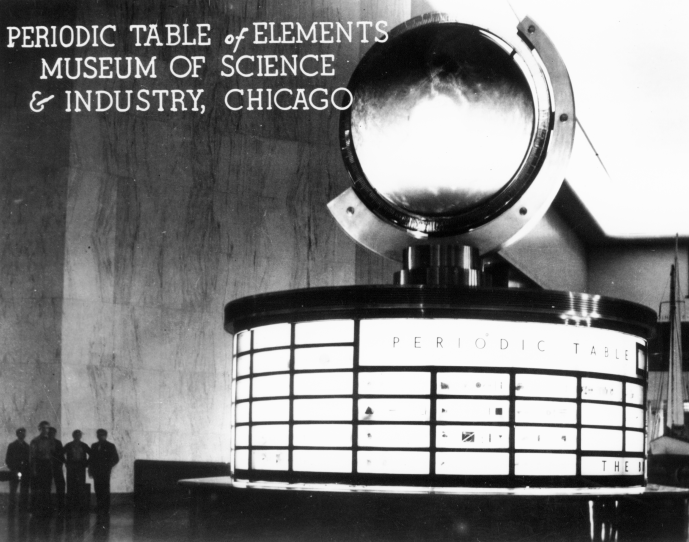
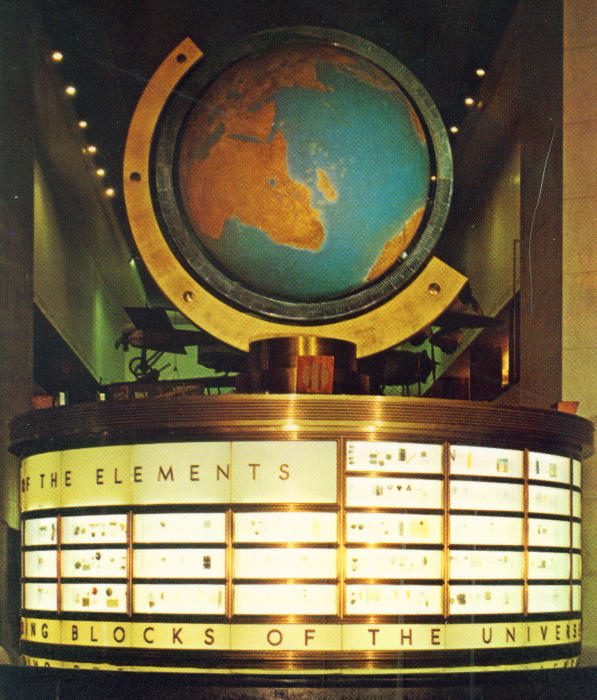
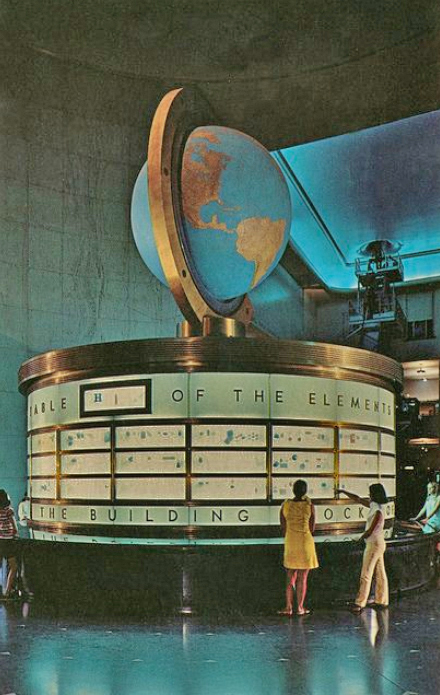
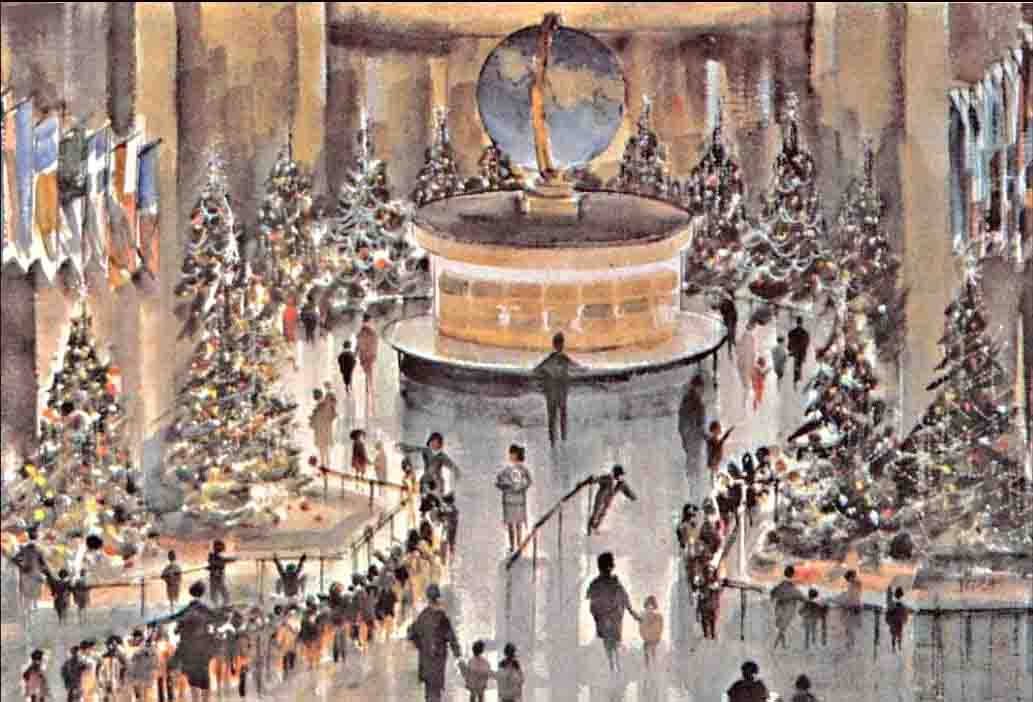
Chicago Museum of Science & Industry Periodic Table
The [Chicago] Museum of Science and Industry (MSI) opened to the public in 1933. The building that the Museum of Science and Industry now occupies however, has a rich history going back to its construction for the 1893 World's Columbian Exposition.
The Special Exhibits Hall – Alexander Graham Bell Memorial Suite – had a huge Periodic Table with the ninety-two elements arrayed in colorful and orderly fashion. These "building blocks of the universe" stood beneath the great central dome of the Museum.
Steve Rosengard, Assistant Curator, Collections Department, Museum of Science & Industry writes:
"After doing a bit of digging, it looks as though the original table was in the Great Hall within the Hall of Science at the 1933-34 World's Fair. Because of prior negotiations, virtually everything inside the Hall of Science was designed by MSI draftsmen so that it could be re-used in the Museum afterwards. The records show that MSI took in the table but had it redesigned and rebuilt by Shaw Naess and Murphy (E.M. Weymer Co. was a subcontractor) in 1938-39. One of the pages from the booklet from the Fair states the '[p]]articular credit is extended to Dr. B.S. Hopkins, of the University of Illinois, for assistance in arranging the collection.' The term assistance is a bit misleading because from the other papers in the file, it's very clear that Hopkins basically did the design entirely on his own. In terms of funding, I would assume that Rand McNally made some contribution beyond the loan of the globe on top since it was known as the Rand-McNally Periodic Table, but I have found no records supporting this."
Some historical images are available from the Chicago Postcard Museum.
Thanks to Roy Alexander for the info!
| Year: 1933 | PT id = 646, Type = formulation non-chem |
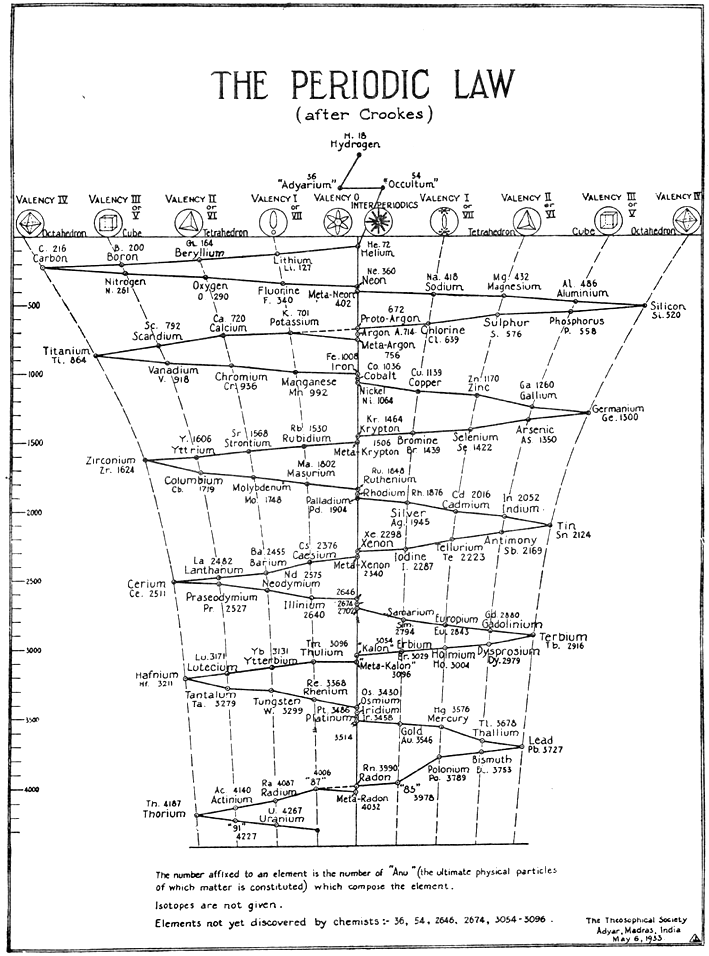
After Crookes: The Periodic Law
The Crookes three dimensional periodic table of 1898, here, has been adapted with the addition of two elements 'Adyarium' and 'Occultium' between hydrogen and helium, as presented to Theosophical Society (see bottom right hand corner).
Looking into this, we found the following:
INTRODUCTION TO THE THIRD EDITION By C. JINARAJADASA
This work contains a record of clairvoyant investigations into the structure of matter. The observations were carried out at intervals over a period of nearly forty years, the first in August 1895 and the last in October 1933. The two investigators, Annie Besant (1847-1933) and C. W. Leadbeater (1847-1934) were trained clairvoyants and well equipped to check and supplement each other's work.
Method of Investigation: The method is unique and difficult to explain. Many have heard of the word "clairvoyance" (clear-seeing), connoting the cognition of sights and sounds not perceived by ordinary people. In India the term Yoga is sometimes related to faculties that are beyond ordinary cognition. It is stated in Indian Yoga that one who has trained himself "can make himself infinitesimally small at will". This does not mean that he undergoes a diminution in bodily size, but only that, relatively, his conception of himself can be so minimized that objects which normally are small appear to him as large. The two investigators had been trained by their Eastern Gurus or Teachers to exercise this unique faculty of Yoga, so that when they observed a chemical atom it appeared to their vision as highly magnified.:
Thanks to Roy Alexander for the tip!
|
|
|
| What is the Periodic Table Showing? | Periodicity |
© Mark R. Leach Ph.D. 1999 –
Queries, Suggestions, Bugs, Errors, Typos...
If you have any:
Queries
Comments
Suggestions
Suggestions for links
Bug, typo or grammatical error reports about this page,please contact Mark R. Leach, the author, using mark@meta-synthesis.com
This free, open access web book is an ongoing project and your input is appreciated.