Periodic Table |
 |
 |
 |
 |
 |
 |
 |
| What is the Periodic Table Showing? | Periodicity |
The INTERNET Database of Periodic Tables
There are thousands of periodic tables in web space, but this is the only comprehensive database of periodic tables & periodic system formulations. If you know of an interesting periodic table that is missing, please contact the database curator: Mark R. Leach Ph.D. The database holds information on periodic tables, the discovery of the elements, the elucidation of atomic weights and the discovery of atomic structure (and much, much more).
Periodic Tables from the year 2000 :
| Year: 2000 | PT id = 99, Type = non-chem |
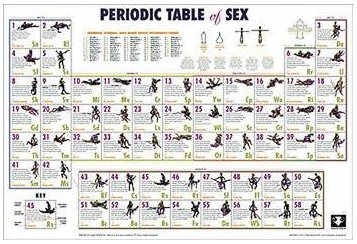
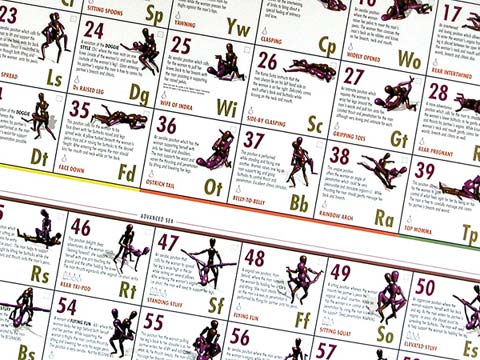
Adult Periodic Table
An adult PT of sex (available from Amazon):
| Year: 2000 | PT id = 129, Type = data |
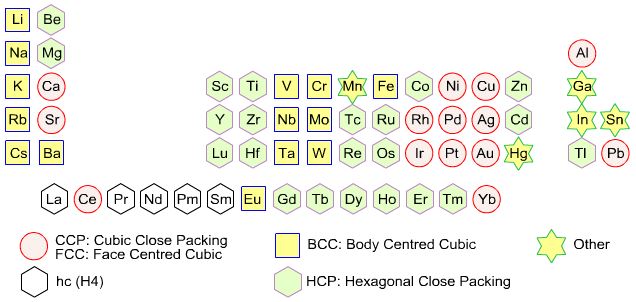
Metal Crystal Structure Periodic Table
Developed from Dr S.J. Heyes' First Year Inorganic Chemistry lecture notes (Oxford University):
| Year: 2000 | PT id = 182, Type = non-chem |
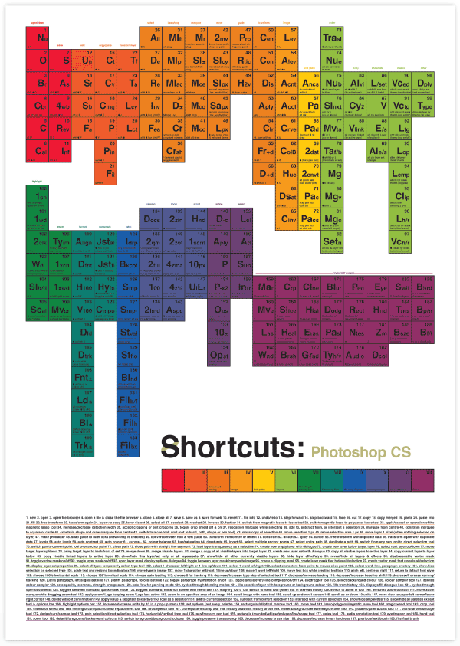
Adobe Illustrator Shortcuts in Periodic Table Stylie
Adobe Illustrator Shortcuts in Periodic Table Stylie:
| Year: 2000 | PT id = 449, Type = formulation 3D |
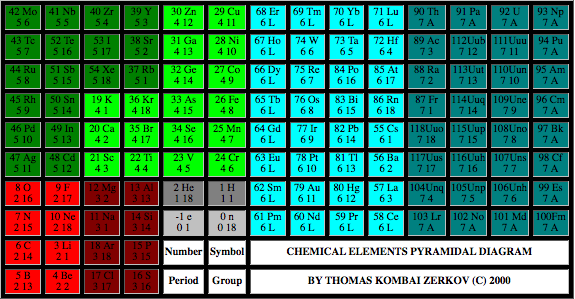
Chemical Elements Pyramidal Diagram
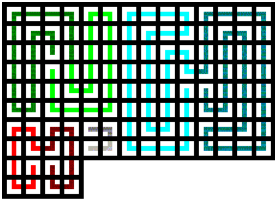
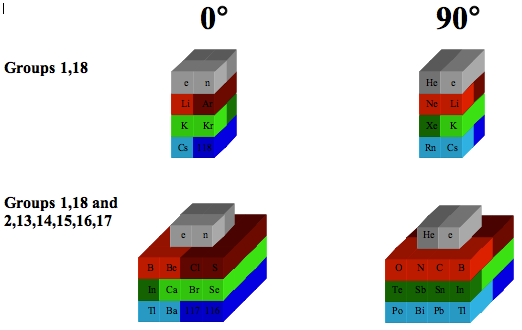
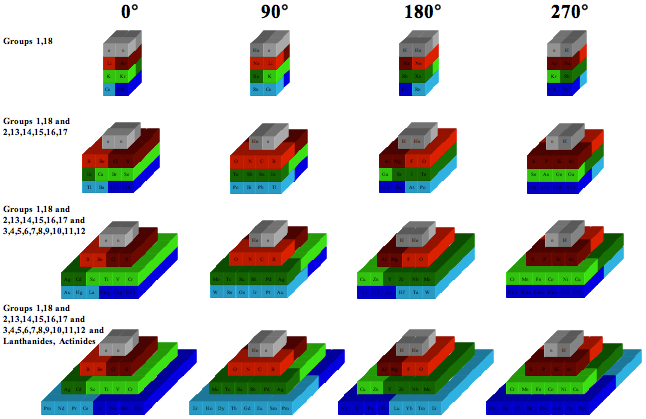
A Chemical Elements Pyramidal Diagram by Thomas Zerkov.
"The present work introduces a new arrangement of the chemical elements. Unlike the most popular existing arrangements, which are two-dimensional, this new arrangement is three-dimensional. It organizes the elements in a pyramidal structure of four levels, giving a clear spatial expression of different relations between the chemical elements. Since the three-dimensional structures are harder to perceive than the two-dimensional ones, the present work also suggests a two-dimensional table representation of the three-dimensional pyramidal diagram, where the four levels are all placed in a single plane, instead of one above the other."
| Year: 2000 | PT id = 476, Type = formulation element |
Elements Known in the Year 2000
Elements known in the year 2000, taken from this Wikipedia page:
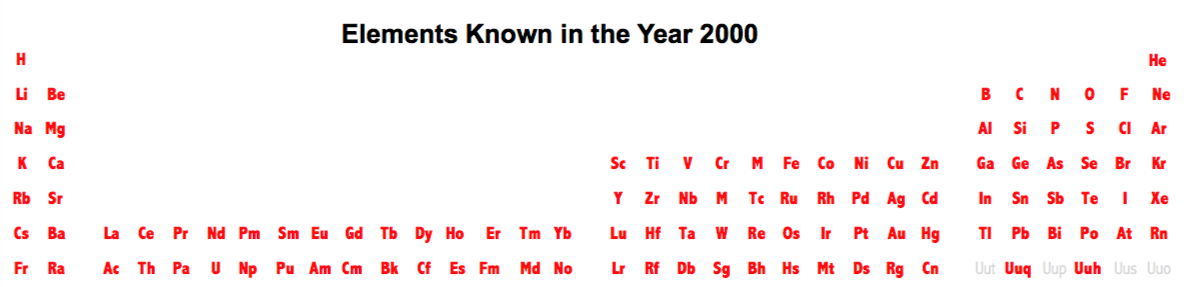
| Year: 2000 | PT id = 630, Type = data |
Electron Affinity
In chemistry and atomic physics, the electron affinity of an atom is defined as the energy change when an electron is added to a neutral atom to form a negative ion:
M + e– —> M– + energy:
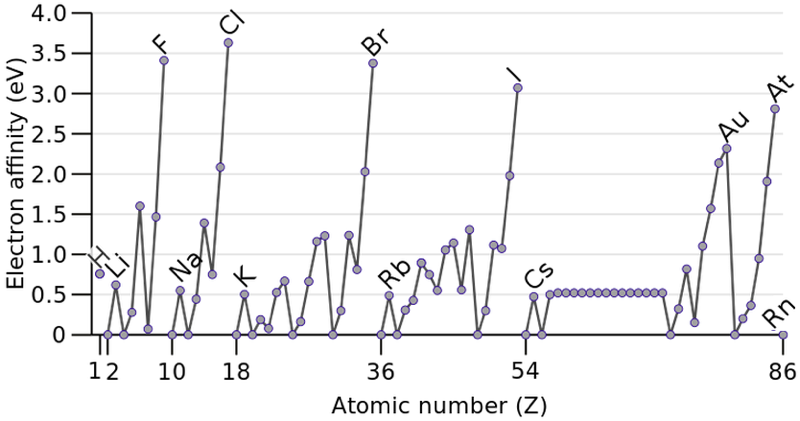
| Year: 2000 | PT id = 707, Type = misc |
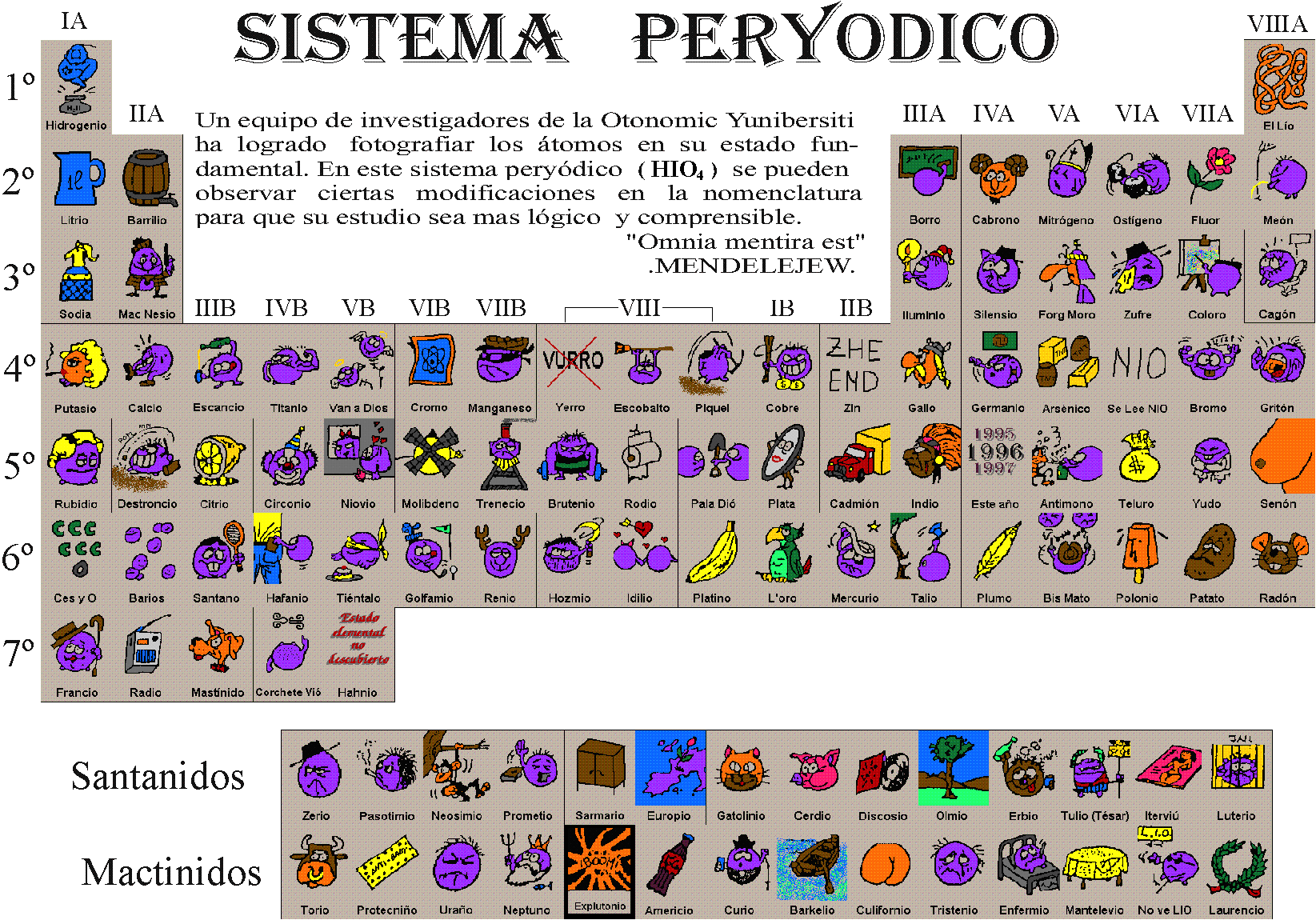
Sistema Peryodico
A famous Spanish periodic table with puns/jokes on the element names. (Click here for a larger version.)
- For example, in Spanish hydrogen is "Hidrogen" which is made up from the root words "water" and "genius"... hence the genie from Aladdin.
- Likewise, the Spanish for chromium, "Cromo" is the same as the word for stamp... hence a picture of a stamp.
This is one for Spanish speaking chemists!
| Year: 2000 | PT id = 757, Type = misc |
MIT Periodic Table Characters
Eric Scerri writes:
"This apparently hangs on a wall of Building 6 at MIT. I have identified the people around the old-school periodic table, they are (from left to right): Zosimos, Ko Hung, Jabir, Boyle, Lomonosov, Lavoisier, Berzelius, Wohler, Cannizzaro, Berthelot & Mendeleev":
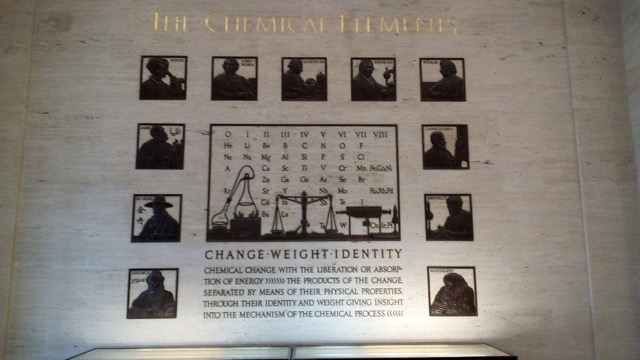
Thanks to Eric Scerri for the tip!
See the website EricScerri.com and Eric's Twitter Feed
| Year: 2000 | PT id = 896, Type = element |
Discovery of Livermorium
Lv 
Livermorium, atomic number 116, has a mass of 293 au.
Synthetic radioactive element.
Livermorium was first observed in 2000 by Y. Oganessian et al.
| Year: 2000 | PT id = 972, Type = review |
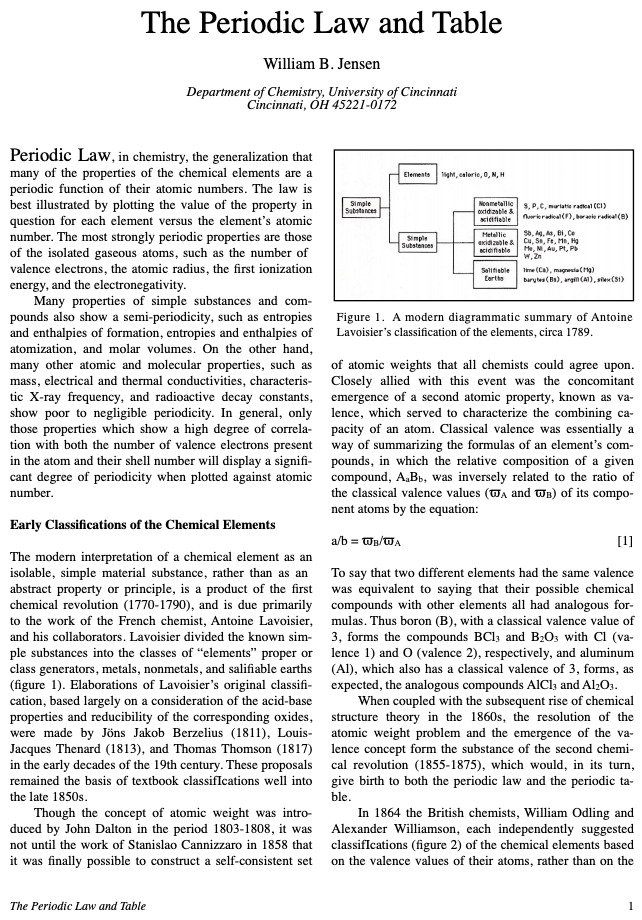
Jensen Article: The Periodic Law and Table
From William (Bill) Jensen's website, an article: The Periodic Law and Table (written for Britannica on Line, Encyclopaedia Britannica: Chicago, lL, 2000, but never published. ).
| Year: 2000 | PT id = 1240, Type = formulation data |
Sneath's Dendtogram
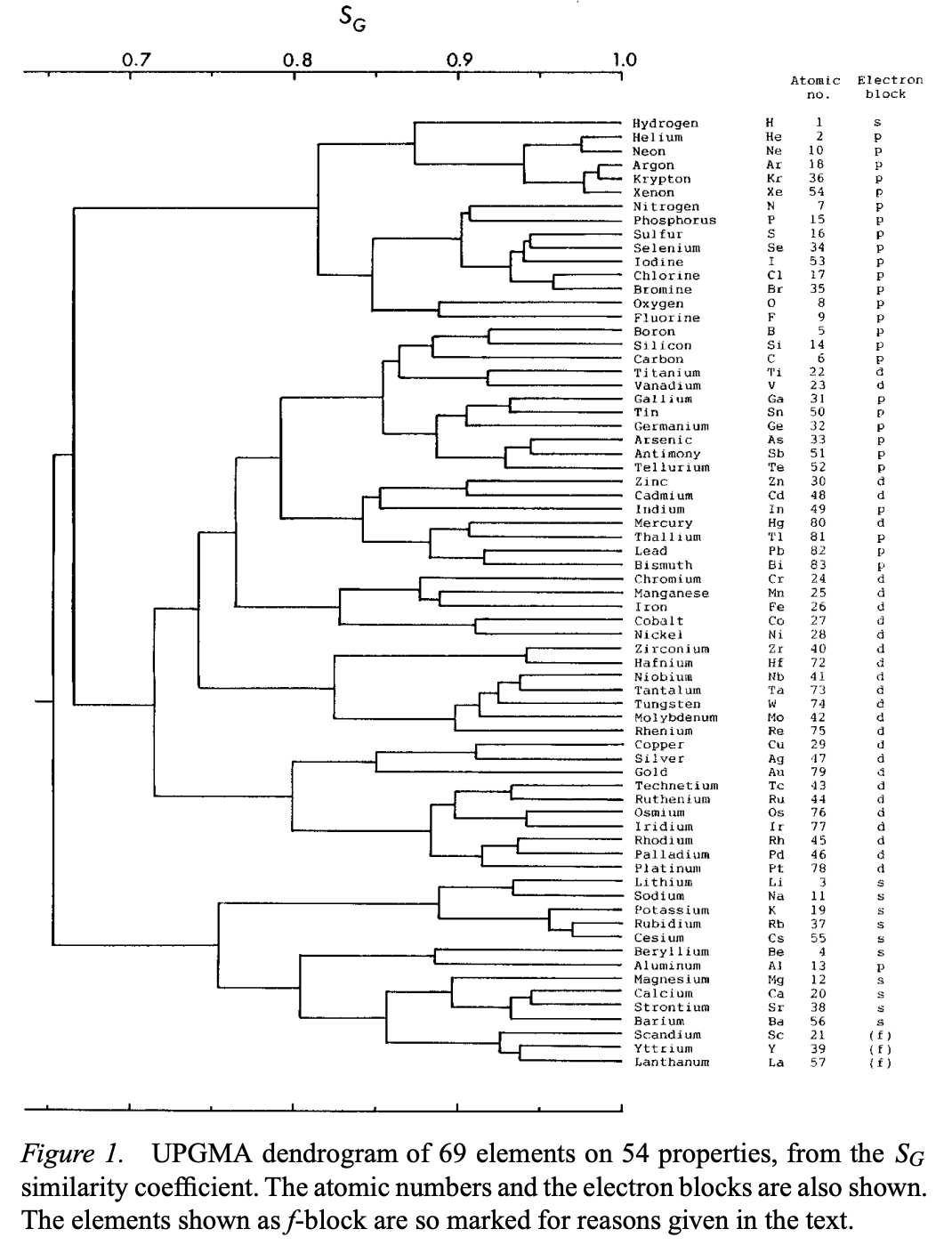
Sneath, P., Numerical Classification of the Chemical Elements and Its Relation to the Periodic System. Foundations of Chemistry 2, 237–263 (2000).
Abstract: "A numerical classification was performed on 69 elements with 54 chemical and physicochemical properties... Only 15 properties were scorable for the noble gases, but despite the paucity of properties reflecting chemical reactivity, analysis of the 69 elements on these properties still showed the major features seen from the full set."
Sneath writes:
"The UPGMA tree shows three major clusters at the 70% similarity level:
1. Hydrogen, noble gases, reactive nonmetals and halogens.
2. A large cluster of less reactive metals and metalloids, with a few nonmetals.
3. A cluster of highly reactive metals.These major clusters are almost consistent with the blocks based on electron shells. The first cluster belongs to the p-block plus hydrogen. The second belongs to the d-block together with a few p-block elements. The third consists of the s-block plus aluminum from the p-block.
Cluster 1: There are three subclusters. 1a. This contains hydrogen and the noble gases."
Thanks to René for the tip!
|
|
|
| What is the Periodic Table Showing? | Periodicity |
© Mark R. Leach Ph.D. 1999 –
Queries, Suggestions, Bugs, Errors, Typos...
If you have any:
Queries
Comments
Suggestions
Suggestions for links
Bug, typo or grammatical error reports about this page,please contact Mark R. Leach, the author, using mark@meta-synthesis.com
This free, open access web book is an ongoing project and your input is appreciated.