Periodic Table |
 |
 |
 |
 |
 |
 |
 |
| What is the Periodic Table Showing? | Periodicity |
The INTERNET Database of Periodic Tables
There are thousands of periodic tables in web space, but this is the only comprehensive database of periodic tables & periodic system formulations. If you know of an interesting periodic table that is missing, please contact the database curator: Mark R. Leach Ph.D. The database holds information on periodic tables, the discovery of the elements, the elucidation of atomic weights and the discovery of atomic structure (and much, much more).
Periodic Tables from the year 2006 :
| Year: 2006 | PT id = 17, Type = formulation |
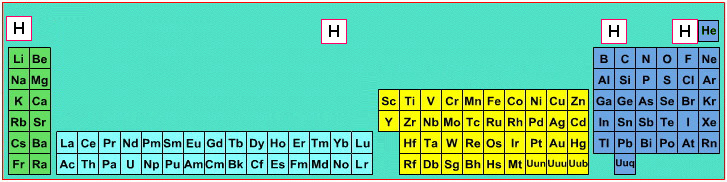
Where Should Hydrogen Go?
There are four possible positions for hydrogen:
- A Group 1 element, above Li, because it forms H+ ions.
- A Group 17 element, above F, because it forms H- ions.
- Above and between boron and carbon because it is of intermediate electronegativity.
- In the top middle, because nowhere else is ideal.
By Mark Leach
| Year: 2006 | PT id = 20, Type = formulation |
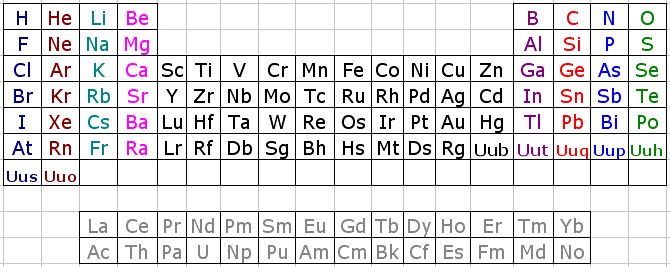
Eric Scerri's Triad Periodic Table
Eric Scerri says, "I have recently developed a new periodic table with some very nice features. I am now shifting my allegiance from the left-step table to this one."
- New design based on the fundamental nature of triads, and on atomic number triads in particular.
- H,F,Cl is a new perfect atomic number triad not featured in the usual medium-long form table. There are also many chemical arguments for placing H among the halogens rather than the alkalis.
- Note the regularity regarding period lengths. 8, 8, 18, 18, 32, 32 ...
- All period lengths repeat without fail, unlike in the medium-long form.
- Also note the bi-lateral symmetry assuming the rare earths are given as a footnote.
Read the paper on the philosophy of science web site.
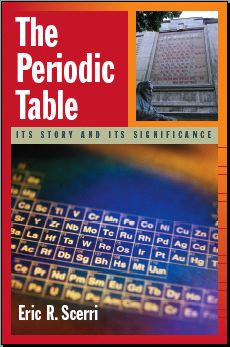
Eric Scerri, The Periodic Table: Its Story and Its Significance, Oxford University Press, 2006. Read an interview with the author, here, and a review of the book here.
| Year: 2006 | PT id = 30, Type = non-chem |
Homeopathic
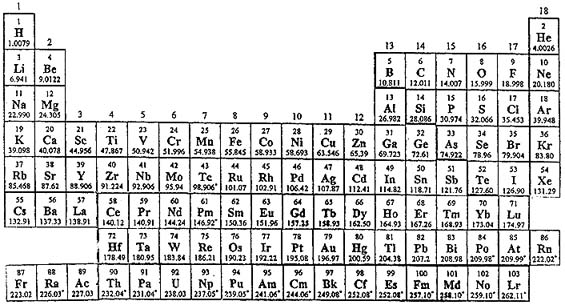
A Homeopathic Periodic Table by Jan Scholten.
From his book Geheime Lanthanide (Secret Lanthanides) 2006. The basic idea is that successive elements in each series ( = row) are like the stages in a heroic story like the labours of Hercules or the voyages of Odysseus, each one appropriate to meet a different challenge.
| Year: 2006 | PT id = 32, Type = formulation |
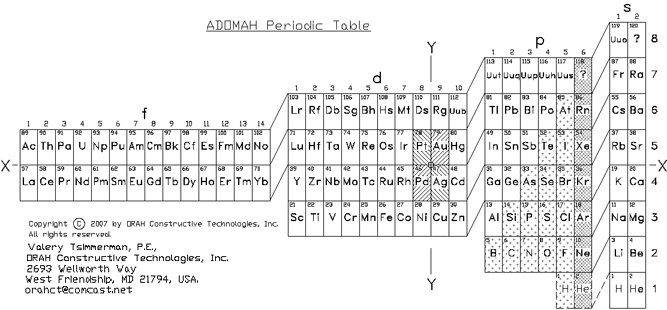
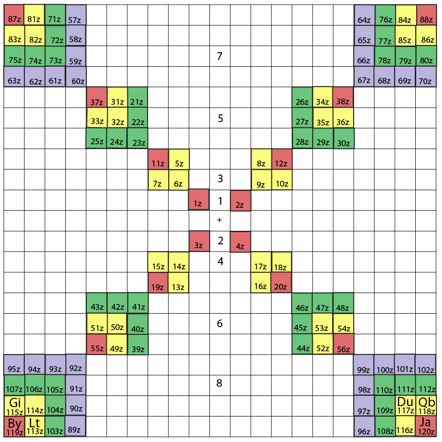
ADOMAH Periodic Table by Valery Tsimmerman
The ADOMAH periodic table is based on the Janet or left-step periodic table. It consists of four blocks (s, p, d & f) corresponding to quantum numbers l = 0,1,2,3. Blocks are separated, shifted and reconnected with each other via diagonal lines. This arrangement creates "layers" or "strata" that retain continuity in respect to atomic number Z, in addition to usual columns and rows. Therefore, numbers shown on the right hand side of the table may represent either quantum numbers n (electronic shells) if horizontal rows are followed, or n + l if "layers" or "strata" are followed.
This feature assists in creation of electronic configurations of the elements. Elements H and He are placed in two positions that reflect their dual nature and give proper consideration to atomic structure and chemical properties of those two elements. This feature also preserves triads He, Ne, Ar and H, F, Cl. Also, the elements are placed in rectangular "boxes", so any two of such "boxes" make up a square thus symbolising electron pairs. This also cuts table length in half. Unlike the Janet table, this table is assembled from bottom up in direction of increase of quantum number n, as well as atomic weight and energy. The ADOMAH table has symmetry and, assuming total number of elements 120, can be divided in four parts of 30 elements with center point located among precious metals.
| Year: 2006 | PT id = 35, Type = formulation spiral |
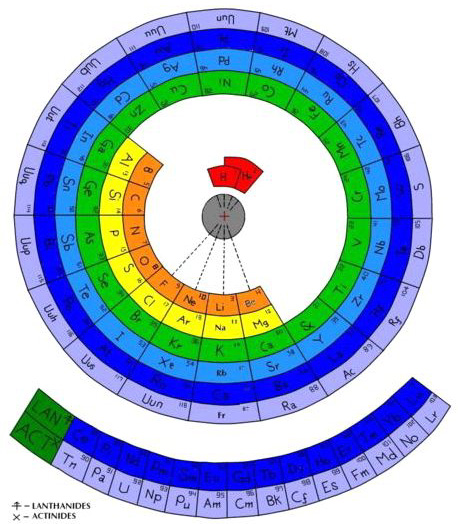
The Wikipedia Alternative Periodic Table
On the Wikipedia there is another circular form of periodic table:
| Year: 2006 | PT id = 42, Type = formulation review |
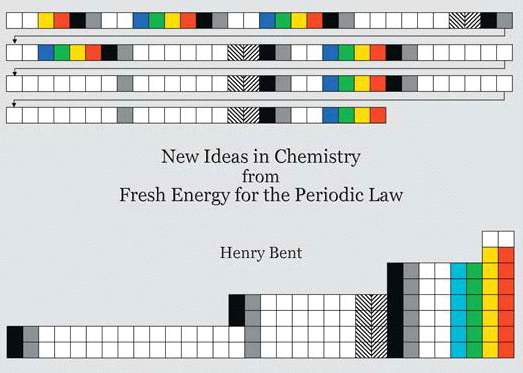
Henry Bent's Exploration into Janet's Left-Step Formulation
Henry Ben't detailed exploration into the Left-Step formulation of the periodic table is available as a book:
| Year: 2006 | PT id = 56, Type = formulation |
Reaction Chemists' Periodic Table
OK, so which Is The Best formulation of The Periodic Table?
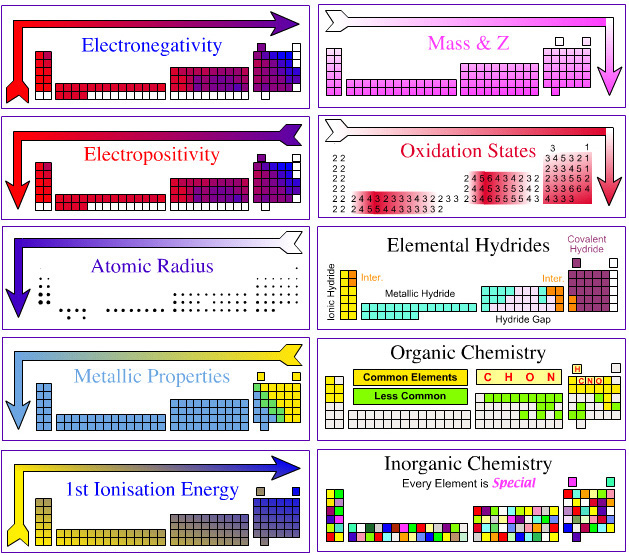
Personally as a reaction chemist, my preferred periodic table is the 'long' form shown below, with hydrogen above and between boron and carbon, although clearly other scientists have other ideas.
All periodic tables show the increase in mass and atomic number, Z, but only the long form unambiguously shows the general top-right-to-bottom-left trends in electronegativity, atomic radius, metallic properties and first ionisation energy.
Electronegativity is absolutely crucial to the understanding of structure, bonding, material type (van Arkel-Ketelaar triangle and Laing tetrahedron) and chemical reactivity, and it underpins much of the chemogenesis analysis.
| Year: 2006 | PT id = 106, Type = review |
Eric Scerri's The Periodic Table & Its Significance
Eric Scerri, The Periodic Table: Its Story and Its Significance, Oxford University Press, 2006. Read an interview with the author, here, and a review of the book here.
| Year: 2006 | PT id = 119, Type = data |
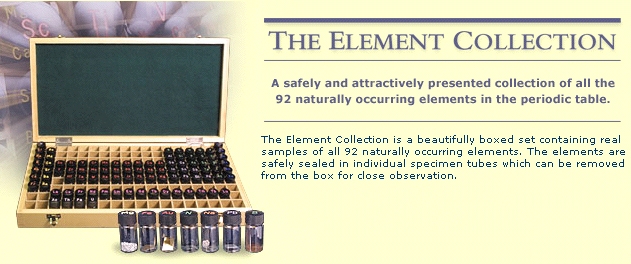
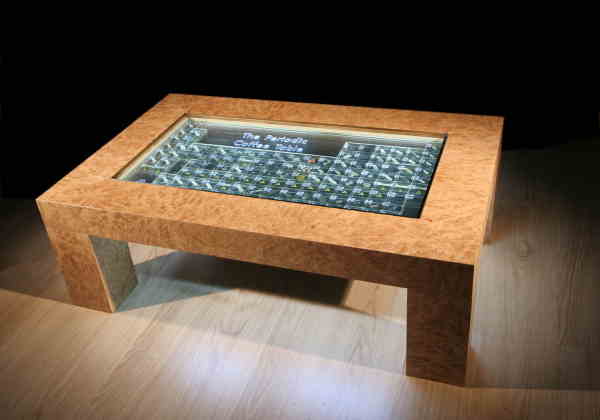
Element Collection Periodic Table
It is possible to buy sets of elements presented as a periodic table from RGB Research Ltd.
| Year: 2006 | PT id = 130, Type = data |
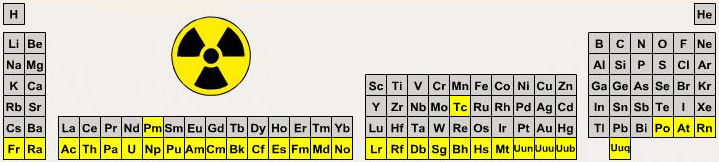
Radioactivity Periodic Table
A periodic table showing the elements that have no stable isotopes, so that all samples are radioactive:
By Mark Leach
| Year: 2006 | PT id = 131, Type = data |
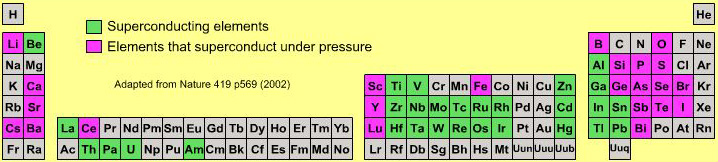
Superconducting Elements
A periodic table showing which elements become superconducting at low temperature.
By Mark Leach
| Year: 2006 | PT id = 134, Type = data misc |
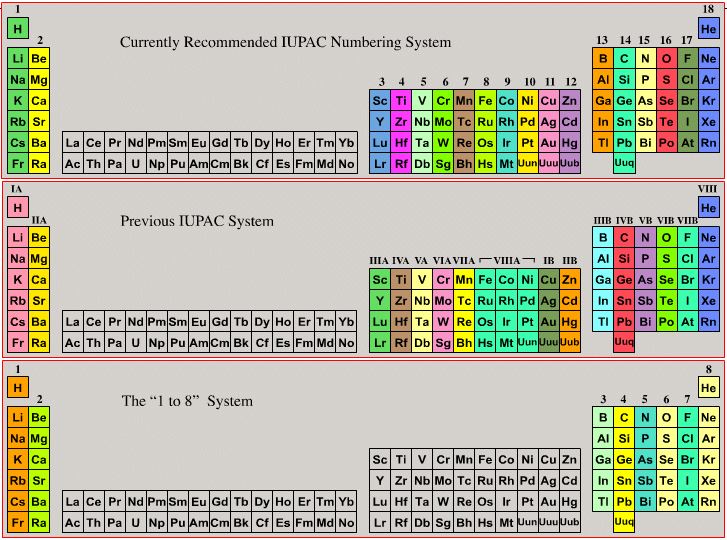
Group Numbering Systems
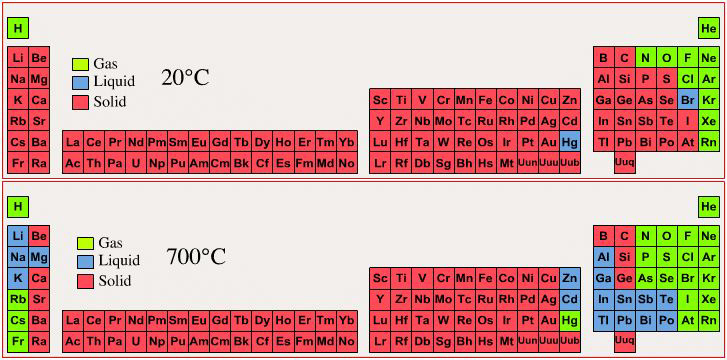
Phase State: Solid, Liquid, Gas at 20°C & 700°C
By Mark Leach
| Year: 2006 | PT id = 144, Type = data |
Astronomer's Periodic Table
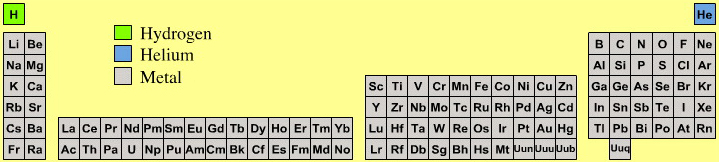
Highly amusing for chemists is the astronomer's periodic table because astronomers consider there to be three types of element:
- hydrogen
- helium
- metal
Yup, cosmologists and other professional star gazers consider all elements, atomic number three and up, to be metals.
By Mark Leach
| Year: 2006 | PT id = 170, Type = non-chem |
Beer Styles
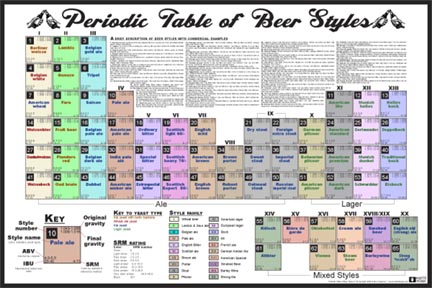
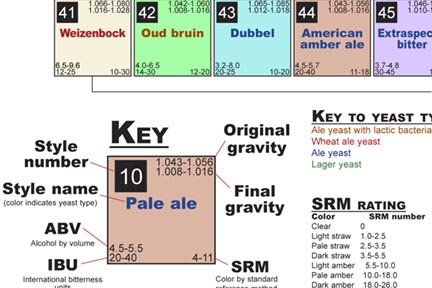
A periodic table of Beer Styles from Mantis Design:
| Year: 2006 | PT id = 172, Type = data |
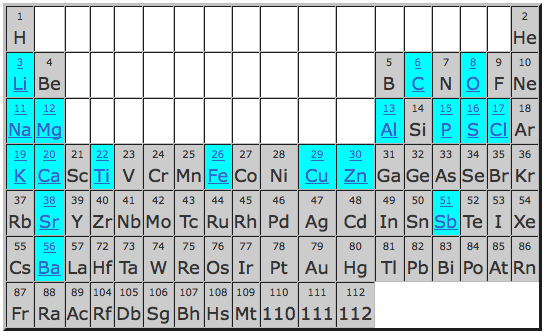
Elements in Fireworks
Fireworks rely on the chemical characteristics of the elements that are used to make them. This special periodic table highlights the elements that have significance to fireworks and pyrotechnics:
| Year: 2006 | PT id = 174, Type = non-chem |
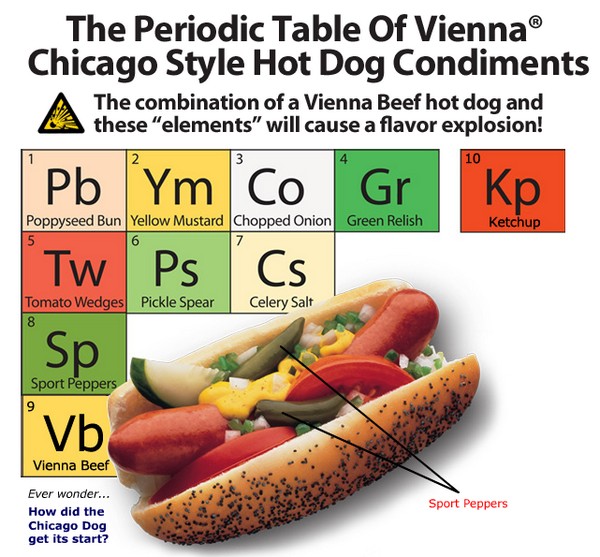
Vienna Chicago Style Hot Dog Condiments
A periodic table of Vienna Chicago Style Hot Dog Condiments:
| Year: 2006 | PT id = 199, Type = formulation |
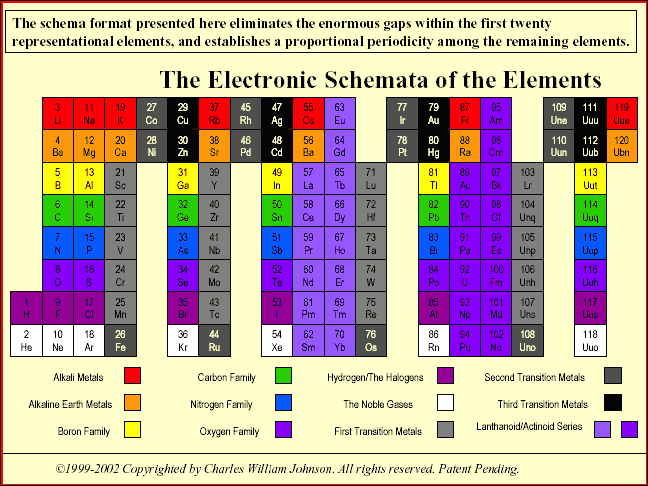
"The conventional periodic table reflects what is called the aufbau design, which represents a progression of numbers; in this case, that of the atomic number of the elements. The table, however, contradicts the aufbau concept in reality, because there are large gaps within among the primary (representative) elements, as well as in relation to the tertiary elements (transition and inner transition elements). The latter case, the Lanthanoids and the Actinoids, lie completely outside of the main body of the periodic table, thereby effectively breaking down the aufbau design... more..." from here by Charles William Johnson:
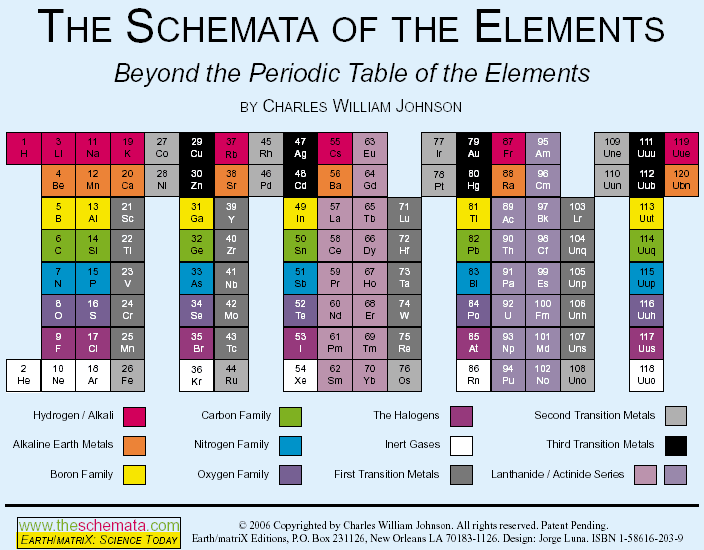
The Neutronic Schemata: Specialized Schemata of the Elements
| Year: 2006 | PT id = 207, Type = non-chem |
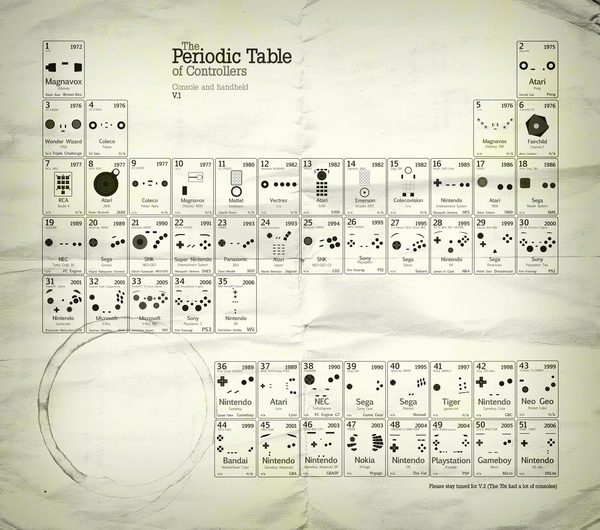
Console Controllers
A periodic table of console (game) controllers, here. Click here for a larger version.
| Year: 2006 | PT id = 232, Type = non-chem |
Look Around You Periodic Table
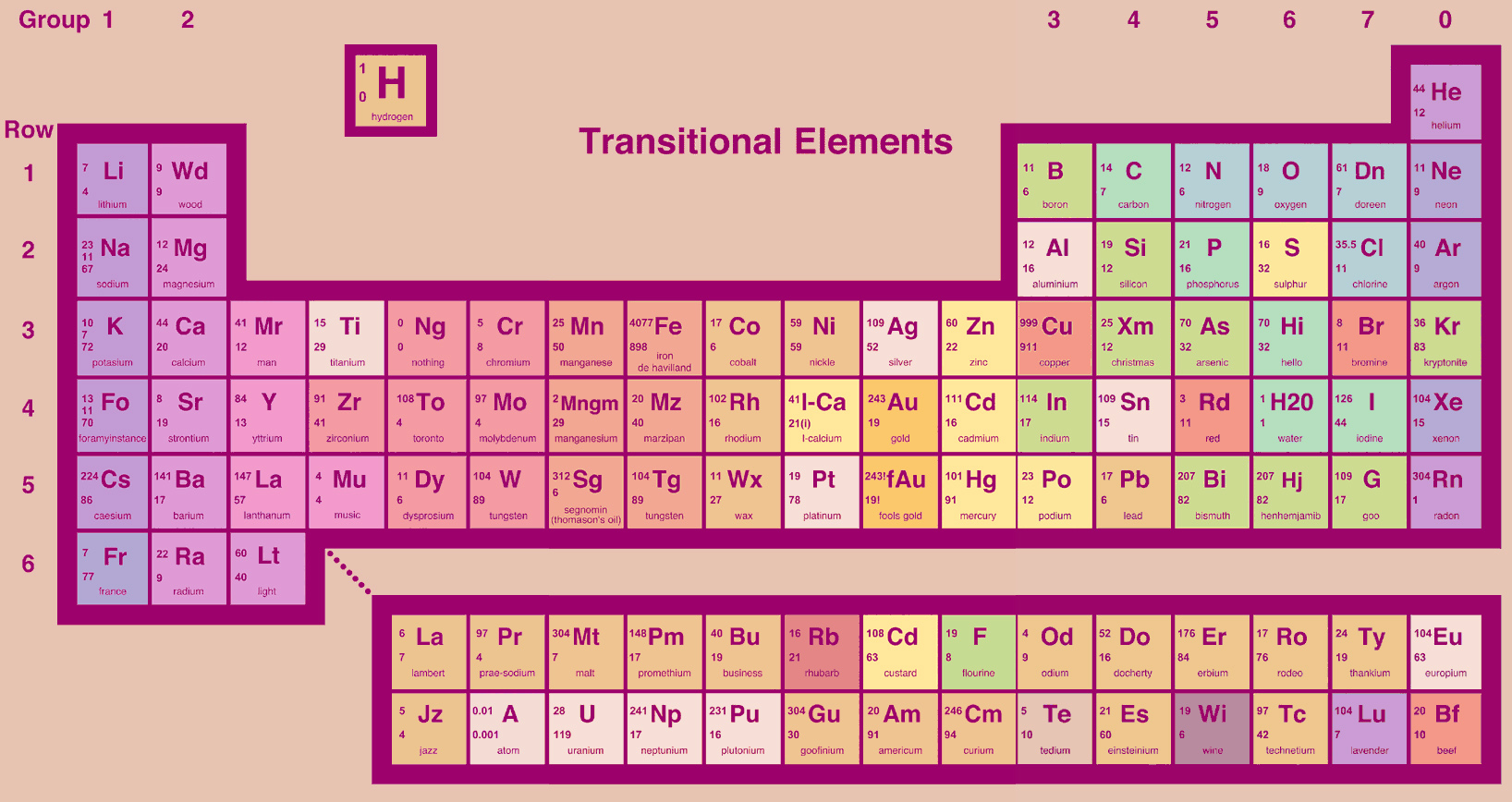
A spoof periodic table form the BBC comedy science program, Look Around You:
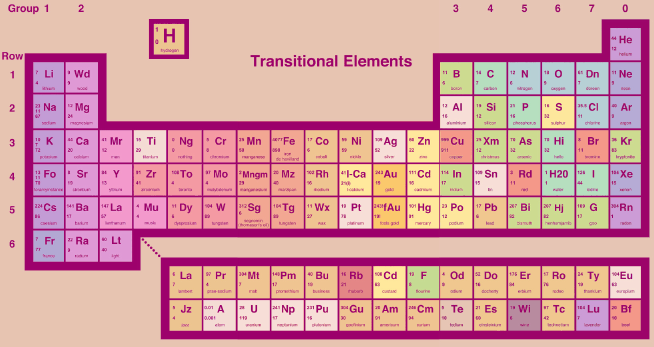
You will need to click here to see the full size graphic and spot the jokes, for example :

| Year: 2006 | PT id = 254, Type = non-chem |
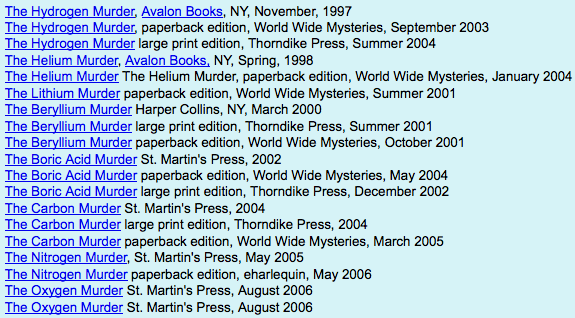
The Periodic Table Mysteries
In this series, Dr. Gloria Lamerino, retired physicist back from California, moves into an apartment above a funeral home in Revere, Massachusetts. When she signs on to help the Police Department in science-related homicides, she doesn't realize she may have 109 cases ahead of her...
| Year: 2006 | PT id = 282, Type = formulation |
Various Periodic Tables
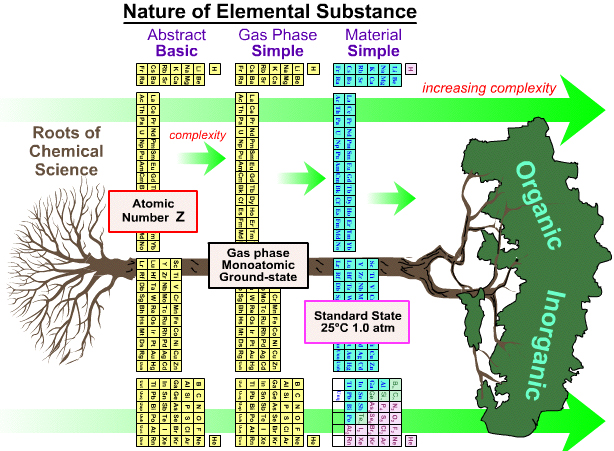
As discussed on this page of the Chemogenesis webbook, the periodic table is ambiguous as to what it is showing.
Does the PT show the element as the abstract 'basic substance', or gas phase atoms or the material substance?
By Mark Leach
| Year: 2006 | PT id = 478, Type = non-chem |
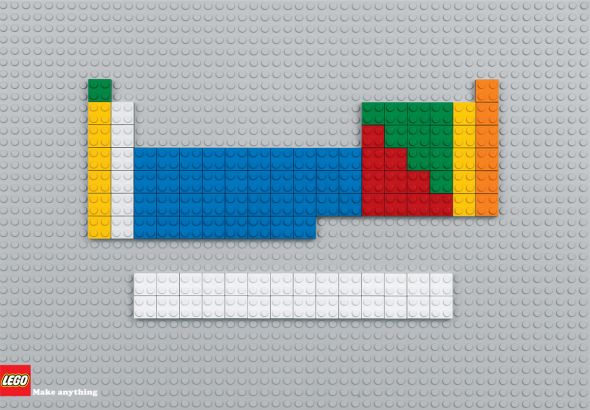
Lego: Periodic Table
| Year: 2006 | PT id = 535, Type = formulation 3D |
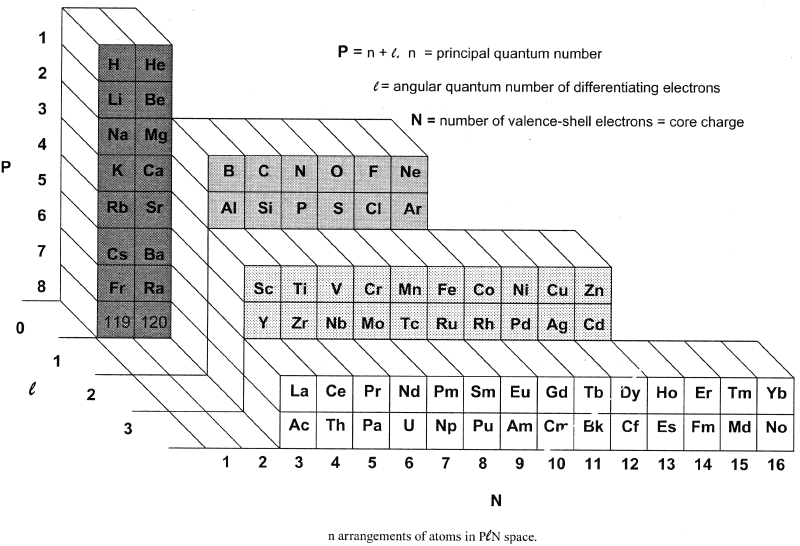
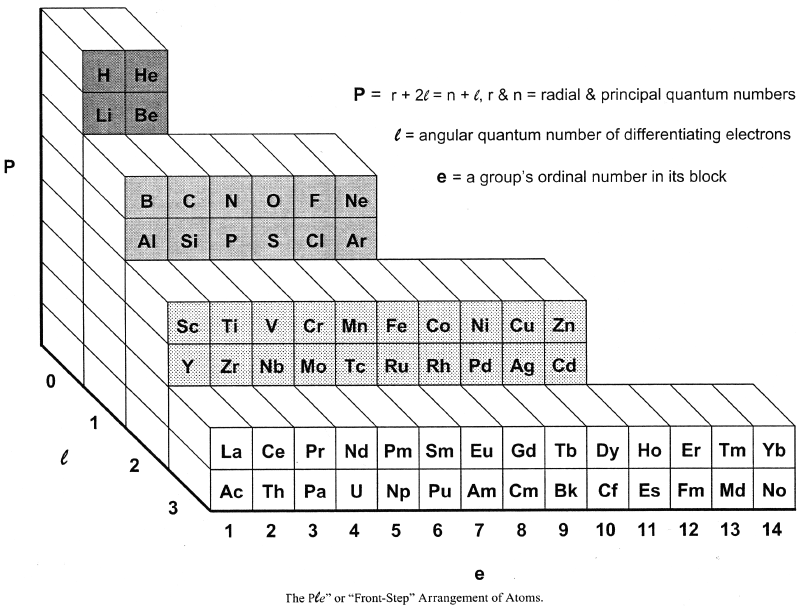
Bent's PlN and Ple (Front Step) Periodic Tables
In his book, New Ideas in Chemistry from Fresh Energy for the Periodic Law, here, Henry Bent introduces the PlN and Ple (Front Step) Periodic Tables, Figs 50 & 52:
| Year: 2006 | PT id = 563, Type = formulation spiral |
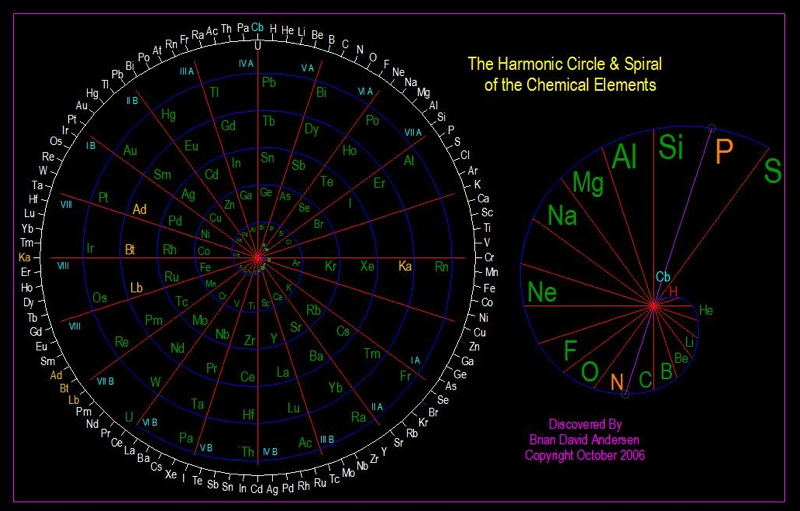
Harmonic Circle & Spiral of the Chemical Elements
Brian David Andersen of Tri-Vortex Technology (Researcher/Inventor/Scientist), Subtle Energy Products trivortex.com:
| Year: 2006 | PT id = 1078, Type = formulation spiral |
Demers' Système du Québécium
Updated from this 2002 entry comes: Quebec System, Numbers and geometry in the classification of the elements by Pierre Demers.
Demers writes:
"First, I present the Periodic Table of Elements, and I proceed to improve it. By an arithmetic and geometrical analysis, I make appear important symmetries of order four which exist in the arrangement of the atoms between them. I confirm these results with an original discussion of irregular atoms. I will try, in a work that will follow, to interpret the symmetries of the classification by the symmetries of the atom which are associated with the precession cones of the kinetic moments and orbitals."
Read [much] more on this page of links:
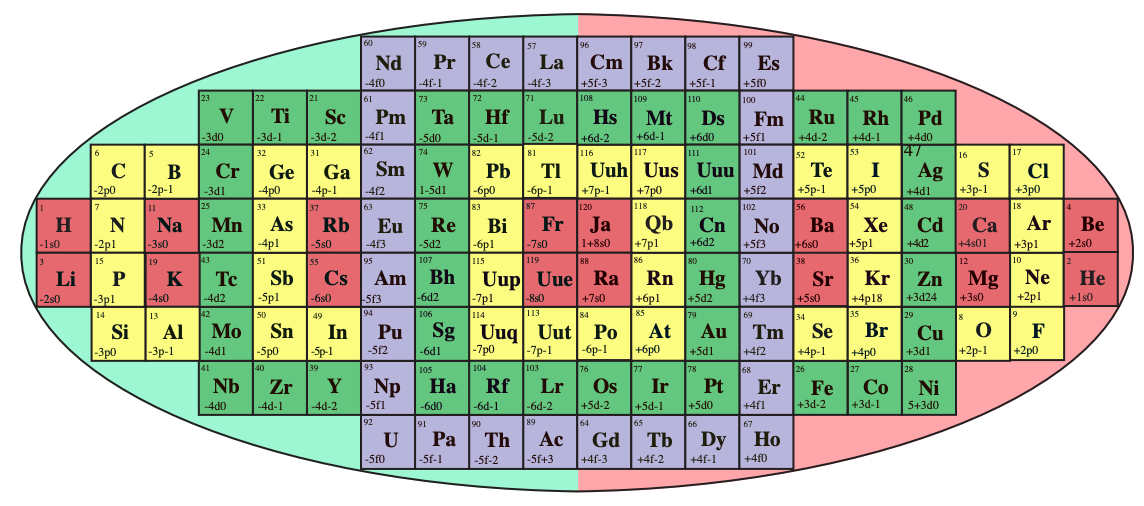
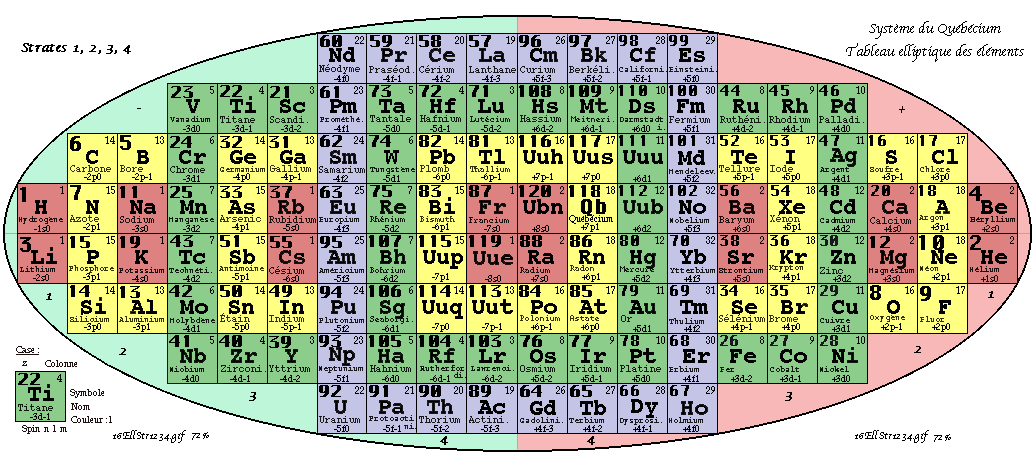
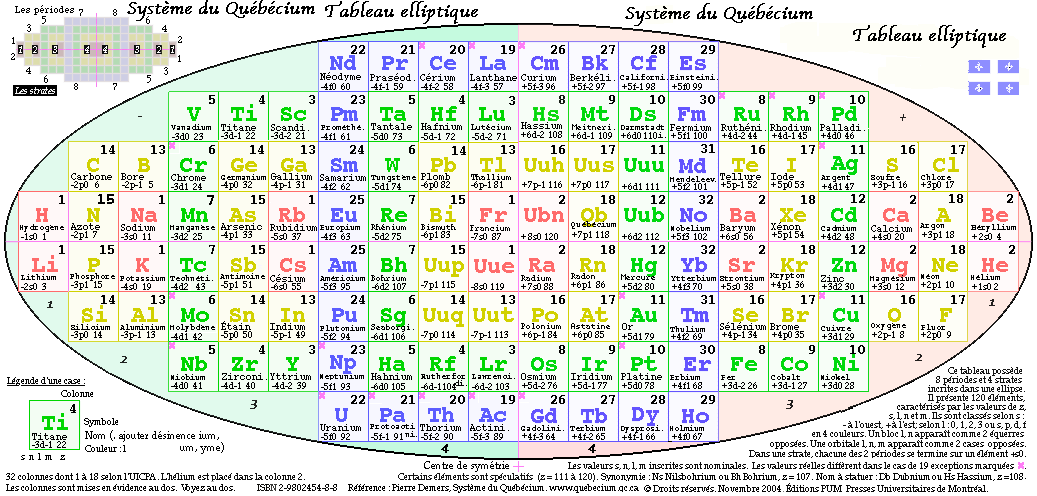

Thanks to Conal for the tip!
| Year: 2006 | PT id = 1209, Type = misc |
Nandor's Exhaustive Lists of Chemical Words
From a really interesting PT website, Mark Nandor's Exhaustive Chemical Words:
So what, exactly, is a "chemical word"? It is an English word that can be spelt using element symbols as 'letters', [famously] for example: Beer (or BeEr):
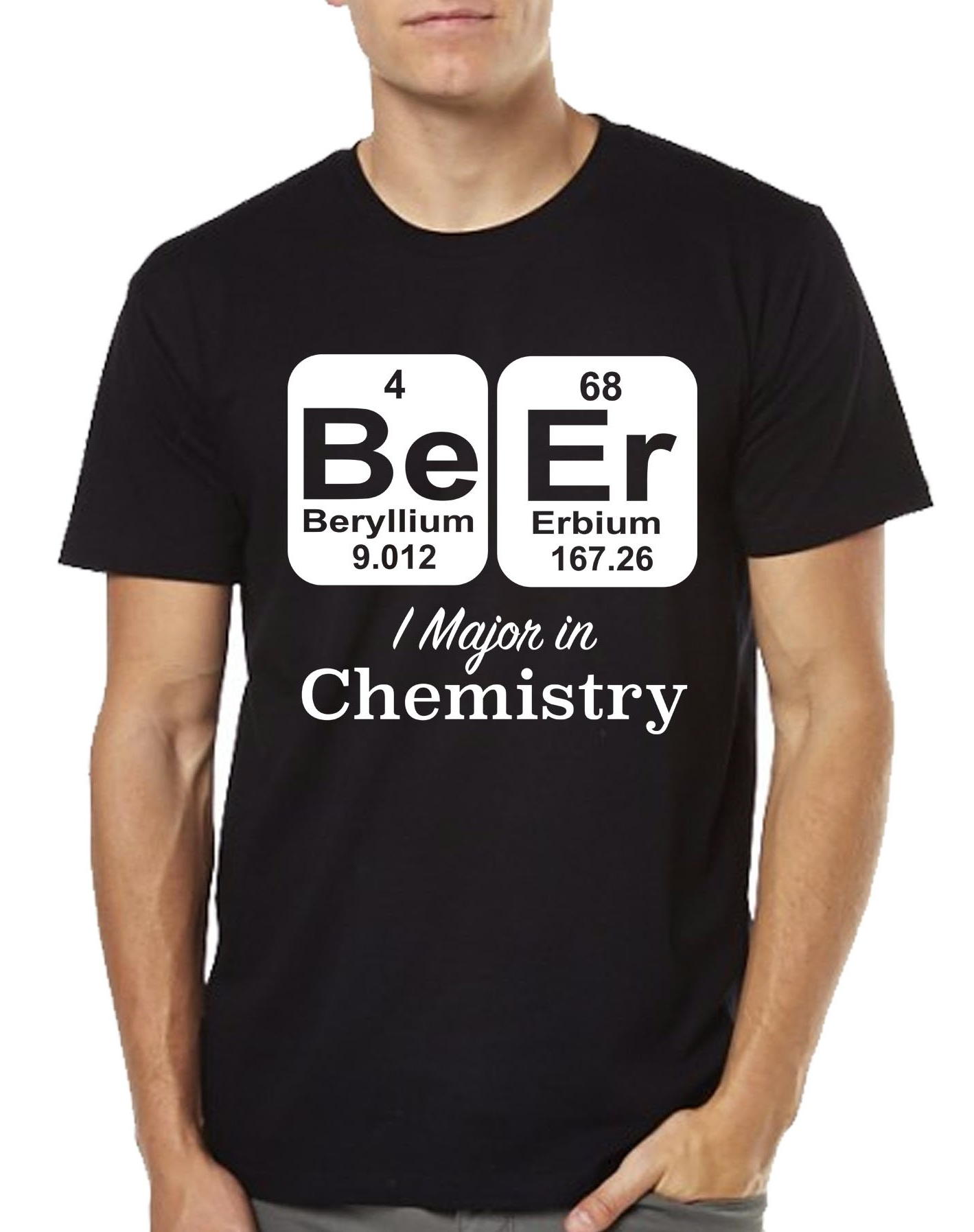
Arches can be "spelt" in two ways:
ArCHeS [Argon, Carbon, Helium, Sulfur]
ArCHEs [Argon, Carbon, Hydrogen, Einsteinium]
On the other hand, there is no way at all to "spell" a work like pillar.
Mark Nandor provides several exhaustive lists:
- All 44,313 English words that can be spelled with element symbols.
- The various ways these can be spelt with element symbols (93,604 ways).
- 264 First Names
- etc.
|
|
|
| What is the Periodic Table Showing? | Periodicity |
© Mark R. Leach Ph.D. 1999 –
Queries, Suggestions, Bugs, Errors, Typos...
If you have any:
Queries
Comments
Suggestions
Suggestions for links
Bug, typo or grammatical error reports about this page,please contact Mark R. Leach, the author, using mark@meta-synthesis.com
This free, open access web book is an ongoing project and your input is appreciated.